Resist and Love

GirlResist:allef-vinicius-305443

“Something there is that doesn’t love a wall,” says Frost, and thus rouses the silent kid in her ninth grade English class who finds in the poet a resistance fighter. At the molecular level, within the genetic structure of the body politic, the germ of resistance can be isolated, understood as a trait that our American forebears had in abundance and we would do well to emulate.

We resist when we’re young because we don’t know what we’re capable of; we resist because without something to push against we lose all feeling in our senses. To be someone we have to bump up against something, push something around, if only to find the edges of the universe we find ourselves floating within.

“The simplest idea of power,” says James Hillman, “supposes that for work to be done, there must be something that resists.” If nothing else, resistance makes power possible, even something which can be measured.

But we measure ourselves by what we’re not going to put up with anymore, by what rights we are owed, by the amount of pushback we get when we bend the world to our will.

We resist, therefore we are.

But this is tenuous and we know it. We are living in times when identities are thrown like knives. “I am this!” “You are that!” “They are not this, not like us.” “We would never do that, not like them!” We peer through our family and tribal filters that polarize the light around us by cutting out the interferences. There is precedent.

A man named Saul, a bona fide terrorist, riding to Damascus with a license to apprehend and arrest Christians for their torture and death, is thrown from his horse, blinded, and pinned to the ground by a bolt of light and a voice from the heavens.  The King James Version puts it best:

“And he said, Who art thou, Lord? And the Lord said, I am Jesus whom thou persecutest: it is hard for thee to kick against the pricks.”

Saul had been kicking against the pricks all his life and the pricks had returned the favor to the extent that Saul could easily have passed for one himself. Modern translations of the Bible have lost the latter phrase, but we can know that Saul was resisting with everything he had, kicking away all the faces of those he carried in his conscience day after day. “You have lost yourself,” they whispered. “You must change your life.”

And change he does. Resisting the dead weight of primitive prejudice, this Saul becomes a Paul, rebounds from his blindness to persuade his former victims that while he once was blind, now he sees. Now he’s fighting—not against flesh and blood—but against principalities and powers, unholy powers in high places who build their walls.

Years later this Paul is still resisting. He knows plenty about fighting the good fight, but he also knows a lot about love. Look, he says, now I only know part of the story, but someday I will know as fully as I am known. Faith, hope, and love, he says, these are the essentials, but the best part is love. You must change your life. We don’t even know how to pray for change, but the Spirit prays within us, and in all things there is something working out for good to those who believe that goodness still lives in the world.

We may call this Truth or God or Love; in the end they are quite the same.

Elaborated Spontaneity #5 (Photo: Allef Vinicius on Unsplash.com)

God Incognito


“I think, therefore I am,” says Descartes, and thereby overturns centuries of philosophy past. He imagines a dark spirit with infinite powers to deceive, who could turn lightness into dark and cause one to doubt the very ground upon which one stands.

Suppose, suggests Descartes, that I am mistaken about the ‘hereness’ of my body, about the realness of the world ‘out there’, about the existence of God? Suppose that every shard of reality I cling to is an illusion: how would I know? How do we claw through the fog? If it’s all wisps and shadows, how will we know when our little bark has run up on the beach?

He edges out on the high wire, squinting hard at the far post, determined to reject everything except that which he could not doubt. And what he could not doubt is that he is the one doing the doubting, and that those who doubt their existence must exist in order to do the doubting. ‘Cogito ergo, sum’ — I think, therefore I am.

It’s a grand and audacious mind game that Descartes is playing. It’s an axiom dressed as a revelation, a discovery of the self. He invites us to doubt, but he never really doubted anyway. What sets Descartes apart, though, is that he’s given personal experience and his own thought as much authority as conventional wisdom. Find the truth, he says. Think for yourself; argue it out in your own head. Be the master of your interior world. You think, therefore you are. And therefore, is God.

What do we mean when we say we “know” God? Do we “know” the wind? Do we “know” the darkness within the cloud? Do we “know” the cry of our own voice caught up and away in the wind and the cloud? This will not suffice; there must be more.

* * * *

The mild-mannered parishioner two pews over, his attention wandering during the homily, moistens a finger and doubles the pages of his Bible under his thumb. He has an idea to look for God in the Old Testament, but not in the bloody chronicles of genocide and terror. Ecclesiastes appears, but he remembers something about everything as vanity. He frowns: he needs a handhold, not a slippery slope. The Psalms are familiar — he’ll pitch his tent there for awhile in hopes of a well-known verse or two.

“Answer me when I call, O God of my right!,” shouts the ragged singer of the Psalms. He rages, he twists, he cries out; he will stitch up one star to another if he has to and create a zip line to Yahweh. Our parishioner stiffens in the pew; no one should talk to God like that. He reads it again, his finger tracing the words. He whispers it to himself, bending over the page, eyebrows lifted. He imagines ravens wheeling against the desert sun, a cave behind him, the whorl of a desert dust devil swirling closer. He raises an arm against the sun and the shriek of the wind, the ground rocks beneath him, and he hears it, a whisper: “I am.”

“Yes,” he says out loud. “Yes, you are.”

Elaborated Spontaneity #4 (Photo: Clarisse Meyers, Unsplash.com)

The First Church of Common Mysteries Now Open


CHurchLavender:cassie-boca-290902.jpg

(Photo: Cassie Boca, Unsplash.com)

Religion gets its knocks these days as the perpetrator of all things evil, the invention of adults who never outgrew their childish fears, the condemner of all that’s spontaneous and upgrowing. A lot of that is true, and when we who can still remember our conscription into religion somehow find ourselves passing as adults and still floundering gracelessly around in the warm waters of the faith we first were baptized in we may be forgiven for our slack-jawed lack of defense. Some of religion, like manners and clothes, is a matter of habit, and habits can free us up to think about important things, so we may be reluctant to pass off a habit that so far has not resulted in serious injury or loss of footing.

But perhaps, like a man whose waist has outgrown his trousers, our boundaries to religion are too small, too much the skinny jeans rather than the comfort waist regular cut with a smoosh more room in the seat. “Were we to limit our view to it,” says William James in The Varieties of Religious Experience, “we should have to define religion as an external art, the art of winning the favor of the gods.”

It’s so much more than that, he says. While there is the institution of religion, the churches, the ecclesiastical hierarchies, vestments, holy books, and, of course, the systematic theologies, commentaries, councils, and connections, all of that is external, says James, yet in no way less significant for all its wear and tear through the centuries.

But the internal, the deep inwardness that comes when we fall into a reverie waiting for the light to change—that is not to be trifled with nor ignored. “The relation goes direct from heart to heart,” says James, “from soul to soul, between man and his maker.”

We have these holy moments; they drift up like dandelion seeds before us and we might not even see them, focused as we are on the flotsam of our days. Some people just don’t have the knack for religion, says Karen Armstrong. Others can’t live without it. The ones who can’t seem to hit the keys may not get to jam with the others at first, but they can find a riff if they’re willing to practice.

“Beauty is nothing but the beginning of terror,” says Rilke. “Every angel is terrifying.” A star is waiting to be noticed, a wave rolls toward us from the past, a violin yields to our hearing as we pass under an open window—all these are intimations of God if we are awake. Will we practice noticing?

“All this was mission,” declares Rilke. “But could you accomplish it?”

This is what grace is about: the courage to notice the common mysteries.

“Truly, we live with mysteries/too marvelous to be understood,” says Mary Oliver.

“. . . Let me keep my distance, always, from those

who think they have the answers.

“Let me keep company, always, with those

who say, “Look!” and laugh in astonishment,

and bow their heads.” (Mary Oliver, “Mysteries, Yes”)

(Elaborated Spontaneity #3)

The Tree Lives On

JoshTree

(Photo: Joy Daquila-Casey)

“I can’t believe the news today
I can’t close my eyes and make it go away.
How long, how long must we sing this song?
How long, how long?
‘Cos tonight
We can be as one, tonight.” (Sunday Bloody Sunday)

From the first stutter beats of “Sunday Bloody Sunday” from Larry Mullen, Jr., the crowd at FedEx Field rose as one with a roar. He was joined by Adam Clayton, The Edge, and Bono, who tore into the lyrics from a song about the IRA bombing of Armagh that has only deepened in meaning in the decades since.

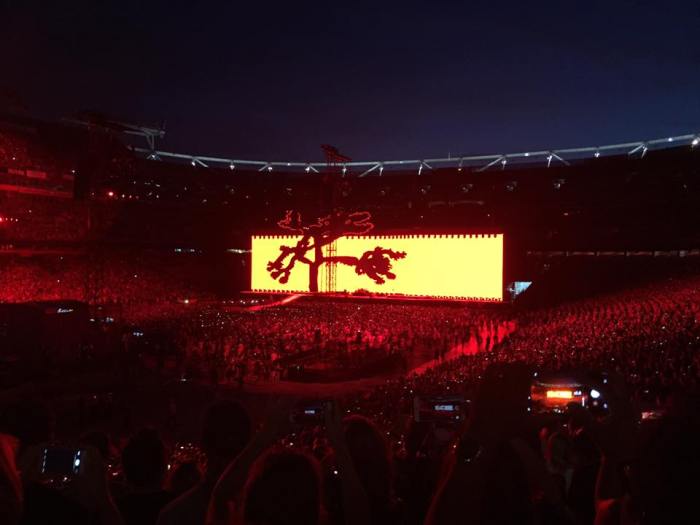
The first four songs, done on a stage in the shape of a Joshua Tree that extended into the audience, are standards on their concert set list: “Sunday Bloody Sunday,” “New Year’s Day,” “Bad,” and “Pride (In the Name of Love).” They were done with gusto, the crowd shouting out each lyric, but with no onstage pyrotechnics except the spotlights. But when the band pulled back to the enormous main stage they turned to “Where the Streets Have No Name” and The Joshua Tree.

Every tour that U2 performs is a spectacular staging of music, media, and art. Along the way, over all these years, their designers have even invented new technologies to create what Bono called “an epic experience” each night.

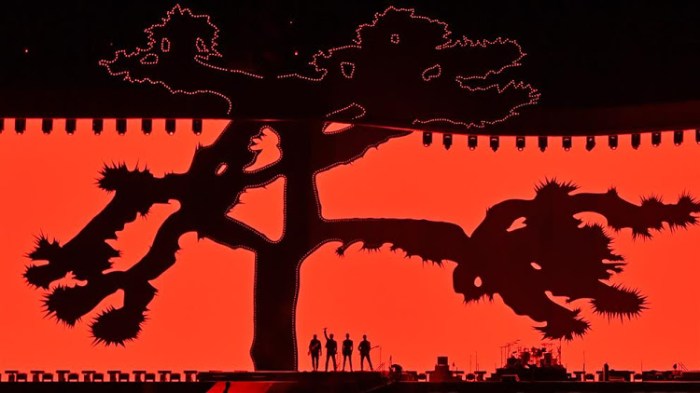
The set for Joshua Tree is deceptively simple, an enormous backboard of desert tan with the outline of the iconic Joshua Tree from the original photo shoot splayed out and rising above the backdrop. But as the band gets into full swing the whole thing lights up, serving as a photo montage, a video screen, and a live action feed of the band, usually all at once.

It’s breathtaking, especially as we see the band at first silhouetted as black figures against a luminous crimson background, and later as we are at the wheel of a car driving down the yellow stripe of a road through the desert. The backdrop dwarfs the band itself, but we see them in individual closeups throughout the concert.


01-u2-joshua-tree-tour.jpg

The Joshua Tree 2017 Tour is a return to the album that gave U2 their first international acclaim back in 1987, sold 20 million units world-wide, garnered them numerous awards, and gave them superstar standing.

Reagan was in the White House and Thatcher was at 10 Downing Street. The world they had made looked pretty grim and U2’s impassioned lyrics and music reflected the dichotomy between America as myth and America as an idea, something that Bono riffed on in this concert. This album was a direct result of U2’s fascination with America as a place of dreams and of bitter reality. All these years later the songs have taken on new meaning in this partisan minefield, this moment in American history that is more conflicted than when the album was born.

For me The Joshua Tree was a spiritual lifesaver. It came out in 1987, just months before my son was born. I was running a small graphics business out of the top floor of the Sligo SDA Church office, working 14 hours a day, and adjunct teaching World Religions at Columbia Union College. After working all day designing and laying out newsletters, magazines, brochures, and flyers, I’d transition to professor mode in the evening. When I’d finish teaching at 9 pm I’d go up to my office and work all night finishing up designs and meeting deadlines. I had a cassette of Unforgettable Fire, U2’s fourth album but the first one I’d bought. When Joshua Tree came out in March 1987 I played it over and over until the tracks were imbedded in my unconscious. The whole album reflected my spiritual restlessness and hope. If I felt like I was “Running to Stand Still” I also knew that “I Still Haven’t Found What I’m Looking For.”

On this night U2 served up the whole album, working through each song with alacrity and vigor, each one invested with the sweetness of nostalgia as well as the urgency of the present moment. Finishing with the haunting “Mothers of the Disappeared,” they waved goodbye to the crowd. But we knew they’d be back.

The encore set of six songs began with “Miss Sarajevo” with the video realigned to a Syrian refugee camp in Jordan and complete with the soaring verses by Luciano Pavarotti. That was followed by “Beautiful Day,” with Bono exclaiming, “When women of the world unite to rewrite history as her story, that is a beautiful day!”

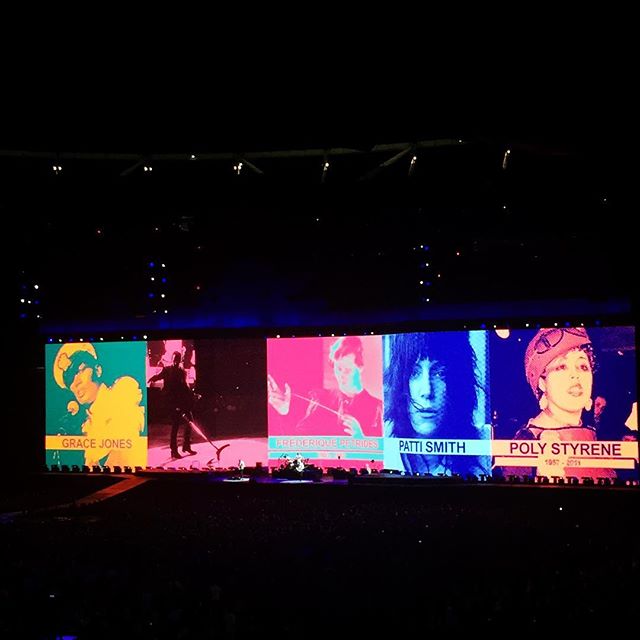
One of the most poignant moments was during “Ultra Violet (Light My Way),” in which a photo montage of women leaders from Rosa Parks to Michelle Obama to Dorothy Haight, Gloria Steinem, Malala, Connie Mudenda, and many others filled the screens.

SriramGopal.jpg

(Photo: Sriram Gopal)

During the intro to “One” Bono called out politicians like Nancy Pelosi (D-CA) and Rep. Kay Grainger (R-TX), personal friends of his, and celebrated the fact that 18 million people around the world are surviving AIDS by taking one pill a day paid for by US taxpayers dollars.

The encore and the show finished with “Vertigo,” amidst a spectacular visual display that could have given the faint of heart cardiac arrest.

In 1991 U2 released Achtung Baby, an album that was a decided departure from their previous albums. The band felt they were stagnating and that they “had to go away and dream it all up again.” Bono described their new direction as “four men chopping down the Joshua Tree.”

All these years later the tree has miraculously survived and we are the better for it.

Elaborated Spontaneity

RoseWhite:sebastian-molina-fotografia-101308

This is the first post in an ongoing experiment in quick writing, usually 500 words or less, on a spiritual theme, in which I play with metaphors, images, and concepts from the Bible. The second one follows, called ‘The Light.’

Imagine an elaborated spontaneity in which we juggle up a new idea, toss it around, look at it in the light, and set it down for a minute. In that short minute we ask ourselves what other ideas could connect here, what memories, what experiences, what chips of light and dark could be struck off in the shaping of it. Then back to the tossing from hand to hand–another way to see how the idea plays in this context and that–does it play or does it work? Does it lead us into paths of imagination for its own sake or does it drag us through the valley of the shadow of the death of hopes?

This is “elaborated spontaneity,” the ability to elongate and stretch and pull and twist a modest idea, almost like we are roping up pasta from scratch into long, fine strands by looping it, flipping it, folding it, twirling it into something delicious, savory, and gifted to others and ourselves, in the moment of creation, more than we thought and less than we touched; a faith that begins as a mustard seed and by chance (maybe by God’s nudge) skitters into good ground, puts up a shoot, shoots up into a shrub, and gathers to it the birds of the air. All this from a simple act of not looking away when our attention is caught like wool on a rose bush.

Ask, and it will be given you; search, and you will find; knock, and the door will be opened for you.

(Photo: Sebastian Molina, Unsplash.com)

Elaborated Spontaneity #1

The Light

LightWorld:aziz-acharki-285336

In the beginning was the word, and boy, was it ever a good word!

That word came from the Wordmaker and the Wordmaker was God, and all the words that rose up from the Wordmaker’s mouth did what they were meant to do, and the world sprang into light and that light was the light of the world.

There were times when the light could be seen like lightning from the east to the west and—truth be told—there was one who saw something like light falling from heaven, but no one saw where it plunged into the sea, if it did. It may still be falling far below that line on the horizon where the sea and the sky blur up together.

There came a time when the light burned low, like the light in a cat’s eye, and you’d have to be looking in the right place to notice it. It held there, but then it was flickering and wavering and almost guttering out and I remember in that moment that the one up ahead of us suddenly cried out, “My God, why have you forsaken me!” just as it fizzled and went out with a pfft.

It seemed an eternity in a darkness so absolute you couldn’t see your hand in front of your face—and there was no sound—the words had simply been crushed with a heavy hand across the mouth. Then—glory!—the light curled up and Someone cupped it close in a hand and it rose like a plume, almost perfect, and we held our breath, but it steadied and jumped and suddenly we had our own lights, each of us, above our heads, like a breath of benediction.

And you may be wondering just now why the light of the world is not a torch thrown high showering sparks, or like a pillar of fire by night or—hell, let’s go for the brass ring—why the light of the world is not a towering inferno for all the world to see.

That is a good question.

This is what we’ve pieced together: the light has come into the world to shine in the darkness and it lights up everyone who wants to be lit. No towering inferno, just many little lights flickering through the darkness. They coalesce, move together at times, split into streams, and come back together. Sometimes you’ll see one light way off, bobbing and dipping, and then joined by other lights. And it may be a trick of the eye, but rarely does one light remain alone for long. Light calls to light. Two become one and then many spring up out of the one. These lights are like a good word in due season.

There’s even a song about it with a line that goes:
“I see my light come shining from the west unto the east.
Any day now, any day now,
I shall be released.”

So, let your light shine in the world.

(Photo: Aziz Acharki, Unsplash.com)

Elaborated Spontaneity #2

Loyalty: Comey and Trump

Everybody has heard of loyalty; most prize it; but few perceive it to be what, in its inmost spirit, it really is,—the heart of all the virtues, the central duty amongst all duties.

— Josiah Royce, The Philosophy of Loyalty

trump-comey

(Photo: The Washington Post)

Loyalty does not appear in Aristotle’s list of virtues, nor does it show up in St. Paul’s fruits of the Spirit, but it is something that the great mass of people know to be valued between friends, toward spouses, and by tribal warlords, Mafia families, fraternity brothers, and Marines. That such a wide variety of individuals and groups hold loyalty dear should not surprise us, since in a time of torrential self-interest we treasure any branch we can cling to that will arrest our plunge over the falls.

Josiah Royce, longtime professor at Harvard and lifelong friend and philosophical jouster with William James, declared loyalty to be the primary virtue. In his Philosophy of Loyalty(1908), he outlines it as the fulfillment of morality and declares, “Justice, charity, industry, wisdom, spirituality, are all definable in terms of enlightened loyalty.” He could hold to this sweeping maxim because he viewed our lives as a tension between the autonomy of the individual and our duty to the community. Loyalty is the magnetism that holds the poles of individual desires and community responsibilities within the same force field.

Royce defines loyalty as a voluntary dedication to a cause outside ourselves. This doesn’t come naturally, since most of us, when we are young, don’t have a clue who we are and why we are here. And this also sets up a paradox, as he puts it: “No outer authority can ever give me the true reason for my duty. Yet I, left to myself, can never find a plan of life. I have no inborn ideal naturally present within myself. . . Whence, then, can I learn any plan of life?”

His answer is that we learn from the models set before us in life. We learn to play, to work, to speak, by entering into our social life with others. Living and learning from others stimulates our own self-expression and our own individuality. It’s never simply a matter of imitating others. We conform in order to learn and having learned we build our own plan for life within the social community.

“Thus loyalty, viewed merely as a personal attitude” says Royce, “solves the paradox of our ordinary existence, by showing us outside of ourselves the cause which is to be served, and inside of ourselves the will which delights to do this service, and which is not thwarted but enriched and expressed in such service.”

If we’re fortunate and have learned from good people we may find that purpose which centers our life, that gives us passion and defines the shape of our soul.

Artists and musicians know something about the power of a cause outside themselves. It is that which Bob Dylan spoke of in his Nobel Prize lecture as the spark that passed between him and Buddy Holly in one of the last concerts before Holly was killed in a plane crash. Dylan describes his awe as he watched from six feet away on the front row: “He looked me right straight dead in the eye, and he transmitted something. Something I didn’t know what. And it gave me the chills.”

A day or two later, just after Holly was killed, someone he didn’t even know handed Dylan a Leadbelly record. “That record changed my life then and there,” he said. “It was like an explosion went off. Like I’d been walking in darkness and all of the sudden the darkness was illuminated. It was like somebody laid hands on me.”

Still a teenager, still living at home, still Bobby Zimmerman from Hibbing, Minnesota, the convergence of those experiences turned him inside out. The music set him free because it was real to life. The books he devoured in grammar school—Don Quixote, Ivanhoe, Moby Dick, The Odyssey, All Quiet on the Western Front—their themes shaped the world inside his heart and fleshed themselves out in his lyrics. His music was his passion, that to which he gave his life.

We see loyalty here to Beauty, to Truth, to Justice—we could call up a hundred moments in the lives of those who have electrified us through the causes that gripped them. Think of Steve Jobs’ fierce dedication to the perfect convergence of Art and Technology. Pick almost any of the Old Testament prophets for whom the cause of justice burned within their bones until they cried out. Antigone and Creon, separated by an abyss of ritual duty—which one is truly loyal, which one irredeemably corrupted? Loyalty runs through our history and literature like a stitch along a seam: now we see it, now we don’t, but a pattern is clearly there.

Aristotle said, “To thine own self be true,” which sounds close enough to loyalty for most of us. It’s a value that we’ve embraced, despite the fact that “our self” is in flux and at times a mystery even to us. There’s more than a hint of desperation in the memes and tweets that proclaim how humbled we are by our own awesomeness. Royce reminds us that, “Loyalty is social. If one is a loyal servant of a cause, one has at least possible fellow-servants.”

But if loyalty is midwife to the emergence of the self, “Loyalty without self-control is impossible. The loyal man serves. That is, he does not merely follow his own impulses. He looks to his cause for guidance.”

That brings us to Donald Trump and James Comey, and the loyalty demanded by one and withheld by the other. In his testimony before the Senate Intelligence Committee, Comey describes a tense meeting with Trump in the White House in January soon after the inauguration. Summoned to a private dinner with the president, Comey was told “I need loyalty, I expect loyalty.” According to The Washington Post, “Comey said he “didn’t move, speak, or change my facial expression in any way during the awkward silence that followed. We simply looked at each other in silence. The conversation then moved on, but he returned to the subject near the end of our dinner.” The president again asked for loyalty, but this time Comey recovered enough to promise him honesty. That apparently wasn’t enough for Trump: “I will give you honest loyalty,” said Comey, and with that rather stilted expression the dinner concluded. The conversation for Comey, again in the words of The Post, “raised concerns in his mind. ‘My common sense told me what’s going on here is he’s looking to get something in exchange for granting my request to stay in the job,’ Comey testified.”

In the light of what Royce has said about loyalty, some observations can be made. First, both men understand the word “loyalty” in very different ways. Trump uses it, rather paradoxically, to express both domination and need. He expects Comey’s loyalty as due him by virtue of his position as president. More importantly, he expects it as payment for the debt incurred by Comey because Trump allowed him to stay in the job—despite the fact that FBI directors typically serve a 10-year term. But Trump also needs Comey’s loyalty, a slip of the tongue that reveals perhaps more than he intended. He needs the assurance that everyone who serves him can be trusted and is willing to pay obeisance. Thus, for Trump loyalty is strictly a personal matter of the noble pledging fealty to the king.

Comey, however, recoils from such a misuse of loyalty because for him there is a much larger issue at stake. He has taken an oath to uphold the Constitution and to maintain a bright, clear line between the kinds and uses of power for their appropriate ends. Furthermore, the loyalty demanded is only as strong as the loyalty given; loyalty cannot be coerced, only earned.

Let us admit that even with the best of intentions our loyalties are divided and our motives are mixed. H. Richard Niebuhr, an American theologian and social critic, channels Royce quite neatly when he notes, “Without loyalty and trust in causes and communities, existential selves do not live or exercise freedom or think. Righteous and unrighteous, we live by faith. But our faiths are broken and bizarre; our causes are many and in conflict with each other. In the name of loyalty to one cause we betray another; and in our distrust of all, we seek our little unsatisfactory satisfactions and become faithless to our companions.”

If we accept Royce’s thesis that loyalty is dedication of oneself to a cause outside of oneself, then the differences between the two men become even starker. Trump’s version of loyalty is a demand centered on satisfying himself alone; Comey’s is a principle that points beyond itself — and him — to an ideal of justice and fairness. Comey is loyal to the ideal of loyalty; Trump is loyal only to himself.


Limits and Learning

WritingOn:toa-heftiba-95457

(Photo: Toa Heftiba, Unsplash.com)

In writing essays I have, for several years now, followed the godfather of essay writing, Michel de Montaigne, in regarding them as essais or ‘attempts,’ even ‘tests.’ “What do I know?” Montaigne famously asked as justification for writing so freely on so many diverse topics, sometimes in the same piece. He was intent on testing himself, finding out what he knew and how he could best express it.

He was also unafraid to admit his learning curve, both morally and socially. “When the discussion becomes turbulent and lacks order,” he says, commenting on the art of conversation, “I quit the subject-matter and cling irritably and injudiciously to the form, dashing into a style of debate which is stubborn, ill-willed and imperious, one which I have to blush for later.”

Me too.

I envy Montaigne’s ability to skip lightly from a discussion of learning how to die to cannibals to educating the young. All the way along he quotes from Plato, Aristotle, Seneca, Cicero, Virgil, Hesiod, Horace, and Plutarch, as well as friends and enemies, Josephus and St. Augustine. The man knew everybody worth knowing in ancient and medieval literature and philosophy.

His book, he said in a note to his readers, was for his family and friends, so that when they lose him (as they surely will soon) “they can find here again some traits of my character and of my humours.” Yet having written and published his essays, he returned to them continually, adding, subtracting, revising, polishing, cutting and trimming, mulling over them, grafting in new ideas onto the trunk of his earlier efforts. He wrote and revised until he died, judging his work never to be finished, but rather always in transit.

Saved from self-absorption by his cheerful humility, Montaigne writes about himself because “Every man has within himself the entire human condition.” In a time when the individual was emerging from the crowd this was heady stuff; today it might be greeted with a yawn or roundly criticized as presumptuous and arrogant: “Who are you to say that you know my experience? Everybody is unique!”

What we have in Montaigne is a voice unafraid to speak up for itself, but one which will gladly learn from anyone, even those opposed to it. His confidence is infectious; he boldly goes where he has not gone before, relaying messages about his changes back to Federation Headquarters as they occur. His self-awareness is acute without being cloying: “And on the loftiest throne in the world we are still sitting only on our own rump.”

Today, wanting to write and determined to try, I began with an idea that had leapt out from my current readings in history and historiography. Since I don’t outline before I write I trusted that having read and pondered and watered my tiny mustard seed of a thought I would be able to grow it into a bush that the birds could flock to in numbers. But from the first sentence I was riddled with doubt. If I took this particular path I would have to explain the background; if I assumed this point, I would cloud the context. On and on it went, the original beam forking into fractals, each one bending the light until I could no longer see.

“A man should learn to detect and watch that gleam of light which flashes across his mind from within,” says Emerson. “In every work of genius we recognize our own rejected thoughts; they come back to us with a certain alienated majesty.” But that was precisely the issue! My thoughts had all been said and written before, usually better, by other people. A certain obsessive quality in me runs every idea through an originality sieve, sifting to find some gem that no one has thought of before.

That’s when I turned to Thomas Merton who wrote constantly and fluently on several dominant themes throughout his life. “No one need have a compulsion to be utterly and perfectly “original” in every word he writes,” says Merton. “All that matters is that the old be recovered on a new plane and be, itself, a new reality.”

Like most authors, Merton wondered if he was connecting, if what he wrote was making a difference in people’s lives. If a manuscript passed through the diocesan censors with minimal damage and then on to the publisher’s editing, Merton couldn’t help but worry that it was bland and forgettable. Later in life, musing on this need for writers to be needed, he says, “You give some of it to others, if you can. Yet one should be able to share things with others without bothering too much about how they like it, either, or how they accept it. Assume they will accept it, if they need it. And if they don’t need it, why should they accept it? That is their business. Let me accept what is mine and give them all their share, and go my way.”

Late in the day, going over this piece, those were words I needed to hear. I hadn’t written what I thought I would, but I had written, even though it was to stitch together the thoughts of others whose writing I admire. That was something, at least. “So do not worry about tomorrow,” said Jesus, “for tomorrow will bring worries of its own. Today’s trouble is enough for today.”

There is that.

Montaigne on Those Who Lead

I often turn to Michel de Montaigne (1533-1592), the cheerful philosopher for the common man, for insight into life. In his essay, “On the Art of Conversation” (required reading for every person these days), he not only shows an admirable self-awareness and humility about his own sometimes quick judgments, but he also provides us a commonsense perspective on those who hold power.

Here is one example:

”It is the same for those who rule over us and give orders, who hold the world in their hands: it is not enough for them to have an ordinary intelligence, to be able to achieve what we can. They are far beneath us if they are not way above us. Since they promise more, they owe more too; that is why keeping silent is not, in their case, merely a courteous and grave demeanor; it is also more often a profitable and gainful one.”

And then in the category of “Checking for Clothes on the Emperor,” he offers this:

”Now I was just about to say that it merely suffices for us to see a man raised to great dignity; even though we knew him three days before to be a negligible man, there seeps into our opinions, unawares, a notion of greatness, of talents, and we convince ourselves that by growing in style and reputation he has grown in merit. Our judgements of him are not based on his worth but (as is the case with the counters of an abacus) on the tokens of rank. Let his luck turn again, let him have a fall and be lost in the crowd again, then we all ask in wonder what had made him soar so high! ‘Is this the same man?’ we ask.”

As a French nobleman, a courtier, and a former public servant, Montaigne could have been writing about any of the six kings who ruled in his lifetime from the Houses of Valois and Bourbon. He knew how Fate and Luck could thrust a man onto the throne, qualified or not, and just as easily take him down again.

That was in a political system without a vote or a choice by the people as to who would lead the country. We have it better: our leaders answer to us—as long as we insist on it. Montaigne’s words reveal the tension in a democratic republic: anyone can run for office; they need only persuade us that they are qualified.

The Compassion Curve

Picture1

Before U2’s iNNOCENCE + eXPERIENCE album and tour (2015) there was William Blake’s “Songs of Innocence and Experience.” Here’s a look at how we begin in innocence, drop into experience, and rise—if we are able—to a new form of Innocent Experience, through what I call The Compassion Curve. Click on the link below to see the presentation.

The Compassion Curve