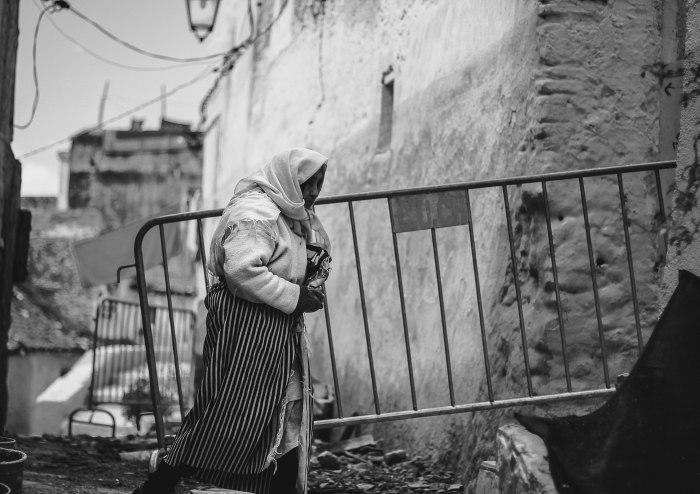
Hear the Pennies Dropping

1womanshawl:aziz-acharki-744640-unsplash

“He looked up and saw rich people putting their gifts into the treasury; he also saw a poor widow put in two small copper coins. He said, ‘Truly I tell you, this poor widow has put in more than all of them; for all of them have contributed out of their abundance, but she out of her poverty has put in all she had to live on.’” — Luke 21: 1-4, NRSV

There are few things that get us Christians rearing up on our hind legs and clawing at the air as talking about Jesus and money. Talking about Jesus’ love is no problem, just as talking about money is easy. Money and its value is the lingua franca of our world, the language that all of us are taught to speak from an early age. But when we put Jesus and money together it’s a whole different story.

For one thing, he didn’t have any. The gospels record him as sleeping rough while on the road. Even animals, he noted wryly, lived better than he did. At least foxes had their dens to retreat to at the end of the day, and the birds had their nests. Having left his home, his mother, and his siblings, for a life as an itinerant teacher and healer, Jesus had nowhere to lay his head.

Not that he was complaining. We never get the sense that Jesus resented the path he was walking, although the burdens he carried just being himself were heavy enough. Nor did he chafe at thwarted ambition or linger wistfully at the edge of the crowd as the rich and powerful swept by. “I coulda been a contender,” never passed his lips.

On the other hand, their relative poverty was a sore spot with some of the disciples. “We here have left everything” was a common refrain among them. Mark shows us two of the disciples, James and John, asking Jesus to commit to giving them whatever they want. “What do you want me to do for you?” he asks. Without hesitation, they answer, “We want to sit on either side of you when you set up your kingdom.” Incredulous, Jesus responds, “You don’t know what you’re asking.” Later, in Matthew’s version of the story that he picked up from Mark, he has the mother of James and John ask the favor. Maybe it was just too embarrassing for the early church community to believe these two would try to muscle their way into positions of privilege, but a mother . . . well, that was to be expected.

Jesus talks about wealth and poverty more than almost anything else, including all the usual subjects one would expect, like heaven and hell, the law, sexual morality, and violence. Jim Wallis, co-founder of the Sojourners Community, says in The Call to Conversion, that “One out of every ten verses in the Synoptic Gospels is about the rich and the poor; in Luke, the ratio is one out of seven.” Some of Jesus’ most scathing remarks are directed against the wealthy for their callousness and their foolishness in putting all their attention and their trust in what they pile up. The disparity between the wealthy few and the many poor was evident — and evidently on Jesus’ mind a great deal.

“But woe to you who are rich,” he warns, “for you will go hungry.” It will be impossible for the rich to enter heaven, he says bluntly. You might as well try to jam a camel through a needle’s eye. The disciples are duly staggered. Then who can be saved? they want to know. Jesus looks hard at them and says, “With man this is impossible.” He pauses, and as they gasp, he finishes, “But with God all things are possible.” Only God can save the rich.

Jesus is teaching daily in the temple in these passages, and he is sitting with his disciples one day, watching as people drop their offerings into the temple box. The rich come up with their long robes and their bags of money and make a show of pouring the coins in for maximum effect.

Then, as Jesus and the others watch, a widow slips up quietly and drops in two coins so small and light they barely make a sound. She does not raise her head nor look around, but simply disappears into the crowd. Jesus watches thoughtfully, two fingers tapping his lips, then shakes his head.

“She out of her poverty has put in all she had to live on,’” he says.

The verses immediately preceding this in Luke’s gospel are warnings by Jesus about position and power.

“In the hearing of all the people Jesus said to his disciples: ‘Beware of the lawyers who love to walk up and down in long robes, and have a great liking for respectful greetings in the street, the chief seats in our synagogues, and places of honour at feasts. These are the men who eat up the property of widows, while they say long prayers for appearance’ sake; and they will receive the severest sentence (Luke 20:45-47).’ ”

This is a difficult story. Our sympathies are with the widow in her plight, and our admiration even more so for her unshakable faith. This woman and her pennies stand before us like a moral stop sign for her willingness to contribute everything she had to an institution she believed in because of the God she believed in. The rich believed in God too, but they believed more in the power of position and social influence.

She may well have been one of the victims of the lawyers who snatched up homes and displaced their owners. In any case, a widow, especially one without grown children to support her, had a hard road to walk, as it has ever been.

Jim Wallis gives us another insight into the significance of her act when he writes: “The gospel story of the widow’s mite (Mark 12:41-44) makes a related point . . . It had to do with her relationship to God, which had transformed the economics of her life. . . How much is given is less important than how much is left over after giving.”

Jesus says in another context, “Take no thought for tomorrow, for tomorrow has troubles of its own.” But we do take thought; we take thought so much that it can tie our brains and our stomachs in knots. As I write, close to a million federal workers are out of work and without pay, as the government shutdown grinds on. That doesn’t include the small businesses which are dependent on providing services to a functioning government. For millions of people, the norm is living two paychecks away from homelessness.

Perhaps the meaning here is best conveyed by another translation which says, “So do not be anxious about tomorrow; tomorrow will look after itself. Each day has troubles enough of its own.” We cannot help thinking hard about such things. But we can learn to live by faith without anxiety.

Jesus says without a trace of irony that everyone who lives in the kingdom that is here and still to come could live without anxiety, “For it is the Gentiles who strive for all these things; and indeed your heavenly Father knows that you need all these things.”

And so, our widow, bless her heart, lives from hour to hour, supported by the gossamer threads of her own unpretentious faith, and slips out of the temple, unaware that her silent act, remarkable in its unassuming nature, becomes a witness remembered for as long as Jesus’ words are treasured.

And Jesus? After teaching all day in the temple, “at night he would go out and spend the night on the Mount of Olives, as it was called. And all the people would get up early in the morning to listen to him in the temple (Luke 21:38).”

Photo: Aziz Acharki, Unsplash.com

The Edge of Innocence

1DesertHills:stephen-pedersen-172497-unsplash

To choose what is difficult all one’s days

As if it were easy, that is faith.— W. H. Auden, For the Time Being

I have been thinking about the story of the Mount of Transfiguration. It features in the gospels of Matthew, Mark, and Luke, and it is a story that somehow connects heaven and earth, faith and doubt, God visible and God hidden, the past, the future, and the present—and so it is a subject for a New Year’s Day.

On New Year’s Day we come the closest to innocence that we are capable of as adults during the cycle of seasons in the year. We are done with the old year and its failures. We’ve shed that year like a snake sheds its skin, and we look to the new year with a touching naiveté, believing that if we want to fly, we can make it so. We will make new beginnings, we’ll have a breakthrough, all our false starts will fade away. Never mind all the home gym equipment that was set up in the basement with such resoluteness the day after Christmas, only to appear on the curb in March with the rest of the trash.

And so, we keep at it, this starting again and making promises to ourselves, because we absolutely must have a way to break up the surge of time and divert it at intervals. If December 31 is the lowest trough of the year, then New Year’s Day is the wave crest. End and beginning curve back to touch each other like one of Einstein’s sinkholes in time.

At the bottom of the worn-out year, scraping the barrel as it were, all the social norms for many ancient civilizations could be reversed or at least suspended for one night. Kings could be dissed without fear, peasants could don kingly robes. For a few hours, in a bacchanal celebration, all the fears and anxieties of the year could be discarded like old rags. It was a time for the expulsion of sins, for starting afresh, for the regeneration of time itself.

Recently, I read a news article about a dairy farmer who was finally selling off his cows after four decades of running the family farm. “It is said that farmers get forty chances,” he wrote in conclusion. “I’ve had my forty and I’m getting out.” Forces beyond his control had made it impossible to carry on, despite the efforts of him and his family. The plight of small family farms only highlights how important it is to us that we have a chance to start over.

Our lives are played out in an arena of paradoxical claims, as we try to unite opposing elements. “Be ye therefore perfect” sniffs at “All our righteousness is as filthy rags.” “Why hast thou cast us off, O God? Is it for ever? Why art thou so stern, so angry with the sheep of thy flock?” gapes in disbelief at “The Lord’s love never fails those who fear him.” For those who search for God with all their hearts, the wry observation of R. S. Thomas, the Welsh poet-priest, rings true:

. . . He is such a fast

God, always before us and

leaving as we arrive. — R. S. Thomas, Pilgrimages

We may be breathless to keep the back of God within sight, but the time between Christmas and New Year’s offers a chance to catch one’s breath. It is a fertile field of both regret and promise, of challenge and joy, of surrender to the Incarnation and determination for the year ahead. The story of Jesus’ transfiguration reveals the poles-apart thinking of the disciples; we see his glory revealed even as his compassion drives him deep into the common suffering of the world, and he is shadowed by the ordeal to come.

He had taken three of his disciples, Peter, James and John, to the top of what might have been Mount Tabor or maybe Mount Herman, leaving the other disciples at the foot of the mountain where they soon attracted a crowd. The three accounts in the synoptic gospels of Matthew, Mark, and Luke are substantially the same, with Matthew and Luke drawing from Mark’s core story, but adding significant details of their own.

Maybe Jesus anticipated what was in store for him on the mountain, or maybe he just needed to get away for a bit with his three good friends. In any case, there is an eerie resemblance to his night of sorrow in Gethsemane. The same three disciples are close to him while Jesus has a divine encounter; in Luke’s gospel account the disciples grow heavy with weariness and fall asleep, and Peter—bless him—speaks and acts in ways that Jesus must reject or risk losing his focus.

The outlines of the story are simple enough. Jesus and the disciples are on the mountain, when Jesus is suddenly radiant with light, his robe so white that it is almost blinding. Two resplendent figures appear and the three of them speak together.

The symmetry is arresting: Moses and Elijah, the Law and the Prophets, bookend Jesus with support just as he is growing into the conviction that he will die violently at the hands of authorities, religious and political, in Jerusalem. (An aside: how did the disciples know who they were? Were there introductions all round?) The disciples are both awed and terrified, so much so that Peter is babbling giddily about constructing three shelters when a voice thunders from heaven, “This is my beloved son. Listen to him.” The disciples fall to the ground, overcome, and the apparitions vanish, leaving Jesus to touch the disciples: “Stand up,” he says, “do not be afraid.” And when they raise their heads, they are alone with Jesus.

What were they talking about? Luke tells us they “spoke of his departure, the destiny he was to fulfill in Jerusalem.” On the way down the mountain, Jesus tells the three not to talk of what they have seen until he has been raised from the dead. Ah, they say, apparently unfazed by talk of Jesus’ impending death and resurrection. In Matthew’s account, the disciples raise a question on a technicality. Wasn’t Elijah’s appearance supposed to precede all this? Yes, responds Jesus, Elijah has already come, but nobody recognized him. “Then the disciples understood that he meant John the Baptist.” What remains unremarked upon by the disciples is that this future event, Elijah preceding the Messiah, is already in motion. John the Baptist is dead, the Messiah is Jesus, and he is going to die.

When they reach the bottom of the mountain, they see a commotion in the crowd gathered there. A man has brought his epileptic son to the disciples to be healed—and they can’t do it. The father implores Jesus to heal his son and Jesus explodes: “What an unbelieving and perverse generation! How long shall I be with you and endure you all? Bring your son here.” There is a final convulsion as the boy writhes on the ground, the demon departs, and Jesus hands the boy back to his father. Mark up another victory against the forces of darkness. All’s well that ends well, right?

If we were filming this episode, we would have used tight shots on the contorted face of the boy, closeups on Jesus as he casts out the demon, and then a slow zoom out to encompass the crowd, ecstatic at the miraculous healing, filled with admiration and awe for the power of Jesus. Luke says that after this Jesus went indoors and the disciples, those who had remained at the foot of the mountain, had a private word. Why couldn’t we cast out the demon? they ask. Well, says Jesus, this kind takes prayer.

***

Pull the cameras back into a high, wide shot stretching to the horizon, high and behind a group of tiny figures making their way south on the Jerusalem road. We know that Jesus has set his face like flint toward the holy city and that ahead of him lies the final conflict and his approaching death. Nothing is scripted here, no one’s hand is being forced; each actor in this drama sets his own lines and actions, according to his will. The events jerk and tilt toward their bureaucratic finality in a way that seems, in retrospect, foreordained, but for those caught up in it, the outcome is realized too late.

***

For us, poised on the cusp of the new year, the transfiguration offers us a way to into the times ahead. The Incarnation has been our transcendental experience on the mountaintop, our unexpected blessing coming out of the darkness; we would like to remain there — if only for a few more days. It’s a time when people seem to set aside their egos and think of others. If they — we — can do that consciously for several days, why can’t we continue? Perhaps we can keep that going for a week and then New Years’ can act like a slingshot to keep us in orbit above the Earth.

“At some moments we experience complete unity within us and around us,” says Henri Nouwen in Bread for the Journey. “But whenever and however it happens we say to ourselves, “This is it… everything fits… all I ever hoped for is here.” This is what Peter, James, and John experienced on the mountain with Jesus. “This is the experience of the fullness of time,” writes Nouwen. “These moments are given to us so that we can remember them when God seems far away, and everything appears empty and useless. These experiences are true moments of grace.”

But we can’t remain on the mountaintop, up there in the glorious light with revered figures from our past. Down below, back in the world, there are the constant reminders that suffering continues and that we are not complete. This kind takes prayer, says Jesus.

Up ahead are trials, but also moments of transcendent joy, communion, beauty. We are blessed by the Spirit, by the epiphanies granted to us that open us to a steadfast courage. There are crosses up ahead, no doubt, but Spring is coming and there is a resurrection.

Photo: Stephen Pedersen, Unsplash

A Scandal We Can Live For

1Crosses:ruben-bagues-549787-unsplash

He was in the form of God, but did not think to seize on the right to be equal to God . . . being born in the likeness of a human being; and being found in the guise of a human being, he humiliated himself and was obedient to the death, death on the cross. Philippians 2:7-8, Richmond Lattimore, translator

Every life that begins points forward to a death, a truth we mortals carry like a stone in our shoe.

Does every father grasped in the clenching fear and joyous awe of the birthing hour cast his mind forward to the death of his son? Perhaps Joseph did, caught up in a mystery whose dimensions seemed to waver in and out of focus with his young wife’s hoarse cries. There is no mention of a midwife in the Gospel nativity stories. Does Joseph deliver the child himself?

Questions like these are how we fumble our way to the heart of the nativity story. We ask them because we want to time-travel back, to be there in that moment to try to grasp how—no, why?—an infinite God plunges deep into our world in order to surface as an infant, an infant for whom the mere rumor of existence is enough to trigger a massacre.

From a reasonable perspective, it would be hard to find a less auspicious beginning for a clandestine King of kings and Lord of lords: a baby born into poverty under one of the most corrupt governments of an empire notable not only for its reach but also for its cruelty. From a revolutionary standpoint, chances for success in overthrowing the Empire hover around zero. I don’t think we can exaggerate how awful the odds are here.

Imagine the storyline pitched by the producers of a film company to the head of a major studio:

What kind of film is this?

It’s kind of an action-adventure, but with a strong underdog angle.

Let’s hear it.

Okay, a baby is born under mysterious circumstances to a poverty-stricken couple who have to flee to another country to avoid a massacre of all children under two by a corrupt and paranoid tyrant.

I see.

And the kid survives and grows up to form a roving band of —

Guerrilla fighters?

No. They go around this country healing people and teaching them about loving their enemies and turning the other cheek.

(silence)

And finally, he’s captured, all his friends desert him, and he’s killed.

Wait. He’s got no superpowers?

No.

No last-minute rescue mission?

No.

Too depressing. What’s the point?

Well, he comes back to life.

Like what, a zombie? That could work—

No, no zombies. He comes back to life and then after awhile he disappears.

And that’s it? Are you kidding me?

Well, he returns later and sorts everything out.

When?

When what?

When does he return?

Nobody knows, it’s just that—

Get outta my office.

We have an advantage over Joseph—we know that the end of his son’s story is the beginning of an even greater story. We know the end of our story, too, the one we share with our human community. What we cannot fathom is the beginning of this baby’s story.

The nativity scenes we witness in paintings are as peaceful and placid a scene as one could imagine. The baby Jesus coos and waves his little fists. Mary is dressed in robes of cerulean and white and gazes benignly on her infant son. The magi are there, having arrived not a moment too soon, but months after they set out from their city. In some of the paintings there are shepherds kneeling by the manger. They’ve already seen angels that night, a heavenly host of them, their burning towering forms lighting up the hills for miles around. Naturally, the shepherds are terrified, but it’s a terror that becomes raw energy; they race down off the hills and into the town. (How do they know where to go?) But they find the place and slip inside, some to kneel, some to stand in the shadows, panting and glancing at one another with wondering eyes.

***

The Coming

And God held in his hand

A small globe. Look, he said.

The son looked. Far off,

As through water, he saw

A scorched land of fierce

Colour. The light burned

There; crusted buildings

Cast their shadows; a bright

Serpent, a river

Uncoiled itself, radiant

With slime.

On a bare

Hill a bare tree saddened

The sky. Many people

Held out their thin arms

To it, as though waiting

For a vanished April

To return to its crossed

Boughs. The son watched

Them. Let me go there, he said.

— R. S. Thomas, Collected Poems

***

God must now think from behind the eyes of a human being. Those considerable limitations are what remains to work with. No superpowers here, just the steady consistency of vulnerability and love. Will that be enough?

If this really was the kairos, the right time for this intervention in Earth-history, we wouldn’t have seen it had we been there. Even if we had been in Jesus’ roving band of disciples, we couldn’t have understood it. As long as power meant violence to take down the enemy none of this would have made sense. And if we’re honest it still doesn’t make sense. The reason we accept it, this Incarnation, this embodiment of God in human flesh, is that we no longer see it as the skandalon, the scandal it really is. What kind of god would have the patience, not to mention the love, to work with creatures who resolutely kill everyone who offers them hope?

“The central miracle asserted by Christians is the Incarnation,” said C. S. Lewis in The Joyful Christian. “They say God became Man. . . Every particular Christian miracle manifests at a particular place and moment the character and significance of the Incarnation.”

This is where it begins for us. It doesn’t really matter if we can’t figure out the biological status of a virgin birth or even if parthenos means a “young girl of marriageable age” versus a virgin who has never had sex. What matters is that we accept this gift of God become human, scandal and all.

Advent for me means the coming of the Christ-child into this world, through the back door of the world, under the silent stars of the world, for the world. It always catches me off-guard, which is good, because we should always be surprised at Advent. Surprised that the kingdom begins in such a quiet way; surprised that at least once during the year we can say in all honesty, that we were blind, but now we see; surprised that silence carries a deeper truth than we could think of on our own.

After surprise comes wonder, since Christ comes to us in every breath we take, every person we meet, in the dust on the road to Emmaus, in the waves we sink into, in the beauty of communion with one another. All of these are Advent moments; they give us a way to live inside the saying, ‘Lo, I am with you alway, even to the end of the age.’

Photo: Ruben Bagues, Unsplash.com

No Guarantees

1ChildKiss:vince-fleming-487796-unsplash

“Communication as a bridge always means an abyss is somewhere near.” — John Durham Peters, Speaking Into the Air

According to the Gospel of Matthew, Herod slaughtered every child of the age of two and under in Bethlehem and its surroundings, because he was trying to kill the king of the Jews whom the magi from the East had come to worship.

To put the Bethlehem massacre by Herod in its full horrific context, the writer of the gospel reaches back to the prophet Jeremiah’s lament for the slaughter of children in Ramah, an Ephraimite village eight miles north of Jerusalem, before those who remained were deported to Babylon. He needs a historical parallel of sufficient magnitude.

“Then was fulfilled what had been spoken through the prophet Jeremiah:

“A voice was heard in Ramah,

wailing and loud lamentation,

Rachel weeping for her children;

she refused to be consoled, because

they are no more.”

Thus, the good news (for that is what euanggelion, the ‘gospel’, means) of the coming of the Christ child, the promised one, the Son of God and the Saviour of the world, unfolds in haste and secrecy in the midst of a bloodbath. But it has ever been so, as powerful and corrupt rulers are threatened by women and children.

The family escapes to Egypt, being warned in a dream, and they remain there—we don’t know how long—until news comes that Herod is dead. They make plans to return to Bethlehem, but Joseph is again warned off in a dream. Instead, they find their way north to Nazareth, a village in Galilee so insignificant that there is no mention of it in historical records outside of the New Testament. Their caution is well-founded, for Herod’s son, King Archelaus, rules for only two years before the Roman emperor, Augustus, removes and banishes him for brutality. If Herod could kill a generation of Judean children with impunity, what must Archelaus have done to incur the wrath of the emperor? Or perhaps it was a pragmatic decision on the emperor’s part, knowing that even the poorest, weakest, and most oppressed will eventually rise up.

Advent is a season when Christians celebrate the coming of the Christ-child, the earthly beginning to Emmanuel, God-with-us, and the short, intense journey that brings that child, now a man, to an abrupt end on the cross. But then there is Easter and resurrection; the unexpected turn of a tragedy become comedy, the ultimate trick on the Trickster, and a silent nod off-stage to where Job stands alone in the wings, with an amused shake of his head and a smile. There are innumerable crucifixions without a resurrection, but in this story, there is no resurrection without a crucifixion.

When lies become the norm we cherish the truth even more, and for us in this century, truth is found in facts. We want the gospels to be history, a medium we think we understand as a story that corresponds to the facts. But behind the facts lie assumptions, and assumptions are most often invisible to those who hold them and inaccessible to those who don’t. What is not mentioned in the gospels about Jesus may not have been known by the gospel writers, or was known, but thought so obvious that their concise narratives did not include it, or was known, but considered insignificant to the core of the story. Their assumptions are not our assumptions; the stories that result are strange to us and sometimes even inexplicable.

Albert Schweitzer devoted years to a search for the historical Jesus and finally concluded that “Each successive epoch found its own thoughts in Jesus,” because one typically “created him in accordance with one’s own character.” “There is,” Schweitzer said, “no historical task which so reveals someone’s true self as the writing of a Life of Jesus.”

Thus, there are multiple versions of Jesus in all ages, as Jaroslav Pelikan so lucidly illustrates in his Jesus Through the Centuries, a cultural history. “For each age,” he comments, “the life and teachings of Jesus represented an answer (or, more often, the answer) to the most fundamental questions of human existence and of human destiny, and it was to the figure of Jesus as set forth in the Gospels that those questions were addressed.” And we could add that people of faith, as well as those who profess no faith, nevertheless carry refracted images of Jesus in their minds that are often at odds with each other. We see Jesus as through a kaleidoscope rather than through a microscope. The gospels give us a collage, not a portrait.

The fragmentary glimpses we get of Jesus are not the result of inattention on the part of the eyewitnesses nor are they lapses in the discipline of the story. Rather, they are the best that people could do to reveal a figure so mysteriously complex and yet so transparently good, that no one close to him could ever say they knew him through and through.

Jesus was not an open book to those who knew him. The disciples were often confused and distraught by his words, drawing him aside to ask for the meaning of a parable or to clarify for them his differences with the religious authorities. Jesus rejoices that God has hidden His truths from the sophisticated and has opened them to those who learn best from actions and images.

We simplify the story of the nativity down to what we can carry without dropping all the other things that fill up our lives. In a creche, the animals form the background, their benign expressions of placid acceptance mirroring our own. Joseph stands to one side, proud but peripheral. The wise men, kneeling or standing, present their gifts with reverence. Mary and Jesus are front and center, the focal point of everything and the period to the exclamation mark of the star that stands above the stable. There is something so achingly touching about this, a child’s toys arranged just so to mimic the world she imagines. Add to this the innumerable Christmas plays in schools and churches acted out in front of proud but anxious parents, each play another means to build a bridge from an ancient culture to our own.

The question for Christians and other people of faith is how to tell this story, this coming-to-Earth story of divine kenosis, of an emptying out and pouring in of God become human. As the epigram suggests, a bridge implies an abyss, otherwise what is its purpose? In communication with one another, in telling the story yet again, we recognize the abyss to be the fact that we cannot clearly and completely express the truths we comprehend, nor can we be assured that our comprehension is correct. We are the ‘speaking animals’ whose verbal options are almost limitless, but by that very fact, we must often grope for the words to match the images we have in our heads.

From within our comfort zone, the Advent story is theologically safe, hermetically sealed, predictable in its results. It’s a ritual we cannot do without, yet it often bypasses the heart.

We need to recapture the ‘otherness,’ the very alien nature of this story of God become a human, a story that rings through history with tones both dark and bright. There are other gods who have appeared in human form, but none of them as a baby and none who stayed around to be murdered—and then rose again.

The thing that we must never forget, that if understood will disrupt our lives and break our complacency, is that nothing in the events of this story can be taken for granted. Joseph could have laughed off his dreams, Mary could have said no, the baby could have died before the age of five from diseases that take the lives of 15,000 per day of newborns in this world. The family seeking asylum in Egypt could have been turned away at the border, held for questioning, or simply murdered on the way.

People made choices without much to go on, save what they held in faith. As strange as those times and that culture may be to us, the common factor we may share if we wish is that God was in Christ reconciling the world to himself and that from the foundation of the earth this has been a work of love.

Photo: Vincent Fleming, Unsplash.com

Seeing Things

ChildEyes:ilya-yakover-267697

In this Advent season we await the coming of the Christ-child. Our sources for this are Matthew and Luke. Mark begins his gospel breathlessly with Jesus as a man, coming up out of the waters of baptism, the skies splitting open above him. John’s gospel begins even farther back, among star-trails of light in the cosmos, the Word materializing out of the blackness of the space between the stars, to arrive uncloaked as the very being and presence of God across the universe. It’s Matthew who gives us the credentials first, the genealogy of the Saviour, beginning with Abraham and running neatly through three sets of fourteen generations each until we arrive at “Joseph the husband of Mary, of whom Jesus was born, who is called the Messiah.”

And it’s Matthew who calls up astrologers from Babylon who, in their glad and awe-struck homage, ply the family with precious gifts of gold, frankincense, and myrrh, and then, after being warned of Herod’s baleful intentions in a dream, take another road back home. No sooner had they gone and the family settled down for fitful sleep, when Joseph yields to a dream (a language he was learning still) to take his wife and newborn child and slip through Herod’s slaughter of the innocents. So, with the gold he buys his neighbor’s horse in whispered haste at three a.m., shuts up the house, and off they go, under the stars, across the rock-strewn miles of desert to seek asylum in Egypt.

With Luke we get the bells and whistles—no wise men this time—but more dreams and angels and shepherds and cousins and songs of humility and unalloyed triumph; an older woman with child who thought herself barren, and a mere girl-child, trembling before the sudden, glittering form of a being who stoops to enter her room, and toward whom she bows her head and shields her eyes because, against the evidence, she is certain she is seeing things.

We look at our own infants and imagine who they might become, what they might do, even (God forbid) the harm that might come to them and the resolve we feel to protect them from anything like that. We wonder how the world will change in the time that passes as they grow into adulthood.

In time, we realize that they are not clones of ourselves, but persons in their own right, with personalities and temperaments that may reflect our influence, yet with their own perspectives and motivations. They are not us; they have their own path to travel.

The being whom Luke names as Gabriel greets Mary in a way that is deeply troubling to her. “Greetings, most favored one! The Lord is with you.” The angel hastens to add, “Do not be afraid, Mary, for God has been gracious to you; you shall conceive and bear a son, and you shall give him the name Jesus.”

The singular event that transforms human history has begun. It begins, as Luke tells us, with a girl, one among thousands, who is filled with awe and confusion at being singled out, placed at the head of the line, in the spotlight, up on the stage.

Every woman and girl could wonder in quiet moments if she might be the one to bear the Messiah. More than one watched with secret joy at the sweetness of her child, only to have her hopes dashed when he turned out far less messianic than even the most generous grandparent could vouch for.

Luke’s Gabriel is hitting all the keys with full chords now. “He will be great,” the being sings out, “and will be called the Son of the Most High, and the Lord God will give to him the throne of his ancestor David. He will reign over the house of Jacob forever, and of his kingdom there will be no end.”

There is silence. The being looks at Mary expectantly. “How can this be,” she says deadpan, “since I am a virgin?” She may have only been 14 or 15, but she knows how babies are made. The being sighs; this is going to be tougher than he thought.

“The Holy Spirit will come upon you,” he says, and glances sidelong at her. “And the power of the Most High will overshadow you; therefore the child to be born will be holy; he will be called the Son of God.” A simply deductive syllogism, he thinks. Two premises followed by a conclusion—a conclusion which must be true if the premises are true. And, of course, they are. There is silence. Mary’s head is down, but the being can see that her gaze is fixed and unmoving. She does not blink. He looks more closely; yes, she is still breathing.

He tries again: “And now, your relative Elizabeth in her old age has also conceived a son; and this is the sixth month for her who was said to be barren.” He pauses. “For nothing is impossible with God,” he finishes up with a flourish. Mary’s shoulders shudder and she lifts her head. Her cheeks are wet with tears, but now she is smiling as she presses her palms into her eyes. She looks up, this girl who has been lifted and spun, whose heart is ablaze with ancient titles, prophetic proclamations, words spoken that were always like objects of wonder heard but not touched, words so overwhelming that they overshadowed the sky and made tense the present.

“Here am I,” she says in a whisper, “the servant of the Lord; let it be with me according to your word.” And Luke recounts laconically, “Then the angel departed from her.”

Let us not diminish the utter awesomeness of this scene. The word ‘awesome’ has been debased in our time, liberally applied as easily to ice cream as to lending someone a stapler. I want to reserve it for the numinous, that which raises the hair on the back of your neck, that which is awe-full. “The Lord is in this place,” breathes Jacob, looking around in the velvet desert darkness as his eyes adjust to the explosion of light as ten thousand angels ascend and descend on a stairway to heaven. That’s awesome.

No matter how many times we may read of angels appearing to people in the scriptures, we mustn’t forget that it was at least as strange to them as it would be to us. The difference between them and their time and us is that we’ve built in defenses against this kind of thing, so that the numinous cannot be part of any algorithms we might use to calculate what we agree is reality.

She could have said no, Mary could. That is just one of a thousand decision-points that could have diverted or ended the stream of this story. Without that yes, that heart-stopping yes, none of our own yeses would have been possible.

The threshold at which we can linger and then stumble through into Mary’s room after the being is gone, is in the thought of the perilous journey ahead for this promised child. In a matter of moments, Mary has gone from a girl with a predictable life ahead of her to the promised portal through which the Son of God enters the world undetected. This is a joy so deep it can only be expressed with tears. There is a holy terror that rockets her up above the world, giddy at that height and breathless as she yields to the heat that courses through her body.

It is a glorious madness that she has opened herself to. If we are brave enough, we will not turn our eyes away as the arrow arcs into the sky to pierce her heart with the certainty that darkness impenetrable also lies ahead. Joy and terror; this is how her ‘Yes!’ thrills through her body.

***

In his tripartite poem, Seeing Things, the Irish poet Seamus Heaney tells of crossing open water as a child from County Galway by boat to the island of Inishbofin in the Atlantic.

All the time

As we went sailing evenly across

The deep, still, seeable-down-into water,

It was as if I looked from another boat

Sailing through air, far up, and could see

How riskily we fared into the morning,

And loved in vain our bare, bowed, numbered heads.

From our distance, looking back, we are both the girl-child that says yes to the being and we are the guardians of the child still to come. Our hearts are full for that child in his early peril. In the Advent season we await his coming into a world both cruelly cold and wondrously beautiful.

Photo: Ilya Yakover, Unsplash.com

The Acts of the Disciples

DiscipleFlame:aziz-acharki-224107-unsplash

The spirit of the Lord is upon me,

because he has anointed me

to bring good news to the poor

He has sent me to proclaim release to

the captives

and recovery of sight to the blind,

to let the oppressed go free,

to proclaim the year of the Lord’s

favor. (Luke 4:18,19)

And Luke’s gospel says that Jesus “rolled up the scroll, gave it back to the attendant, and sat down. The eyes of all in the synagogue were upon him.”

Let us sit with them for a moment, in that holy silence. Jesus carefully, reverently, rolls up the scroll. He does not hurry. He holds the knurled ends of the scroll in his hands, feels the polished wood turning against his palms, as the papyrus curls back to its resting position. The attendant reaches to take the scroll as Jesus sits down. No one stirs. It is the silence of expectancy, not of inattention and boredom.

What were they expecting, and why would they be transfixed, holding their breath for the next moment? Perhaps it was the way Jesus read the passage, ascending the hills of the text to each crest, hitting the “me” of each one with emphasis, descending to the plains in between, and then scaling the highest one to summit in triumph on “the year of the Lord’s favor.”

If you have always been told that a day was coming when everything that breaks you every day would vanish, and you would be able to take a full breath, and you could lift your head and you could stand up and you could smile and even laugh—then you will know what each person knew when Jesus said, “You’ve just heard Scripture make history. It came true just now in this place.”

The people in that meeting place that Shabbat turned to one another excitedly and remarked at how well Jesus spoke. They were not talking about his elocutionary style, but about the thrill of hope that jolted through them in that moment. The words from Isaiah 61, so familiar and so tantalizing, rang in their ears.

But then there were doubts. Wouldn’t the Day of the Lord come with trumpets, thunder, signs in the heavens? And wouldn’t it be announced by the Messiah, the awesome figure of power and glory of whom the prophets spoke? Instead, we get a local boy, smart but shiftless, who left his mother and travels the countryside. “Isn’t this Joseph’s son?” they asked. “We’ve known him since he was a little kid. Is he saying that he’s the One? He’s getting way above himself.”

And then Jesus went off-script. You’ll probably tell me to heal myself, he said. You want me to do tricks, like what you think I did up in Capernaum. If I don’t do the same thing here, you won’t believe me. Well, let me tell you something. No prophet is ever welcomed in his own country. There were a lot of widows in Israel during the famine, but our own prophet, Elijah, was sent to a widow in Sidon instead of them. And there were a lot of lepers in our country, but Elisha was sent to heal Naaman, the Syrian. Not one of ours was healed.

As they say, ‘the optics weren’t good.’ Excitement and admiration turned to doubt, and doubt to hostility and rage. More than just grilling the preacher’s sermon over Sabbath lunch, they were infuriated. Leaping to their feet, the whole congregation—families, men, women, and children—dragged him to the cliff on which the town was built to fling him bodily out and down.

Imagine the scene: people so angry, so completely consumed by rage that they seem demon-possessed. Neighbors he has known all his life, shoving and kicking him, his arms stretched out in their grasp, and him falling and stumbling back up, his eyes riveted ahead to where the ground drops away for hundreds of feet.

This is a video that will go viral, but before it does, let us freeze the frame with Jesus at the lip of the cliff—and since this is imagination we can do this—and ask ourselves what they are thinking.

If you saw them on the street you would have no idea they were capable of killing. They look like ordinary people. But seeing them now, ranged behind the figure twisting in their grasp, we see the leers, the harsh laughter, the sweat. A woman’s face is framed behind his shoulder. She is jeering, the veins in her forehead distended and throbbing. She feels forgotten, neglected, the hopes that were stirred by the promises of the prophets have vanished, and all that fills her mind is the thought of foreigners receiving the healing that is rightfully hers. Next thing they’ll be pouring across the border, Syrians, Caananites, Samaritans, lepers! It is a betrayal of everything she stands for, made worse by one of her own, a traitor in their midst like a devil among them.

Luke places this story near the beginning of Jesus’ mission, while Mark and Matthew record it as further down the timeline. Commentators suggest that Luke’s purpose is to show us that this is how Jesus’ mission is going to play out. The rejection he endures by his own people is triggered by his hints that God’s Spirit will be poured out on all who need it, those in other nations as well as in Israel. The nationalist fervor that roils this crowd into a murderous rage fulfills the prophecy that Jesus speaks.

We know how the incident ends, although we don’t know how it is done. Jesus teeters on the cliff’s edge, and then suddenly he is striding back through the crowd, parting them before him as if a force-field surrounds him. Luke gives it one line, ending with “he went on his way.” What matters most is that the kingdom has been announced, the Spirit is present, and Jesus is on his way into the world. Evil is no longer safe.

Jesus announced the kingdom in that dusty town on that Sabbath. He also denounced the fear that gripped the congregation in a snake’s coils. Annunciation and denunciation, two sides of a coin that has been carried by prophets and preachers and ages of sages. Wherever there is denunciation by the prophets, annunciation can be found in the neighborhood. And where the announcement falls upon deaf ears, denunciation of their callous disregard soon follows. The denunciation clears away the thickets, allowing the annunciation to spring forth.

But we must add something else to this prophetic witness between these two movements: the renunciation of our sins. Denunciation of the power structures in church and society, the uncovering of that which is intentionally hidden, is a necessary step toward the freedom of justice. But for the Christian, and any person of good faith, there follows in response another step equally important— that of renunciation.

Jesus began with the annunciation because he is the one who brings in the kingdom. In our time it is up to us as people of faith to begin with the denunciation of systems and structures that oppress and break the spirit of people. It would then be the most natural thing in the world to leap to the annunciation. Problem and solution; it’s how the world works.

But we are called to walk humbly as we act for justice. It is with the gospel in trust that we are invited to renounce our sins. The public renouncing of the sins of our discrimination opens the way to announce the good news of the gospel. And the gospel lived out is what reconciles us to God and to each other.

These are the acts of disciples who follow Jesus: they denounce, renounce, and announce. A movement begun by one is carried on through the Spirit by those who are willing to follow.

***

Twenty centuries after Jesus announced the kingdom we tell ourselves that, “The arc of the moral universe is long, but it bends towards justice.” Fifty years after Martin Luther King, Jr., famously uttered that phrase we look up to see that arc crossing overhead, but with no discernible point on the horizon where it could touch down. That is, unless we prepare the way by renouncing our sins of injustice, as a nation, as a church, and as individuals.

Unity without equality for everyone is conformity to injustice for all.

Mark Oakley, in The Splash of Words, invokes a Franciscan blessing: “May God bless us with discomfort at easy answers, half truths, and superficial relationships. May God bless us with anger at injustice, oppression and exploitation. May God bless us with enough foolishness to believe that we can make a difference in this world, doing in his name what others claim cannot be done.”

Photo: Aziz Acharki, Unsplash.com

Life Becomes a Dark Saying

NoutGonsMt

I don’t know what it means to say that Christ “died for my sins”. . . but I do understand—or intuit, rather—the notion of God not above or beyond or immune to human suffering, but in the very midst of it, intimately with us in our sorrow, our sense of abandonment, our hellish astonishment at finding ourselves utterly alone, utterly helpless. — Christian Wiman, My Bright Abyss

It is a curious thing to be a human being. There is in us a drive to be more than we are and also a drive to be that which we are not. These are not the same, and it’s worth our time to make the distinction. But what we find most difficult is to be what we are. If we could truly know what we are, both in the aggregate and as individuals, we might not be so anxious to be something else. Even more to the point, we might not be so anxious.

“Be all that you can be,” says the Army’s recruiting slogan, with the implication that whatever you are right now is not enough compared to what you could become with the proper training and motivation. It’s a clever slogan, and it works for a lot of people, because most of us do not really know what we are but we’re pretty sure we’d rather be other than what we are. Whatever that is.

So here is one way we’re given to understand what we are. The basic message is: you’re no good. The thing is that while a lot of advertising uses this technique, so do some iterations of Christianity.

The advertising arm of this approach is relatively benign. It says—sometimes loudly, sometimes softly—but always incessantly: you are deeply lacking in some crucial areas of life. But don’t worry, there are people here who can help you, who want the best for you, and who know what’s best for you. Toothpaste, cars, clothes, men’s shaving razors (Harry’s, I’m looking at you), lifestyles, attitudes, beliefs—anything can be commoditized and sold. It’s a service we’re proud to provide.

The Christian versions also begin with the claim that we are absolutely corrupted and there is nothing good in us. The more sadistic brands then justify beating the hell out of children and making sure the adults know what complete failures they are. The milder, but more acquisitive forms counsel surrender to Christ in order to reap the rewards of victory. Having put our hand to the plow we never look back; the furrow we cut through the world is straight and true because we have made it so. Victory is ours.

We are quick to say that all the glory goes to God. He is the one who has blessed us. As we warm to the subject, we rejoice in the fact that since everything belongs to God, and since He wants us to be happy, He can give us whatever our hearts desire. He does not want his children to be seen as poor. It brings shame upon the family name. God knows our needs and wants. Once we were blind, but now we see that God is our great investment banker: if we put ten dollars in the collection plate, He will multiply that and increase our goods ten-fold, a hundred-fold, beyond our wildest dreams. All things are ours if we are willing to believe that God will reward our faith.

It is a seductive message the prosperity gospel puts out. There is truth to it, but not in the ways the seduced would want to own. The first truth is that on our best days we’re running a low-grade fever of illusion that we can scrub out all our imperfections if we just put our minds to it. The second truth is that on our bad days we’re blaming everybody else for our failures. These things are so true that they whipsaw us back and forth until we demand a product that will put an end to the pain.

For some, the analgesic comes in the form of all that advertising sells. For others, the pain is dulled by a Jesus who promises a carefree life. The proviso is that our faith must keep that balloon aloft. The moment we stop huffing and puffing is the moment we plummet. Still others of us will attempt perfection because we think that is what Christ demands. We will fail. Christ’s lawyers will tell us that we fell short, that we were out of compliance. Our weakness is our fault.

But here is another kind of truth:

“And when he had called the people unto him with his disciples also, he said unto them, Whosoever will come after me, let him deny himself, and take up his cross, and follow me. For whosoever will save his life shall lose it; but whosoever shall lose his life for my sake and the gospel’s, the same shall save it. For what shall it profit a man, if he shall gain the whole world, and lose his own soul? Or what shall a man give in exchange for his soul?” (Mk 8: 34-37, Authorized Version)

This has long been for me one of the most significant texts in the New Testament. It is paradoxical, upside-down thinking, literally about matters of life and death. Without blinking or turning away, Jesus calls us to one of the most barbaric forms of death in human history. Our eyes bounce and swoop over the words now, because for many the cross has become mere jewelry. Jesus’ death on the cross is far, far back in history, the stuff of theological councils, a done deal. But this story, this ragged, gut-wrenching cry—this is a forewarning of what is to come.

Needless to say, this invitation will not draw the masses to the revolution. It isn’t even a message that Jesus reserves for those most familiar with his rhetorical themes—his disciples. He might have drawn them quietly aside, cleared his throat, and said: “By the way, you’ll want to be preparing for your eventual death on a cross. Do that and you’ll live forever.” Instead, He turns and speaks openly to the jostling people who are following him around, the ones just hoping to be healed or touched or listened to or in some real way seen for the first time in their lives. Did they hear him? Could they hear him? Is he trying to thin the crowd, to cut it down to the hard-core cell of those who would go to death for him and the cause?

He says all this, knowing somehow that all of them will abandon him to his wild dreams as he breathes his last on the cross to the laughter of the soldiers who nailed him there. But he is serious, and we must take him seriously. We owe him that much.

(In time from now we will realize how utterly clueless that was, to think our debt to him could so easily be paid up by deigning to listen, politely leaning forward, our brow wrinkled in concentration, a half-smile on our lips that we hope will be taken as agreement, but that barely hides the clanging of our hearts and the hot, racing pulse that suddenly is pounding so loudly in our ears that we cannot clearly hear what he is saying. And yet Jesus will not call us out on that. We will find it in our own time, consciousness dawning belatedly, gratitude welling up and dissolving our barriers to his gentle forgiveness.)

***

We have a soul and we can lose it, and we have a life, and we can lose that too. Actually, the way Jesus puts it here, we are ensouled; that’s what we are as humans. To have life is to be a soul; to be a soul is to have life. There are lots of ways we can lose our ensouled life, but apparently only one way we can save it, and that is by taking up our cross and following Jesus. Each of us has a cross and our cross is as individual and unique as we are. Our job is to recognize it and to take it up, not just once, but every day.

Denying ourselves, we give up our panicked glances for the exits, and our half-remembered survival tips, and we trust that when it comes to it, when our last means of escape has been closed off, that we will know as we are known, and that that will more than suffice.

For an immigrant mother, struggling in poverty to provide for her children, her cross might be the loneliness of fear and the grind of daily life, to bear it through the grace and strength of God. For another, his cross may be the wear and tear on his faith as he copes with the treatment of his cancer. A pastor, struggling with opioid addiction, who must dull his pain while caring for others.

We don’t choose our crosses, but we do find them in the course of our lives. For some of us it will be that which we cannot shake off, which haunts us at the edges of our peripheral vision. Some might call it the Shadow, the deep part of ourselves we do not want to recognize and which is capable of much mayhem within our souls.

I suspect that many of us will find a brother in the man who cried out to Jesus, “I believe! Help my unbelief.” His first response is what he thinks Jesus wants to hear. His second response is his heart-cry, the desperate honesty of one who has no more options, but cannot let go of his fleeting hope. In like manner, our faith will wax and wane, yet can be sustained by the One who says, “My grace is sufficient for you.”

“Life becomes a dark saying,” wrote Soren Kierkegaard. Yet, “it perhaps happened that your mind became more gentle and took to heart the words that had been planted in you and that were able to give a blessing to your soul—namely, the saying that every good and perfect gift comes down from above.”

We are curious creatures, we human beings. Early in life we think we know so much. Later in life, we find we know so little. Earlier in life we are making ourselves, but later in life we discover ourselves. Earlier in life, we are taught to forgive other people. Later in life, we learn to forgive ourselves.

Photo: Nout Gons, Unsplash.com

A Lesser Disappointment

LesserDis:gavin-hang-1077453-unsplash

Similarly, it would be redundant to say that certain leaders are good; of course they are good; their influence as leaders depends on their goodness. We should not say that a leader is bad; we should say, instead, that this person has failed to be a leader. — Paul Woodruff, The Ajax Dilemma

In the range of emotions that we experience, disappointment falls somewhere between sorrow and resentment. It does not cut as deeply as sorrow nor does it fester like resentment. It comes from a 15th-century French word, disappointen, which meant, unsurprisingly, ‘to remove from office.’ It brings to mind failed expectations, a setback, something that we wish had not happened. But we’ll recover, given time. It could have been worse.

The Great Disappointment of October 22, 1844, is a formative part of Adventist history. We pay more attention to it, liturgically speaking, than we do to the resurrection. It forms the crucible out of which we were poured, as a religious community, with a new purpose and justification for mission. In the strictest sense, it is our primary mythos, our origin story. We’ve been carrying our disappointment in our pockets ever since.

The Adventist pioneers who had set their sights on heaven suffered deeply, agonizingly, when their end-time prophecies misfired. Many had committed their money to the cause, left their crops to wither in the fields, and sold their possessions, even their homes. They were invested in this in a way that is something of a wonder. It wasn’t so much the loss of material things; those could be replaced. It was the complete dashing of hope, the blackness of night that lasted after the sun rose, the bitter realization that this shadowy and twisted world would hold them in its grip until death after all.

This is more than disappointment; it is abject defeat, humiliation, and loss. Perhaps it was the taciturn nature of those New England Millerites that kept the grief taut and held it to ‘disappointment,’ albeit a Great Disappointment.

Social psychologist Leon Festinger’s landmark study, When Prophecy Fails, on the Millerites and a UFO cult, introduced us to cognitive dissonance, the state of mind that arises when our deeply-held beliefs and behaviors are at war with one another. We seek cognitive consistency and a reduction in the dissonance. Typical responses to it include rejection, resentment, retrenchment, and reinterpretation. Adventists, for the most part, chose reinterpretation. They admitted they were wrong about the particulars, but right that there was a cosmic event.

Once bitten, twice shy. The early Adventists were not about to set a date again for the Second Coming. Everybody can see when you’re wrong on that one. Instead, they reinterpreted the event horizon to something theologically unique, but spiritually moribund—the investigative judgement. While it refocused the energy that had flagged in the wake of October 22, it has been a puzzlement to many members and to theologians from outside the tradition.

There is something about failing so spectacularly at the outset that sets a people apart for generations to come. Adventists have a mark of Cain upon them, a collective sense of social inferiority that causes them to trot after celebrity. Sometimes it provokes pity within their non-Adventist or secular friends, but more often it results in confusion. Those who are better acquainted with our eschatology—perhaps through a Revelation Seminar—may hold faint admiration for how we picked ourselves up, reinterpreted our mistakes, and turned defeat into a global educational, health, and religious enterprise of 20 million people.

Now, 174 years after we put our foot wrong the first time, we are about to break a leg. In 1844 we looked up when we should have looked within; in 2018 we are looking within, when we should be looking out. In 1844, we tried to get out of this world, when we should have examined the house of prophecy we had built. In 2018 we are condemning our own when we should be helping our world. A house divided against itself cannot stand.

But, in a knife fight put your money on the one who wields Occam’s razor.

There are probably many theories as to why the Adventist church is at this juncture right now. The simplest one is that leadership’s hostility toward women’s ordination became an issue of divine right to rule. At stake is the question of justice, just that, of what is right and fair for those involved. It’s a minimum standard, what most democratic societies strive for in one way or another, because without it the other civic virtues—freedom, respect, equality, opportunity, honor—are in jeopardy.

And if the leadership of the General Conference continues to align with injustice and authoritarianism it will find it has become irrelevant. Regretfully, but decidedly, many of us will turn away to try to live out what the Lord requires of us: To do justice, to love kindness, and to walk humbly with our God. The imperatives are simple; the carrying out of them, as always, is a matter of faith and grace.

We need a new language, one that can expand our meanings as needed and that just says no to the brittle formulas of authoritarianism, sexism, and literalism. We will live, as disciples, within parable, metaphor, analogy, allusion, indirectness. Anything but a bald, braying literalness whose faint light only illumines disappointment. “A faith-language will be always open enough for a God who has more truth to teach us,” writes Mark Oakley in The Splash of Words, “who ‘speaks’, not ’spake’. It will be a language that finally reads us more than we read it, helping us to listen to our life.”

We need to rediscover the beauty of the Sabbath, not as a commandment or a ticket to a heavenly excursion to the New Jerusalem, but as a potent symbol of creativity, exodus out of oppression, solidarity in suffering, care for this earth, and blessed rest.

We need a vocabulary that can account for “the evil that men do” as well as the weight of glory that humans bear. We need to take seriously the human comedy and to understand tragedy in all its severe beauty and dignity. We need to regard prophecy as a compass that points us to our true north of faithfulness to Jesus’ words and life. We need to see the extraordinary nature of the Bible as revelatory literature and poetry.

We need a consciousness that regards women and men as full citizens of creation, engaged joyfully in a circle of work and worship and play, not a ladder of competitiveness and condescension. We need the humility to grasp that the only uniqueness to which we need aspire in this world is that for which all Christians are called—to take up our cross and follow Jesus. We need the empathy which recognizes that our crosses are our own. And we need the steadfastness that keeps us on our journey of faith, even when some would compel us to return to a time that no longer exists. Instead of anger against leaders who divide us, we can regard them with mild disappointment — and continue on.

We need to reinvent Adventism for our time. Something leaner and more supple, more informed by faith and imagery and poetry and less throttled by policy; Earth-centered, with a hope that begins here of something eternal beyond.

Since no one knows the day nor the hour of the Kingdom still to come, we need to rejoin the work of being Christ’s hands in the world and leave the finishing of it up to God. Like a farmer who works the fields, reading the weather and the land, we can be aware of the change of seasons without the delusion that we are causing them. We can work with diligence, looking ahead of us and around us. And someday, as only God knows, we will be surprised by joy from above in the midst of our sowing.

Photo: Gavin Hang, Unsplash.com

When a Bowl is Not a Bowl

TeaBowlWhite:percy-pham-449167-unsplash

The most provocative of all realities is that reality of which we never lose sight but never see solely as it is.” Wallace Stevens, Collected Poetry and Prose.

There is a Zen saying:

“Before enlightenment, a bowl is just a bowl.

During enlightenment, a bowl is no longer a bowl.

After enlightenment, a bowl is a bowl again.”

More and more these days, this expresses much of how I perceive the paradoxes and puzzlements I face in life.

The saying refers to those moments when the host prepares the tea for his guest. Each step is carefully attended to, unhurried and calm. To hear the sound of the hot water being poured into the bowl and how the tone changes as the level rises; to hear the sound of the whisk briskly stirring; to see the steam rising from the surface and feel its heat through the bowl held in one’s hands—these are each moments to be lived into with all our senses and to be remembered. In other words, the point is not to slurp down a cup of tea and rush out the door, but to see in the most common of moments a glimpse into the sacred beauty of life. It is also to grasp, with a shock of heightened awareness, that something we took for granted may be pointing us to a truth.

Here is a mundane example of how our perceptions change in other realms of life: I buy a book that catches my eye. The subject is within the universe of interests that I carry, and I think I would like it. I read the front, the back, the introduction, scan the table of contents and the first paragraph. And I buy it. Fickle beast that I am sometimes, my interest wanes and I put it on the shelf. A decade later I take it down; memory has stirred curiosity and I am entranced. I wonder why I hadn’t seen the riches of this book years ago. I study it fervently, underline and annotate it, commit passages to memory. In short, it has become one of the most cherished books in my library. Nothing has changed except my perception of its relevance and meaning to me—and that has made all the difference.

How does our perception change relative to the universals and the particulars? Jesus, in his suspension of the Sabbath law (Mark 2, Luke 6), teaches us to aspire to the universal (the love and care of others) over the particular (keeping the Sabbath commandment pure). How do we reconcile this? How should we work this out in practical terms? Do we ignore all Sabbath restrictions? Abandon the Sabbath altogether? What is the universal here? Is there a principle by which we can live?

We judge our theologies by several criteria. We ask if they are grounded in Scripture, by which we understand that the doctrine is not founded on a single verse, but multiple sources throughout the Book. We ask if they are carried by Christian communities down through the centuries, an argument from continuity and tradition. Sometimes they are not, like the seventh-day Sabbath, so we revert to the Scriptural criterion.

But we also ask what any given doctrine reveals about God’s character and thus, how that knowledge affects our relation to God and to others. In short, we want to know if this belief will make a difference in our lives. What is the “cash value,” as William James says, of our beliefs to our conduct and meaning for life?

The most basic universal principle from our side, the human response to God, is that freedom to choose to follow God is part of our learned spiritual behavior. In fact, we can say that freedom to choose is our human birthright. It’s always been a principle part of our defining identity as humans, and people of faith are bold enough to say that it is God-given. It took the Enlightenment to bring this into the foreground, against the resistance of religious and political powers who had a fierce determination to bring about their ends through any means possible.

Now we are in a post-modern era in which the very idea of truth is vulnerable. Our economy of truth trades on facts—usually those of science—and the gathering, collating, dissemination and testing by facts is our major industry. Because determining what is factual is arduous and costly, we rely on experts who have the time, the skills, and the interest to uncover the truth in many areas of life. Although a good scientist’s professional modus operandi is that current truth is only as good as its last iteration, when it comes to religion some seem to think that beliefs stated by committees should stand for eternity.

Part of the difficulty here is that theology, our human reading of God’s ineffability, cannot be verified or proven false in the ways that scientific propositions are. As Richard Holloway puts it in his Doubts and Loves, ”The reason theological dispute is so endless is that there are no empirical experiments we can appeal to that can obviously settle them, the way we might settle a dispute over the exact temperature of the boiling point of water.” And that is where religions pick up the weapons of coercion, guilt, and intimidation.

We return to the example of Jesus and the disciples, famished in a field on the Sabbath day. Raising the bodily needs above the ritual requirements, Jesus says nothing as the disciples pluck and eat the grains on their way. It’s only when the Pharisees confront him (were they keeping the disciples and Jesus under surveillance?) that he responds, upsetting their carefully honed arguments. David, he said, allowed his soldiers to eat the consecrated bread, even though only the priest may do so. Then he adds the statement that relativizes our theological maxims: “The Sabbath was made for the sake of man and not man for the Sabbath: therefore the Son of Man is sovereign even over the Sabbath.”

What this seems to affirm is that when human needs come up against religious requirements, human needs must take precedence. If there’s one thing that Jesus and God insist upon it’s the practical care of others. See that you care for the widows, the orphans, the poor, the disabled, says Jesus. Care for the children. I’ve come for the sick, not the healthy, he says. Of course, if we think we’re healthy and wealthy and in need of nothing, then we’re probably suffering from spiritual and social blindness—and we might not even know it if we’re incapable of seeing beyond our feet.

We have our particulars and they have their place. In religion, they help us pay attention to the details. Do we pray with hands raised and eyes closed? Do we tithe? Do we observe holy days and live modestly? Sweep away the details and we wobble from one religious fad to the next. But to make absolutes out of the details is to place formidable barriers between us and God. In those cases God can still get through to us, but the question is: when we see the barriers falling will we realize we are being liberated or will we think we’re being attacked?

***

So, in the end, after enlightenment, the bowl is just a bowl again. Once it was simply a means of holding the tea. Then it was the vehicle for clarity and insight, perhaps thought of as something miraculous because of it. Now, once again, it is a means of holding tea, not to be venerated but certainly respected for the part it played in opening one’s eyes. Without the bowl there would be no drinking of the tea, but without the tea there would be no purpose for the bowl. The tea is the purpose of the bowl, the bowl is the means of the tea, and together they provide the moment in which to be fully present.

Let us say that the church, as distinct from our spiritual communities, is the bowl.

There is another aspect to this which is even more important: The means to the realization of any truths, as important as they may be, are not the truths. The map is not the territory, the symbol is not the reality to which it points, the law is not the gospel—in fact, even the Gospel points beyond itself to the person of Jesus and the being of God. We too easily settle for that which can be categorized, quantified, and assessed. In the language of Paul Tillich, we turn the penultimate into our ultimate concern—whether it be the Bible, our personal faith, or our church. We look at the finger pointing at the moon instead of the moon itself.

Zen has a cure for that: if you keep returning to the bowl instead of going forward to the truth it’s pointing to, then you need to drop the bowl.

Photo: Percy Pham, Unsplash.com

The Worlds We Make

WorldsDawn:lydia-shi-735079-unsplash

We can have words without a world but no world without words or other symbols. — Nelson Goodman, Ways of Worldmaking

The first line of the Dhammapada, a collection of the Buddha’s sayings, is, “All that we are is the result of what we have thought.” With that, the Buddha signals that thought precedes action and mind shapes character. This is in common with the words of another sage: “As a man thinketh, so is he (Proverbs 23:7),” a maxim which suggests in its context to beware of the stingy who insincerely invite one to share a meal. They are not to be trusted, for the hidden thought will be exposed in the interplay between the two.

So, I am here quoting those who once lived upon this earth, people we know only through their words. The gulf that lies between the utterance of those words in time and where we stand today is not just about the millennia that have passed between us, but about the worlds those words brought into being and the worlds that arise when we read them today. Are they the same worlds?

We create worlds through our words, says Nelson Goodman, in Ways of Worldmaking. In a few pages of closely reasoned arguments, Goodman shows that the frames of reference we construct to describe what we experience are systems of description; they are not that which is being described. We never truly apprehend the object of our experience, only the description we construct to talk about it.

An example: If we say, “The sun always moves,” and “The sun never moves,” both statements are equally true and equally at odds with one another. Goodman asks if these statements describe different worlds— whether there are “as many different worlds as there are such mutually exclusive truths?” No, rather we make accommodation by saying that under this frame of reference this statement is true and with another frame of reference the other statement is true. “Our universe, so to speak,” says Goodman, “consists of these ways rather than of a world or of worlds.”

I find this both invigorating and disconcerting. In a way, Goodman is playing games—language games—to make a point: there is no irrefutable foundation for all truth, only descriptions that are more or less right for their context. The fact that we construct these descriptions out of what we find in anthropology, physics, psychology, literature, philosophy, theology, and other disciplines, means that we are constantly remaking our worlds of thought. “Worldmaking as we know it,” says Goodman, “always starts from worlds already on hand; the making is a remaking.”

***

Here are some materials at hand that we can make a story out of, a description of something and someone that matters a great deal to us.

Jesus is crucified about 33 CE and the first gospel, generally thought to be Mark’s gospel, is written about 70 CE. That is a gap of about 40 years—a whole generation—without any written source of Jesus’ life. The people who gathered each week in small groups to remember the Lord were those who had had first-hand knowledge of Jesus. The boy who gave over the loaves and fishes that Jesus fed five thousand people with would have been a man with children and grandchildren of his own. Lazarus, raised from the tomb and given a second life, would have passed on by this time. The disciples, men with families when Jesus chose them, would have grown old and scattered, some to Rome, others staying in Jerusalem, Thomas (as legend has it) making his way to India to establish a Christian community, and Philip probably down in Ethiopia. All of these people lived and died on the stories that were told and retold about Jesus, as they met together in upper rooms, sometimes in a wealthy person’s home, sometimes on the run, often over a meal with song and celebration. They were people, quite literally, of the word, the Word that came and lived amongst them.

Think of the stories they told, the anecdotes tenderly passed down through the family chain like pearls of great value. From the sayings of Jesus to the signs he performed to the parables he told, these narratives sustained these groups through their days and eventually formed the web of Mark’s gospel.

In his breathless and rustic style, the author of Mark’s gospel creates a narrative—a world!—that Matthew and Luke break down to use in the remaking of their individual worlds. Later, around 90-100 CE, comes John’s gospel, a parallel universe to the previous gospels, converging at points, but drawing its own course through its orbit. It closes with these tantalizing words:

“But there are also many other things that Jesus did; if every one of them were written down, I suppose that the world itself could not contain the books that would be written.”

These gospels are the Gospel, the good news about Jesus who came into the world and “the world came into being through him; yet the world did not know him (John 1: 10).”

***

We read these words today, millennia away from their creation, in the awareness that the bone and sinew, words and meaning of their author and the person of which he wrote come down to language and symbols, marks on paper or pixels on a screen. Despite the billions of words devoted to this Jesus, the stories that could be told have no end because these words, having been written, continue to produce new stories in the strength that “The light shines in the darkness, and the darkness did not overcome it (John 1:5).”

Instead, we may become accustomed to these stories to the extent that we no longer take in their meaning. Our eyes pass over the letters, we register the shape of the words as we would the silhouette of objects whose outlines against the light are familiar only because of the form of their darkness.

“This world, indeed,” notes Goodman, “is the one most often taken as real; for reality in a world, like realism in a picture, is largely a matter of habit.”

“Language can create faith but can’t sustain it,” says Christian Wiman in Ambition and Survival. I’m not so sure. When I read of the Buddha holding up a flower before his gathered disciples and one of them—only one—smiles, and Buddha says the equivalent of “He gets it!,” something in me thrills to that imagined scene. When Jesus begins with “The kingdom of heaven is like . . .,” it’s “Once upon a time” all over again. We’re hardwired for stories: good, bad, mediocre, we pick them up, and turn them over and over in our hands until we find the seam that opens them. From these we fashion a world that we can live in.

“To have faith in a religion, any religion,” continues Wiman, “is to accept at some primary level that its particular language of words and symbols says something true about reality.” That I can agree with.

He goes on: “This doesn’t mean that the words and symbols are reality (that’s fundamentalism), nor that you will ever master those words and symbols well enough to regard reality as some fixed thing. What it does mean, though, . . . is that the only way to deepen your knowledge and experience of ultimate divinity is to deepen your knowledge of the all-too-temporal symbols and language of a particular religion.”

Separated as we are by thousands of years and the innumerable worlds of language and imagination between us and Jesus, these slender figures on our pages are the portals between our worlds. The path to the divine remains, astonishingly, through the darkness and light that is our world.

Photo: Lydia Shi, Unsplash.com