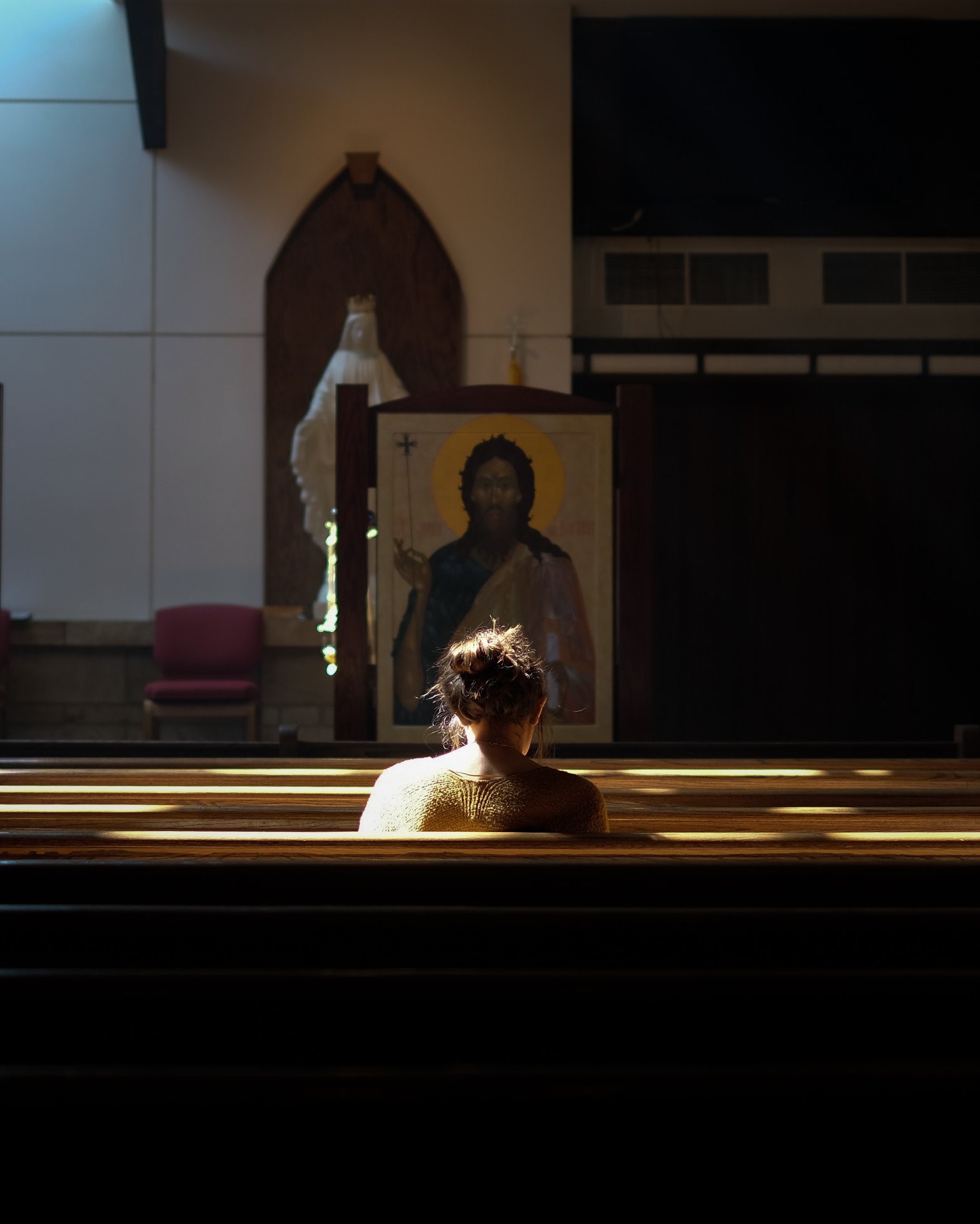
One Love

”By his grace and help therefore let us in spirit stand and gaze, eternally marveling at the supreme, surpassing, singleminded, incalculable love that God, who is goodness, has for us.” — Julian of Norwich
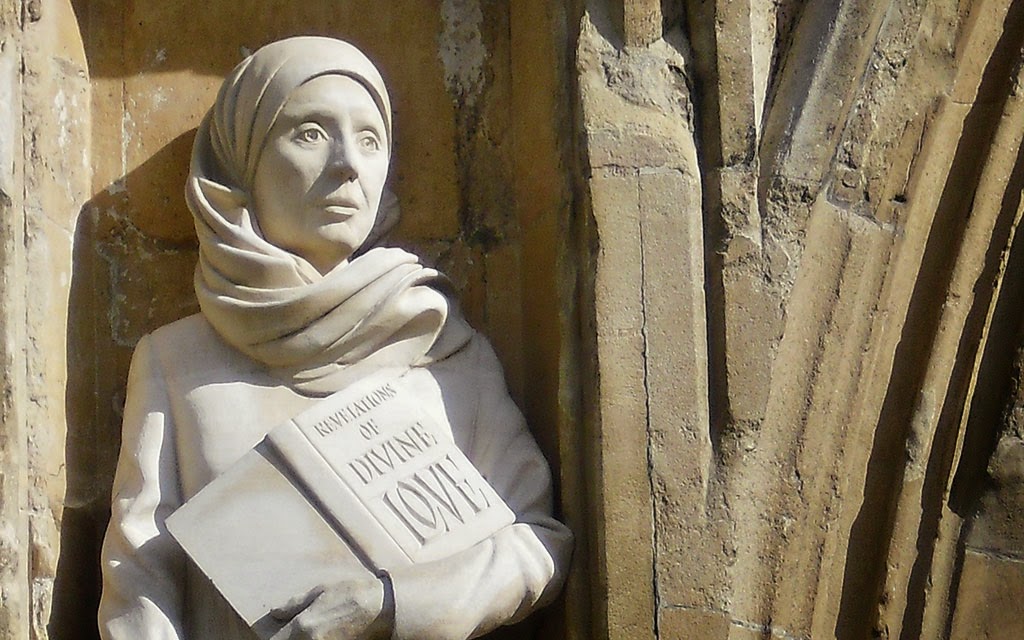
On the eighth of May, in the year of our Lord 1373—the third Sunday after Easter—a thirty year-old woman, known to us as Julian of Norwich, received sixteen “shewings” or revelations, which she later acknowledged were visions from God. Near the beginning of that month she had fallen to an illness, the nature of which was not known. After a week in which her condition worsened and she was thought to be dying, a parish priest was called to administer the last rites. At the conclusion, as he was leaving, he placed a crucifix before her and bid her look upon the face of her Savior for comfort. In the next hours, as she prepared herself for death, the showings were revealed to her in rapid succession.

The first fifteen came to her the morning after the visit of the priest, starting at four a.m. and finishing at nine. The last one, the sixteenth, occurred later that night, concluding and affirming the previous ones. Much to her surprise, and that of her family and friends, she recovered. The meaning of the visions occupied her for the remainder of her long life.

There resulted two written versions of the revelations, the first and shorter version inscribed soon after she recovered, and the longer version some twenty years later, the result of much meditation in the intervening years. Although the later, longer version may naturally contain some embellishment on the original visions, both are considered authentic by the Church. She called herself “an unlettered person,” a deprecatory statement that testifies to her humility, but is refuted by “the sheer integrity of Julian’s reasoning, the precision of her theology, the depth of her insight, and the simplicity with which she expounds profound truths.”1

So little is known of her life that what we learn of her character and background must be gleaned from the writings themselves. Based on allusions and hints in the text, biographers have tried to put together a plausible story that takes into account the context of her times.

In 1332, ten years before her birth, the bubonic plague—the Black Death—originated in India, making its way westward by 1347 to devastate Europe. Geoffrey Chaucer was born in 1340, two years before Julian, the same year that Queen’s College was founded at Oxford. In 1349 the Black Death arrived to kill off a third of the population of England. By 1350 Salisbury Cathedral was completed, and in 1352 Corpus Christi College, Oxford, was founded.

In 1361 the Black Death reappeared in England for the second time, devastating Julian’s home city of Norwich, this time striking down infants and small children. Julian would have been nineteen at the time. Her memories of the first plague during her childhood may have been diffuse but unforgettable. In the second wave she was nineteen, married and probably the mother of at least one child, a child who quite possibly was also one of the victims.

Although she does not mention specific personal losses in her writings, she does reflect on the travail and sadness she experienced. There was a time, she writes, “when I had a great longing and desire of God’s gift to be delivered of this world and of this life. For oft times I beheld the woe that is here and the wellness and blessed being that is there . . . This made me to mourn and earnestly to long—and also my own wretchedness and sloth and weariness—that I did not want to live and to travail as it fell to me to do.”2

Plagues and wars were regarded as God’s punishment in Julian’s time, although human sin was the weakness that brought on the devastation. A single sinner could bring down the wrath of heaven on a community. It is the state of our sufferings here that weighs upon her in her solitude. Like anyone else, the presence of evil and suffering seems to her disproportionate to our culpability.

Her biographers and translators (she wrote an early form of English that can be difficult to read) are quick to affirm that in matters theological she followed the Church’s teachings without question—with two important exceptions. She did not accept that God could be wrathful and she did not believe that humans were wholly evil. Augustine’s doctrine of original sin neither convinced her nor intimidated her. As for the wrath of God, she saw only love in all that God did.

Just as the whole of life is rooted and grounded in love, and just as we cannot even exist were it not for God’s love poured out on us, so Julian infers that it is impossible that God should be angry. “I could see no sort of anger in God, however long I looked,” she recounts. “Indeed, if God were to be angry but for a moment we could not live, endure, or be (Julian 138)!” The dread we feel when we sin is not from fear of God, but from our deep need for God’s forgiveness and grace to overcome our sense of separation. It is the fear of the runaway child who suddenly sees herself alone and longs for home and for her parents.

Various theories and conjectures have been put forward to explain her divergence on these matters. Insubordination does not factor here: she voluntarily submitted to the Church’s authority and teachings. Lack of knowledge? Hardly, since the doctrine of hellfire, purgatory, and eternal torment would have been part of every child’s upbringing in her time. One commentator suggests that despite the trauma of surviving two waves of the Black Death before she was twenty, she was the product of a loving, stable, and happy home. While Norwich was a consequential city, the fourth largest city in England at the time, she had been shielded from its ranker aspects and probably never traveled beyond its immediate countryside. Simply put, she had little continued exposure to the cruelties and vileness of human depravity. In her innocence she saw the beauty and worth of every person.

“There is a godly will in our higher part, which by its basic goodness never wills what is evil, but only what is good. This is the reason why he loves us, and why we can always do what pleases him,” she wrote (Julian 118).

In her work as an anchoress, a person who voluntarily withdraws from the larger world to pray for the world and to counsel others, she no doubt heard their woes, their pains, their grievances against others, and their spitefulness. But she steadfastly held the belief that there was a seed in every person—without exception—that was pure and undefiled and was the germination point for the Holy Spirit in that person’s life.

Yet, the very presence of evil and suffering troubled her. She returned to the subject time and again throughout the revelations. “Good Lord,” she writes, “how can everything be all right when such great hurt has come to your creatures through sin?” In an aside to her readers she confides, “I desired, as far as I dared, to have more information for my own peace of mind (Julian 106).”

The answer came to her in two parts. Of the first, concerning our salvation, there is no mystery. Everything we need to know, everything we are hungering to hear from God about forgiveness, grace, and love, is there for the taking. “In this our Lord intends us to be occupied: delighting in himself, as he delights in us (Julian 106).”

The other part may not satisfy us today, accustomed as we are to perceive mysteries as information we have not yet analyzed, collated, and distributed. “The other part is completely hidden from us,” she writes. “It is our Lord’s own private matter, and it is the royal prerogative of God to be undisturbed in that which is his own business (Julian 107).” If we really wanted to please God, she says, we would want only what is God’s will, and in this case it is God’s will that we should not know this just yet. In later passages she hints that the last great secret that God will reveal to his children will be how he has determined the final judgment.

Sin, Julian says, “has no substance or real existence. It can only be known by the pain it causes (Julian 104).” The pain passes quickly and works on us to purge us and make us self-aware; in that pain we turn to God for mercy. “Because of his tender love for all those who are to be saved our good Lord comforts us at once and sweetly, as if to say, ‘It is true that sin is the cause of all this pain; but it is all going to be all right; it is all going to be all right; everything is going to be all right (Julian 104).’ ”

The refrain that sings throughout the Revelations, from beginning to end, is that all will be well. We might think this to be a passing surge of emotion, but it remains at the core of her being after a lifetime of reflection on her extraordinary personal vision. She lived, as near as can be determined, well into her seventies, loved and admired by those drawn through need and circumstance into her circle, as acquainted with the sorrows and agonies of life as with the abiding assurance of God’s love.

***

Every once in awhile, perhaps when it is most needed, some person is lifted and held in the arms of God long enough that they return with God’s heartbeat pulsing through their veins. This has happened in diverse eras to reassure us that God has not left us orphaned. What catches our breath and quickens our spirits is that some of them return with gifts from that far country (as miraculously close as the light behind their eyes)—gifts of words and images that draw us up to God.

“With regard to the physical sight,” Julian states, “I have related what I have seen as truthfully as I can. For the words I have repeated them exactly as our Lord showed them me. About the spiritual sight I have already said a fair amount, but I can never describe it fully (Julian 191–2).”

What we can say runs behind what we can imagine. What we can imagine we can’t always say. Does our imagination outrun our language? Does our language constrict the limits of our imagination? Julian’s vision of God and of Jesus—she called him ‘Mother Jesus’—and of the Holy Spirit, transcended both her time and her Church.

The being of God is, in our present state, unknowable, but in the Word made flesh—in Jesus—we see all we need to know of God that we can bear. We sometimes turn away from this because we do not trust our experience. Julian herself at first could not believe her spiritual eyes: “On the very day that it happened, when the vision had passed, I—wretch that I am!—denied it, and said quite openly that I had raved (Julian 187).” But the Lord showed it all over again to her, in greater detail this time, and quietly said, “You know that was no raving that you saw today.” Take it, he said to her. Believe it, comfort yourself with it, live in it. “For his will is that we should continue to believe it to the end of our life, and remain in the fullness of this joy thereafter (Julian 188).”

All will be well.

  1. Julian of Norwich. Revelations of Divine Love. Translated into Modern English by Clifton Wolters. New York: Penguin Books, 1966, 29–30.
  2. Frykholm, Amy. Julian of Norwich: A Contemplative Biography. Brewster, MA: Paraclete Press, 2010, 24.

Glory Days

Paul is perhaps the greatest poet of personal religion . . . The first romantic poet in history.”1

Photo: Marius Christiansen, Unsplash

Those who set out to write The Great American Novel after Huckleberry Finn are doomed to failure, although the attempt has produced works worthy of admiration, and inevitably, emulation. Did Twain know he was writing literature that would not only have a shelf-life beyond his own mortality, but would stand as a story that continues to delight and enrage people to the present day? Did the artist known as Homer grasp that his Iliad and Odyssey would become the templates for war novels, road trip movies, and epics of war heroes returning home in disguise? Probably not, although in Dante’s case he was pretty matter of fact that his Divine Commedia was destined for greatness, and within his lifetime it was proven so.

We make our judgments about what is good-better-best when we have more than one thing to compare. We rely on our experience and, probably more than we should, on what experts tell us. We know what we like to read, what moves us and fills our heads with strange and huge ideas.

But when it comes to the Bible, particularly the New Testament, we rarely think of the beauty of the writing. We’re concerned for the authenticity of the voice and the orthodoxy of the theology. The irony is that none of the writers of the New Testament thought of themselves as theologians. They wrote what they saw and imagined and recalled within their communities as they were moved by the Spirit of God. That any of their narratives came together in the first place, particularly the Gospels, seems like something of a miracle in itself.

When we realize that post-resurrection believers of the Way, who lived and worked and worshipped together weekly, exchanging stories of ‘the Christ,” did so without any of the written texts that we know as the Gospels—did so for some forty years, an entire generation—it should give us pause as we dust off that paperback version of the New Testament which can be had for the price of a latte.

Editions of the Bible, niche-marketed more heavily than any other book in the world, may strike us as opportunistic (a “Souldiers Bible,” a Protestant version, was carried by Oliver Cromwell’s troops), the goal of Bible publishers being to spread the Word by any means necessary. Annual sales of the Bible top $425 million, with over 80,000 versions loose in the world today (Brandon Gaille.com). Zondervan alone has over 350 versions of the Bible in print, and in any given year over 20 million Bibles are sold in the United States. The average Christian owns at least nine versions of the Bible, nevertheless twelve percent of American Christians think that Noah was married to Joan of Arc.2

Thus, we idealize the Biblical authors in such ways that we don’t see them having a life apart from their writings. Amos is “among the shepherds of Tekoa” when he is gripped by God to prophesy. We don’t know how he felt about this disruption to his life. Given that the message he carried was of woe and darkness, it couldn’t have given him much comfort or ease among those with ears to hear. Was he a shepherd himself? We assume so, but we don’t know. Did he go back to sheepherding after his prophecies thundered out?

Maybe they came in spurts as he meditated on the hills with his flocks. Maybe he carried them in his head until such time as he could write them down—and how remarkable that he was literate. Did he exult at the excoriations of Israel’s neighbors and tremble at the judgements on Judah and Israel for their triple transgressions? When he was bashing the rich and indolent women of Bashan for their vanity and cruelty, did he imagine that thousands of years later we would read of them dragged out through their breached city walls by fishhooks through their noses and cheeks?

Isaiah—and then Second Isaiah and probably a Third Isaiah—are years apart as authors, their writings spliced by anonymous editors into some of the most beautiful, heartbreaking, jaw-dropping poems of grief, exultation, and glory in the Western canon. As Robert Alter notes in his magnum opus, the translation of The Hebrew Bible, “It is above all the vehicle of poetry in all these prophets that demands close attention . . . and it is perfectly fitting that God should address Israel not in prose, which is closer to the language of everyday human intercourse, but in the elevated and impressive diction of poetry.”3 Were they writing for the ages or for their own time?

We want to know their motivation for writing, the methods they used, whether the writing itself was a burden or a joy or something they saw as a holy duty. In contrast to the best-selling authors of our time, they functioned as conduits instead of celebrities in their own right. We infer their temperament and purpose from the broad strokes of their writings.

The author of Mark writes a hasty, breathless, and down-home form of Greek. It is a compressed narrative that Matthew and Luke expand, revise, and extend. Matthew’s constant citing of Hebrew prophecies and laws reveals Jesus as the fulfillment of centuries-old hopes. Luke begins his gospel with a personal salutation, but then drops into the background and stays there, even through his sequel in Acts, appearing obliquely as the companion of Paul. John offers some tantalizing hints about himself as “the disciple Jesus loved” and “this is the disciple who is testifying,” and then finally, in the last verse, emerges onto the stage himself to say, “I suppose that the world itself could not contain the books that would be written” about his best friend.

But it is in Paul’s letters—all of them written in a fairly short span between the middle fifties and sixties before his execution, probably in CE 64—that we get a sense of a Biblical author in some detail. He can be, and probably was, an infuriating person. He certainly provoked enough animosity to be beaten, threatened by mobs, chased out of towns, and forced to flee for his life more than once.

That he was an extraordinary person is beyond question. Fluent in several languages, he was fueled from a passionate core that took him from being one zealous for God to the point of having a license to hunt down the people of the Way, to one equally zealous in the service of the risen Christ. The man who could roundly curse his opponents in Galatia by calling them “dogs” could also write a panegyric on love in First Corinthians 13 that has never been equalled.

There is no disputing that what we know as Christianity owes its existence in large measure to this indefatigable little man, small enough to be lowered in a basket over a city wall, who traveled thousands of miles, usually on foot, for some thirty years, establishing small communities of believers in cities throughout Asia Minor.

He remained a faithful Jew all his life, but one who had his spiritual and intellectual axis violently recalibrated by a vision of the risen Christ. For him, this crucified Jesus had breached the defenses of the principalities and powers of this dark world, and had brought heaven and earth together. God, through Jesus, had bridged the abyss between divine and human, reconciling the world to himself, and it was Paul’s honor to carry that message and to suffer with Christ.

There are few people like Paul. He was relentless in his purpose, unwearying in his efforts to build communities of people who would cease to live for themselves and instead be the hands of God in the world. Confident to a fault, he could yet call himself “chief among sinners,” and in his lowest moments wonder if he had wasted his life for no purpose.

In his second letter to the Corinthians he confides that “we were so utterly, unbearably crushed that we despaired of life itself (2 Cor. 1:8).” While God had rescued him from that peril, in the letter to the Philippians written from prison in Ephesus, he writes a poem about Jesus that could only have come from a man who had had time to explore doubt, fear, and the sure prospect of a violent death. “Let the same mind be in you that was in Christ Jesus,” he pleads, tracing the self-emptying of Christ who “became obedient to the point of death—even death on a cross (Philippians 2:5,8).”

Paul encourages his friends—and we may count ourselves in that select group—to “work out your salvation with fear and trembling, for it is God who is at work in you, enabling you both to will and to work for his good pleasure (Philippians 2:12,13).”

He never loses hope, not that he will escape suffering and eventual death, but that he will soon see Christ Jesus face to face and he will “know as he is known.”

This complex, irascible, brilliant man, who can thread the needle of the closest arguments, and yet pour out his heart unreservedly to whoever is drawn into his orbit, probably had personal contact with fewer than a thousand people in his lifetime who would, in time, be referred to as “Christians.” In the letters he wrote, letters that both dealt with the common frictions of diverse people living together and yet revealed the most glorious secrets of the living God, we find the preparation for the Gospels themselves, and the most compelling example of other people’s mail changing the world.

  1. A. N. Wilson, Paul: The Mind of the Apostle, 220, 221.
  2. Brandongaille.com
  3. Alter, Robert. The Hebrew Bible: Prophets, 618.

Into the Night

Photo: Vincent Chin, Unsplash

”Above all, maintain constant love for one another, for love covers a multitude of sins. 1 Peter 4:8, NRSV

”You can take, if you will, your solace in heaven, but you must work out your ethics on earth.” Susan Neiman, Moral Clarity

In the events leading up to the crucifixion of Jesus, we have one of the greatest dramas in human history. Jesus’ entry into Jerusalem was hailed by hundreds, maybe thousands, as the decisive moment of triumph for their nationalistic hopes. There was Jesus’ show of righteous anger, as he drove out the money merchants from the temple to return it to the people as a house of prayer. The events of the last supper, the washing of the disciples feet, and the sorrowful walk to Gethsemane; Jesus’ hours-long prayer for comfort, relief, courage, and faithfulness, interrupted by the mob intent on capture—these are indelible impressions for our imaginations.

But the political and religious authorities who jockey for power during the hours before the crucifixion do so through the selling out of Jesus by Judas. It is a scene of almost unbearable pathos, as Judas steps brightly forward with a forced smile of bonhomie and kisses Jesus. The mob is tensed, as if facing an imminent threat. Jesus is calm, almost bemused by the scene. I was in the temple every day, he says, and you could have taken me then. So now you come, with weapons and torches at night?

Peter and Judas both betrayed Jesus. Both stories are there for us, because we’ve all been Peter betraying Jesus, and given other circumstances, we might have been Judas if it comes to that. What is the difference between Peter and Judas? Both of them betrayed Jesus. Both of them repented with tears and anguish. Only one of them survived. The gospels spend more time on Peter’s betrayal than on Judas’. Their mention of Judas is tight-lipped, with breath indrawn.

How might we think about Judas if we put aside our feelings? We would see him with Jesus for three years, working alongside the others, going out with them on their first missionary journey, returning to hear Jesus, exultant, say that he had witnessed Lucifer fall like a meteor from heaven. He had seen Jesus feed five thousand people, had been there for countless exorcisms and healings, he had heard all the parables and stories, taken in Jesus’ urgings and warnings, shared his weariness and his hunger on the road, and enjoyed the company of Jesus’ friends and patrons. Like the others, he had given up a lot to follow Jesus. In short, he had lived a parallel life with Jesus that converged at many points.

In a person for whom one’s capacity for evil has not been faced and acknowledged—the shadow side of the personality—a rejection by one’s parent as a child erupts in the adult as shame, guilt, and fear whenever that person comes into communion with another who accepts and loves him. Robert Stein, a Jungian psychologist, suggests that infantile aspects we usually grow out of because they could harm others, things like greed, brutality, and aggression, continue to contaminate the soul of such an individual as an adult. Such people provoke rejection by others while insisting on fully expressing their shadows. They want to be loved in spite of the inevitable punishment they experience. Only then will they feel they’ve experienced acceptance and love. Jesus’ refusal to retaliate must have shaken Judas to the core.

It’s worth considering the betrayal of Jesus by Judas. For one thing, it is so much a part of the tableau leading to the crucifixion that we think of it as a necessary step to our salvation. Nobody wants to be cursed for all history, but Judas makes his decision to accelerate the fate of Jesus, and then is swept backward by the rush of events. In a matter of hours, he becomes the eternal asterisk to the trial of Jesus. Once he has served the ends of the authorities, he is of no further use to them. His dramatic throwing down of the blood money he’d received is regarded with sneers. Judas becomes the poster man of snitches and traitors, despised by those to whom he offered his services, hated by those he turned on, cursed by all—except Jesus.

Perhaps the most tragic aspect is that Judas’ actions might have been unnecessary in the course of events. The temple police knew who Jesus was, and they had to know he spent most nights he was in Jerusalem at the Gethsemane Garden. They would have found him, even without Judas. Their designs to capture Jesus at night were merely tactical: they wished to avoid a popular uprising if they apprehended him in the temple. Judas’ offer was convenient, and thirty pieces of silver was a small price to pay if they could claim that his own disciple delivered him up, turned him over as a threat and a public menace.

Some biblical commentators have conjectured that Jesus’ band included at least one member of the Zealot party—Simon—and that Judas himself might have held zealot sympathies. Judas’ own agenda may have included forcing Jesus’ hand to declare the revolution and get on with his messianic mission. In that case, Judas could have rationalized that he was only providing the opportunity for Jesus to assert himself. When the police closed in and led Jesus away, Judas must have been both bewildered and stricken.

***

Judas turned Jesus in, Peter turned him away. What Judas did could only happen once. What Peter did happens every day. Judas repented in horror and bitter tears, but he could not bring himself to believe that forgiveness could ever be his. The only relief from the suffocating blackness of guilt was suicide. Peter repented, too, in horror and bitter tears. Like Judas, he rushed out into the night to weep his heart out under the stars.

What saved Peter, but could not save Judas, was Peter’s utter guilelessness. He was not capable of subterfuge or even strategizing for gain, either his own or for the ultimate vindication of Jesus as Messiah. He wore his heart upon his sleeve for all the world to see, including Jesus. When he repented, he went all in. Just hours before his betrayal Peter had balked at Jesus kneeling to wash his feet. This is not what the Messiah should be doing. If I don’t, said Jesus, we are not in fellowship. “Then, Lord,” cried Peter, “not my feet only; wash my hands and head as well!”

Jesus had built his church upon a rock whose best qualification for the position was finally his unreserved humility.

Yet, Peter was also the walking definition of enthusiasm, the Greek derivation of which means to be caught up ‘in God.’ Only the truly humble are capable of such enthusiasm because on some level they have willed the removal of any obstacle to the Spirit. For the rest of us, this will be our deepest aspiration, the intention of which is just the beginning of our resurrected life.

***

I have a friend who worked his way through seminary by working for and living in a mortuary. He helped officiate at the funerals and his wife did the hair and makeup of the deceased. Their little boy, four years old, often accompanied his father out to the cemetery. One day, looking at the mounded earth of a grave, Jake wondered aloud, “Dad, when Satan dies, will God put flowers on his grave?”

At the end of all wars, even the one that has defined the history of this Earth and its solar system, we can imagine just such a moment when the Lord of all mourns the tragic trajectory of Lucifer, the bright morning star, for whom humility, forgiveness, and love was a bitterness that pride could not bear.

Not For This Life Only

Photo: Eberhard Grossgasteiger, Unsplash

If for this life only we have hoped in Christ, we are of all people most to be pitied. — I Corinthians 15:19, NRSV

Pity is only as good as our capacity to rise above it. It’s a natural response for most of us to the suffering of others, and it can open the door to something longer lasting, say empathy or understanding. But by itself, pity doesn’t lift or restore us. It usually drops us in our own estimation.

We want hope now, in this life. We need it. The paradox here is that our hopes for the future churn up our present and make us restless for a present that opens up the future. Most of us do not live in the present, despite the wisdom of the ages and the sages among us. We live with one foot in the past and we lean into the future, while the present is what happens to us as we stretch between the two. Somehow, we make it work.

We’re not even sure what the dimensions of the present are. It depends on the context. If we’re talking about the present in the historical flow of things, it could be this year and maybe part of last year, although so much seems to happen now in weeks and days that last year seems like an eternity gone.

Our own present flexes and stretches like an accordion. My present is that which is of interest and concern to me right now. The length and depth of the love I have within my family and friends, the books I’m reading, the words I am writing, the events I am reacting to. How I respond to Christ in this moment, how honest I am with myself or how I dodge the things that unnerve me.

We hear enough about living in the present from wise people in all ages and from all faiths in the world that we should pay more attention. Jesus asks us not to worry about the future because it has enough worries of its own. Paul suggests that we hold the past in memory and press on to the present. Both of them believe that God meets us in the present and promises us a future. God can’t change our past, but he can help us to live with it.

But Paul is writing to the Corinthians, people whose community together is shot full of incest, drunkenness, and fighting. They are learning as they go, trying to rely on each other and on this mysterious Spirit, not at all sure they can leave behind what defined them in their past. Maybe that makes it harder to live right in the present, seeing as how some lines of habit are burned into their relations with each other.

But there’s something else. The Christ that Paul has introduced the Corinthians to had been murdered by the Romans in a manner specifically designed to humiliate and terrify him and anyone who might have claimed to be his friend. State criminals like that were crucified and their bodies were thrown out on the ash heap, to be torn by dogs and left to the birds. This is not a person you want to claim as your god.

If the Corinthians only have hope in this life, Paul claims, they are most to be pitied, for the implication is that their god has played them for fools. Even pagan gods were immortal. And anyway, they wouldn’t be caught dead on a cross at the hands of inferior beings like us. More likely, they would rain down fire and plague until we cried out speechlessly.

The theme that Paul riffed on, the extended guitar solo, if you like, soaring on the music of the oral traditions of Jesus in his time, was the battle that Christ had waged with the angels and principalities and powers of the universe. That battle had been won when Jesus died; the worst they could do to him turned out to be the burning fuse that eventually blew their powers to kingdom come. Along the way, these powers found common cause with those who were so anxious to perfect the path to God that they crushed the spirit of those who sought to find their way.

“When the ‘religion of fear’ finds its way into the Christian church,” said Jurgen Moltmann in The Crucified God, “those who regard themselves as the most vigilant guardians of the faith do violence to faith and smother it.”

The violent bear it away, a la Flannery O’Connor.

“This pusillanimous faith,” continues Moltmann, “usually occurs in the form of an orthodoxy which feels threatened and is therefore more rigid than ever. It occurs wherever, in the face of the immorality of the present age, the gospel of creative love for the abandoned is replaced by the law of what is supposed to be Christian morality, and by penal law.”

The Corinthian Christians, along with all their bumbling relationships, were having a loss of confidence. Their neighbors and former confidants were trying to understand how anyone could fall for such a loser god. Because that man, Jesus, was crucified and he died, just as every Jew the Romans crucified died. The Romans scored 100 percent on the efficiency scale for all that. So if these Christians had put their trust in that man, they deserved to be pitied (when they weren’t being mocked) because a dead god was even less useful than a dead goat. Nobody could beat the Romans for mopping up all resistance and wiping out the political opposition.

They were efficient, but not effective: One man got through to the other side.

Oh, he died alright. But in some way that can’t fully be explained, after crucifixion and a hasty burial in a sealed tomb, he showed up in Galilee on the beach, he entered a locked room in Jerusalem filled with terrified disciples, and he hiked the seven miles to Emmaus with two of his friends and then vanished over dinner. Peter saw him, the twelve saw him, as did five hundred of his friends in Jerusalem, along with James, his brother, and his closest circle in Jerusalem. Lastly, in a weird kind of premature birth, he appeared to Paul who made that singular experience the balance point of his spiritual gyroscope for the rest of his life.

Paul’s message, the engine that kept him going over mountains, across seas, through the fires, in spite of whippings and chains, is that Christ, the one into whom all the fullness of God had been poured, the one who suffered a most humiliating death—that one had been raised from death to start human history up again with a new beginning.

As Clarence Jordan once said: “The crowning evidence that Jesus was alive was not a vacant grave but a spirit-filled fellowship. Not a rolled-away stone, but a carried-away church.”

Buddhism says if you are shot with an arrow, don’t get in a debate about the type of arrow, the composition of the arrow-head, and the trajectory that embedded it in you. Pull out the arrow.

We could argue for eternity how the resurrection could have happened, but without resolution. Because it isn’t verifiable by our usual standards of empirical measurement. It isn’t even comprehensible in a way that can be said without stuttering. What matters is the result of the message of the resurrection—a faith-filled community that infiltrated the world and stayed true, even unto death. That is power. The glory is still to come.

Cross Purposes

Photo: Josh Applegate, Unsplash

Salvation is a child and when it grows up it is crucified. Only he who can see power under weakness, the whole under the fragment, victory under defeat, glory under suffering, innocence under guilt, sanctity under sin, life under death can say: Mine eyes have seen thy salvation.—Paul Tillich, The New Being

When I was a child, I discovered that when I crossed my eyes I could see the world in very different ways. Instantly, my left eye invaded the territory of the right eye and the result was a disorienting Escher-like amalgam of images, as if Spock and Kirk had gotten their body parts reversed going through the transporter device. It was an ersatz Picasso-lens for budding cubists. Ignoring the taunts of older children that one day my eyes would stay crossed, I enjoyed these brief forays into alternate reality.

Standing on my head was another way to re-imagine the world. Although I couldn’t sustain the full, upright position for long, I could live for a few moments in a world with a limitless blue airiness underfoot beneath a ceiling of trees, streets, and buildings.

It’s good for us to see the world from odd angles from time to time. It reminds us that ours is just one of many viewpoints. And it gives us insight into primitive Christianity, which abounds with paradoxes and upside-down values.

Christianity often seems to be at cross purposes with standard operating procedures. In the Genesis story, creation is the high point, but after sin, everything is downhill from there, whereas with evolution everything begins with the humble one-celled organism and climbs to the top of the food chain, which is us. In the darkest, coldest month of the year, Christianity says the light came into the world. In the spring, when everything in nature is waking up and blooming, Christians celebrate a death.

“I am come that they might have life, and that more abundantly,” claims Jesus, but then he also proclaims the poor to be blessed. The Beatitudes are all about opposites. Blessed are those who mourn, for they shall be comforted. Blessed are those of a gentle spirit; the world shall be theirs. Everywhere you look in the Gospels there are these cross-eyed, head-stand ways.

Don’t kill each other, says Jesus, but in the next breath he pushes it way back behind actions to intentions. Don’t nurse anger toward others, because anger nursed can then be weaned to murder. Without denying the front-facing commandment, Jesus goes back to the root of the outward action.

It’s easy for us to love those who love us—or at least to avoid conflict with most people. But what about those who get in our face? Jesus tells us to love our enemies and to pray for those who hate us. This is how God sees us as children of his family. After all, Jesus reminds us, God makes the sun to shine upon the good and the bad alike and sends rain for both the liars and the honest. You’re all in the family, he says. Do you think I’ll treat you unequally?

It takes a while to get used to this radical way of thinking. Actually, we don’t get used to it. It doesn’t become habitual and it certainly isn’t instinctual; it is something that must be re-learned and practiced daily. It’s as if our brains were developed to float in our skulls just so, vertically aligned in such a way that stimuli reaching us from the external world hit their receptors precisely, with no tolerance for wavering or misalignment. The world shot in portrait mode only, the landscape view constrained to fit only through distortion and elongation. Only when we stand on our heads does any of it begin to make sense.

Why does so much of what Jesus says sound so alien? Lest we think that 2,000 years and a clash of cultures has created this great divide, we can take some rueful comfort in that his mother and his brothers thought him a stark lunatic and his own disciples could not grasp his simplest commands. “Who is the greatest in the kingdom of Heaven,” they ask. He calls over a child, sets him down in the midst of them and responds, “Unless you turn round and become like children, you will never enter the kingdom of Heaven (Matthew 18:3).” The meaning is unequivocal: what part of “never” don’t we understand?

Yet, when one door slams, another opens. “Let a man humble himself till he is like this child, and he will be the greatest in the kingdom of Heaven.” In this new economy of virtues only the humble survive. In one stroke, Jesus flattens the social hierarchy based on status and power and spreads it horizontally. If we want to see this kingdom as it is, we shall have to look in landscape mode, turning and turning in the widening gyre 360 degrees, until we return to this little child.

Paradoxes and reversals abound. Paul is shipwrecked, beaten, imprisoned, and starved. He has to light out of town more than once under cover of darkness, and who could calculate the miles he put in walking, sailing, riding for the gospel of the kingdom. Yet all these things he counts as nothing, save for the cross of Christ and the glory to come. “Our eyes are fixed,” says Paul, “not on the things that are seen, but on the things that are unseen.” We can imagine him, stripped for thirty-nine lashes, with a gaze that penetrates to heaven.

What do we see? What are we looking at? Even after the hundreds of miles he walks and the beatings he endures, there is a certain bounce in Paul’s stride. “Therefore, we never cease to be confident,” he writes. “Faith is our guide, we do not see him.” He looks at the world with eyes wide open, seeing himself as he is, but more importantly, how God sees him. Living as an exile in this world, Paul knows that those who play by the rules of the world may succeed in the ways of the world—although they will lose their lives—but those who take up their cross and follow Jesus will gain their lives. In the midst of death there is life.

“Sin is our refusal to become who we truly are,” writes Michael Mayne in Pray, Love, Remember. When we confess our sins we may think of all the moments we tripped up in our daily walk, all the unthinking ways we brushed others aside, the petty grievances we took into foster care, the blindness to our effect on others that caused them pain. But Mayne is looking deeper than just sins. “Chiefly I am aware of a much more subtle temptation,” he writes, “to settle for less than I might be. To choose the lesser good. To lack curiosity and wonder. To miss the mark because my sights are fixed too low. Not to perceive that I am ‘fearfully and wonderfully made’ in God’s image.”

At all times, but especially at Lent, if we ask it of God, we are blessed to see ourselves as we are and what we may become. Seeing thus is to see the world turned upside down, and yet to walk confidently.

It may all seem to be at cross purposes with how the world works. Yet, in the end, all our purposes begin with the cross, the cross that brings life, the death of Death, and most wonderfully, resurrection.

The Eyes of Your Heart

2SunFace:shalom-mwenesi-784837-unsplash

“. . . so that, with the eyes of your heart enlightened, you may know what is the hope to which he has called you, what are the riches of his glorious inheritance among the saints, and what is the immeasurable greatness of his power for us who believe, according to the working of his great power.” — Ephesians 1:18,19

Once we understand there are many ways to enlighten our hearts, the horizon of possibilities before us widens. This is especially true when we seek beauty and truth — distinguishable and thus equally indispensable. When we find these sources, whether they be bathed in the center of God’s glory or reflecting God’s light from their centrifugal swings around the Son, they open to us new channels for perception.

Poetry penetrates deep to the heart, but indirectly. If you’re willing to look you can find the poets who somehow hear the music that beats in your bloodstream and when you read them, you understand yourself in ways you couldn’t have arrived at on your own. “When you encounter this splash of words,” writes priest and poet Mark Oakley, “you understand that ultimately poetry is not about factual information but human formation. Like water, language goes stagnant if it doesn’t move.”

When I first read Rainer Maria Rilke, this poet of the great silences, the man who was christened with a girl’s name for the sister who was lost, it was as if he had read my heart’s way and was speaking my longings in words that were almost holy. When I began with his Sonnets to Orpheus, I could only manage a page or two and then I’d have to put it aside and do something else for awhile, something that didn’t lay me open to the bone. If we can bear it, this is an opening to wonder and mystery.

Or maybe it’s music — Faure’s Requiem, or Bach’s St. Matthew’s Passion, or U2’s I Still Haven’t Found What I’m Looking For or the tears that flow from Eric Clapton’s guitar through While My Guitar Gently Weeps during the “Concert for George.” That’s what Carlos Santana calls “Holy Ghost music,” something that happens between musicians and audience that goes beyond artistry and technique to a communion of fire and spirit.

These moments, these strands of bright beauty, are all around us, and if we choose, we can weave them together in our memories for a coat of many colors to wear on our dull and darker days. Their beauty, though ephemeral, is real in the moment: we can see them and feel them as they pass through us. But their greater power is that they remind us of something we’ve known and lost or once had but did not fully appreciate. They are signs of the ineffable, signals received from a source whose coordinates seem strangely familiar. As such, they give us practice in the exercise of faith.

***

“It is within man’s power to seek Him,” writes Rabbi Abraham Heschel in God in Search of Man, “it is not within his power to find Him. All Abraham had was wonder, and all he could achieve on his own was readiness to perceive. The answer was disclosed to him; it was not found by him.”

Heschel turns to Maimonides, who did not offer proof for the existence of God but said that the source of our knowledge of God is the ‘inner heart,’ the medieval name for intuition. We don’t apprehend God through a syllogism, but through an insight, a spiritual discernment.

It’s not that reason can’t play a role in spiritual things; reasoning often brings us into the neighborhood of faith and removes barriers to our willingness to listen. It provides a way to organize our categories: faith, evidence, rationality, miracles, finitude and infinity, eternity and time-boundedness, perfection and inexactitude, the sacred and the mundane. It helps us bracket our prejudices and recognize our standpoint. And it can reveal our inconsistencies and lapses in judgement. This is the stuff of the philosophy of religion, all of it intriguing, fascinating, compelling. But it can also keep God at a distance, an object to be argued about, not a Being who enthralls us. For that, we need the eyes of the heart. “Faith terminates not in a statement, not in a formula of words, but in God,” writes Thomas Merton in New Seeds of Contemplation.

Heschel continues: “But the initiative, we believe, is with man. The great insight is not given unless we are ready to receive.” Faith commences, God completes.

So here now is Paul, writing to his friends in Ephesus, rejoicing with them that their sins are forgiven, that God has chosen them to be filled with love, and that when the right time arrives the whole universe — heaven touching earth — will be brought into joyful harmony in Christ. That time is now, Paul insists. The “eyes of your heart” will perceive it through faith.

Here is the audaciousness which characterizes the apostolic community and which still — perhaps even more now — takes our breath away. In the midst of wearying journeys, dissensions and disputes, divisions which cut to the heart of who Paul and his friends thought they were because of Christ, he gathers up the threads of their faith in action and promises that this is indeed the first light of the new day of God’s kingdom.

Two millennia later this promise almost seems like mockery. Far from being a community without divisions, the Church seems to model the political world with all its coercion, bad faith, and posturing. We see the same underhandedness and false hope in the Church that plays out in a daily live-stream from any number of our politicians and corporate leaders. The Church as a body sometimes does not even reach the standard of respect and equality for people that our society continues to struggle toward. We Christians have a lot to answer for. Are we wandering in the wilderness?

Paul’s message to Jew and Gentile was that God was in Christ reconciling the world to Himself. What had been promised for centuries, though covenants made were broken and straight places fell into crookedness, had now in the fullness of time come to pass. Quite beyond any power they might have exercised to move the cosmic forces into alignment, the promise was made good in spite of their weakness. Nothing they did could bring it into being nor could they prevent what God had planned from the foundation of the world. It was a gift open to all who could see it, a world reborn.

Paul has heard of the faith of these Ephesians and their “love toward all the saints,” and he prays that God may give them “a spirit of wisdom and revelation.” To his friends at Ephesus — and to us — he says, “you are no longer strangers and aliens, but you are citizens . . . of the household of God (Ephesians 2:19).”

To Paul, every little community of believers that formed was the household of God, a wavering light that would bloom brighter as their faith was seen in action.

The question was whether they could see this potential for themselves if the bonds of friendship and community they had begun could strengthen and flourish. Could they perceive God in the whirl and flux of this world? The eyes of their hearts would see the hope to which God had called them, the richness of belonging to this great cloud of witnesses, and the greatness of God’s power to sustain them.

Faith commences, God completes. Believing is seeing.

Photo: Shalom Mwenesi, Unsplash.com

Planks and Sawdust

1GreenEyes:alexandru-zdrobau-84424-unsplash

“He answered me:

‘Like someone with faulty vision, we can behold

Remote things well, for so much light does He

Who rules supreme still grant us; but we are foiled

When things draw near us, and our intelligence

Is useless when they are present.’” Dante, Inferno, Canto X:100-105

In Dante’s Inferno the damned in the sixth circle of hell are allowed to see far into the future, but in a remarkable detail in God’s plan they know nothing of the present nor can they see what is happening right in front of them. In life, consumed by ambition and the grasp for power, they ignored those closest to them, while they schemed and strategized against their enemies. In the chess game that was 13th-century Florentine politics, these men planned out their deadly moves against their opponents, while they could not see clearly how their actions affected their own families. In Dante’s Hell, the sinners are cursed to suffer the symbolic effects of the sins they committed in life. Because they did not see on Earth they will not see in Hell.

***

Luke 6 is about the relationship between our intentions, our character, and our actions, and how those actions reverberate throughout the circles of our relationships. In contrast to Matthew’s sermon given from the mountain, Luke’s version has Jesus coming down from the hills at daybreak and choosing twelve out of the crowd of disciples, (in Greek mathetas, ‘those who follow’) and designating them apostles. Then he stands at the foot of the hill, “on level ground,” and addresses the hundreds who have come from Jerusalem, and from as far away as Tyre and Sidon, to hear him and to be healed.

It’s a message that exactly reverses what we might expect. We’ve skimmed it so many times that we no longer see how radical it is, how the good news it proclaims is bad news for some, how confounding it must have been for those who thought Jesus was launching his Messiahship.

He begins with the punchline, the message that was most pointed, that like an arrow pointed to the largest group listening to him that day: “How blest are you who are poor; the kingdom of God is yours.” The words that follow are paradoxical: those who weep now will laugh, those who are hated will dance for joy. Then, with a hinge that shows Luke’s literary skill, the reversals are stated. The rich have had their fun; now they face hardship. The well-fed will be hungry, those who laugh will be weeping.

The clincher is that those who mourn now stand in a long line of people who have suffered unjustly, including the true prophets of old, and those who garner all the praise now should know that people spoke well of the false prophets back in the day too.

Jesus then turns to such politically incorrect sayings as “Love your enemies; do good to those who hate you” and “turn the other cheek” and “treat others as you would like them to treat you.” His disciples must go beyond the reciprocal manners of doing good to those who do good to them; that is just standard social courtesy. What the kingdom expects has a much deeper meaning, one that transforms relationships and begins with self-awareness and humility.

Jesus’ social communication skills reveal a person who challenges us to exceed the minimum in social interaction. “Pass no judgement and you will not be judged,” he says, “do not condemn and you will not be condemned.” That’s the minimum. Just as “sinners” (those who flout the finer points of the law or whose professions place them outside the community) love those who love them most people know they’ll get back what they dish out to others. There is a common ethic that most people subscribe to, an enlightened self-interest that expects some give-and-take and is willing to give some leeway to others until pushed to defend oneself. In that way, we can claim to be as good as we are expected to be.

But to be disciples, those who follow Jesus, there is a higher standard that comes from love. Duty does the minimum, but love attempts the maximum. Duty follows the rules, but love seizes opportunities. Duty does what is required and no more, but love acts spontaneously. Duty wants a receipt; love says, “Don’t worry about it.” The “sons (and daughters) of the Most High” will be compassionate toward the ungrateful and the wicked, just as God is compassionate.

He offers them a parable about the blind leading the blind and both falling into a ditch, and then he follows up with a parable that speaks of the kind of self-awareness and humility that is foundational for discipleship.

“Why do you look at the speck of sawdust in your brother’s eye, with never a thought for the great plank in your own? How can you say to your brother, ‘My dear brother, let me take the speck out of your eye’ when you are blind to the plank in your own? You hypocrite! First, take the plank out of your own eye, and then you will see clearly to take the speck out of your brother’s.” (Luke 6: 41,42)

As metaphors go this is vintage Jesus—heavy on the hyperbole, richly vivid in imagery, delivered with a twinkle in his eye. But he is serious. The disciples learned that no matter where they stood in the social register, they were to be leaders in ethics. They are followers of Jesus now; they will be teachers of others, and a teacher cannot teach what he has not learned. Character makes influence a live possibility, and influence, in turn, helps shape character. We’re known by what we produce, by what people around us can see of us in our behavior. “By their fruits, you shall know them” is not just a Biblical saying, it’s how we navigate our relationships and place our trust in others. As such, it’s the foundation of a society. Out of the abundance of character the fruit of the heart is grown.

Are disciples to be silent about evil and injustice then? “The ban on speck-hunting,” notes G. B. Caird wryly in his commentary, Saint Luke, “does not, of course, mean that Christians must condone evil or refrain from forming moral judgements. This is a parable about personal relationships.”

***

Most college and university teachers I know have at times suffered from “imposter syndrome,” that dread feeling that students will see right through you to the vast, empty, and echoing interior of your knowledge warehouse. If you teach ethics, as I did for many years, you feel the pressure even more. I wondered, at times, how I had the nerve to stand up in front of students who demanded at the very least that I always knew what I was talking about, and who expected, in varying degrees of interest, that I flawlessly practiced what I preached. But there is some comfort in the very realization of how much we lack; if we can see our condition we can, at least, do something about it.

In order to follow Jesus, we need to see where we’re going. It also helps to be aware of how much we don’t yet know nor do. Planks in the eye get in the way of that. What I have noticed is that if you pray for help to remove your plank God may send you someone with clearer vision than your own, someone with a speck of sawdust in her eye. Plank removal may begin when you see that person’s speck and then realize your own condition. This ordinance of humility can have the effect of deepening our self-reflection as we learn through observation. For all of us have something in our eyes that clouds our vision.

“If we are humble,” writes Thomas Merton, “and if we believe in the Providence of God, we will see that our mistakes are not merely a necessary evil . . . they enter into the very structure of our existence. It is by making mistakes that we gain experience, not only for ourselves but for others.”

Jesus once restored the sight of a blind man by putting saliva on his eyes and then touching him. “Can you see anything?” he asked. “I see people,” said the fellow, “but they look like trees, walking.” Jesus touched his eyes again, and the man looked intently, and this time he saw everything clearly. Some commentators note that Matthew and Luke did not use this story from Mark, perhaps because they were embarrassed that it took Jesus two tries to heal the man. But I think the story is meant for all of us for whom seeing clearly does not happen all at once.

Photo: Alexandru Zdrobau

Three Degrees of Success

3LightningCrops:jonathan-bowers-531776-unsplash

If the audience easily recognizes the three degrees of failure (birds, rocks, thorns), how would it interpret those three degrees of success (thirty, sixty, hundredfold)—even in the literal microcosm of sowing? Jesus’s parable seems quite ready to expect and accept degrees of failure and of success. — John Dominic Crossan, The Power of Parable

“Listen!” Jesus is saying, “a sower went out to sow.” The people on the shore listening smile and nudge one another. The Master is on a roll, telling his stories. There are so many people gathered that he’s in a boat a few feet offshore, speaking to the crowds by the lake in the late afternoon sun.

He speaks in parables, short stories whose meaning lies outside the literal elements of the story and points toward a moral or theological purpose, what New Testament scholar John Dominic Crossan defines as “a story that never happened but always does—or at least should.”

The Parable of the Sower in Mark’s gospel (Mark 4:1-20) assures us of God’s pleasure at any degree of return on crops planted. In Mark’s version of the parable, Jesus tells of the loss of seeds to the birds, to rocky soil, and to thorns that choke their growth. But for the seeds that land in good soil and survive there is an eventual harvest. Some patches have a return of thirty percent, some up to sixty percent, and others — perhaps optimistically — a full one hundred percent. The Sower tends them through their growth cycle right up to the harvest and is glad for whatever they produce. Reading this, we never get the feeling there’s anything less than delight and satisfaction for the sixties or even for the thirties. They’ve taken root, they’ve flourished, and they’re ready for the harvest. Next year maybe there will be more.

Mark tells us that Jesus “began to teach them many things in parables,” these pithy, sometimes enigmatic stories that puzzled and angered the religious authorities, and seemed to trip up the disciples as well. This parable, by Mark’s reckoning one of the most important in Jesus’ teachings, shows us that God is realistic about our growth rate and unfazed by what we are now.

We grow and develop spiritually at different rates and in different ways. For some, the obstacles to trusting God can be formidable. If our trust has consistently been sabotaged by parents, friends, and others — those we can actually see — why would we trust an invisible God? For others, trust comes easier. They’ve had the good fortune to grow up with people who could be counted on to keep their promises and who usually chose to do their best for their children. Or maybe they just have the “religious knack,” as religion scholar and author, Karen Armstrong, puts it.

After the crowds leave and Jesus is alone with his disciples, they press around him. Why does he speak in parables, they ask? Why doesn’t he just tell the people straight out what they should and shouldn’t do? It’s easier, quicker, and there’s less chance of being misunderstood. Don’t you get it? he asks, surprised. “Do you not understand this parable? Then how will you understand all the parables?” And he tells the parable again, annotating and explaining as he goes, filling in with more details the story he had told in brief to the crowds. He seems to think of this one as a template, that in some way it holds the key to understanding how he uses any parable, which, in turn, is the way he most often communicates his good news about the kingdom of God. It may also keep him from being arrested.

John Dominic Crossan, a New Testament scholar, puts forward the view in The Power of Parable that Jesus was using this common story-telling device in a new way as a challenge to the status quo. Parables operate as metaphors, a Greek term which means “‘carrying something over” from one thing to another,’” writes Crossan, “and thereby ‘seeing something as another’ or ‘speaking of something as another.’” The challenge in these metaphors, he continues, is this: “If tradition is changed, it may be destroyed. If tradition is not changed, it will be destroyed. That is the challenge of this and of all other challenge parables.”

It challenges those who place burdens of guilt cemented in tradition on the ones who seek the kingdom by telling them they are not worthy to come as they are. And it challenges we who are called — not because there isn’t room for us in the kingdom, but because we do not stop to listen to the call. And if we do listen and respond, we may be fighting the idea that we have to be free from sin in order to apply and to qualify. But it’s the Sower who sows, not us.

We are tempted to wait until our potential for spiritual growth comes naturally, without effort. We are tempted to measure ourselves by those we admire or against a list of virtues or the gifts of the Spirit. We succumb to these temptations because we compare ourselves to others and we become impatient when we don’t see in our lives the virtues that take time to develop. As for gifts, we may be born with them or get them later in life, but in either case, we don’t generate them.

We are quick to judge others. If we keep our judgements of others to ourselves it’s all to the good. In time, we may even judge them less. When the ratio of judgement to empathy and understanding begins to change we’ll see them much differently. We will see ourselves differently too, perhaps as people who can forgive in spite of not yet forgetting. Patience, grasshopper.

We are quick to judge ourselves, a response that is hard-wired into most of us. Thankfully, we usually know when we’ve gone off the tracks. Thomas Merton has said that we don’t need to create a conscience. “We are born with one, and no matter how much we may ignore it, we cannot silence its insistent demand that we do good and avoid evil.” Still, a lot of us find ourselves rehashing the same arguments with others and with ourselves, over and over in our heads, attacking with our vorpal swords and blocking the parrying blows. And while passing judgment on ourselves is not quite the same as exercising our conscience, it often feels like it, enough that we may desire “the rotten luxury of self-pity,” as Merton says, and just leave it at that.

But like the seed which the Sower sowed, we grow as we go, for there is no practicing before we enter life, only a continual trial-by-error. Self-reflection — not the same as debilitating self-criticism — helps us see ourselves as we are. And as someone has said, God loves us the way we are, but he doesn’t want us to stay the way we are. So, we walk by faith, not by sight, as we are renewed from day to day.

Barbara Brown Taylor, in her collection of sermons, The Seeds of Heaven, gives us a way to read the Parable of the Sower that upends our expectations about the kind of ground we are supposed to be.

“The focus is not on us and our shortfalls but on the generosity of our maker, the prolific sower who does not obsess about the condition of the fields, who is not stingy with the seed but who casts it everywhere, on good soil and bad, who is not cautious or judgmental or even very practical, but who seems willing to keep reaching into his seed bag for all eternity, covering the whole creation with the fertile seed of his truth.”

As Jesus said, “Let anyone with ears to hear listen!”

Photo: Jonathan Bowers, Unsplash.com

Wisdom for the Contingent World

2ManReading:arunas-naujokas-741964-unsplash

“The truth is, that Jesus remains too disturbing a figure ever to be left to himself. Christianity in all its multifarious manifestations, Orthodox and heterodox, has been a repeated attempt to make sense of him, to cut him down to size . . . How oblique and how terrifying a figure he actually was in history. Terrifying, because he really does undermine everything.”— A. N. Wilson, Jesus: A Life

It is a remarkable fact, given Christianity’s 2,000 years of history, that Jesus was not a Christian nor is it at all certain that if he could walk among us in the flesh that he would know what to make of what we have made of him. Like a child’s bendable toy, Jesus can be made to assume almost any posture that we choose. And it has been pointed out innumerable times that what we make of Jesus says more about us than it does about him.

When we try to measure his effectiveness as a reformer in terms of how closely his followers adhere to his ideals, we have to admit that Plato, Aristotle, St. Augustine, St. Paul, Mohammed, and Darwin, Marx, and Freud have had a far greater direct influence on the human race.1 Even so, for a figure in history whose story has nevertheless touched billions of people, it is sobering to realize how little we know of him as a man. Millions invoke his name as a prayer or an oath and of his image, there is no lack in art, music, drama, poetry, and scholarship. Bumper stickers proclaim him, from the testy, “Do you follow Jesus this close?” to the smug, “Jesus Christ is the answer” to the cloying, “Jesus is not a Republican or a Democrat. His party is the Kingdom of God.”

A. N. Wilson’s book, Jesus: A Life, quoted above, attempts to grapple with the powerful story of Jesus (Wilson calls it a ‘myth’), a story that cannot be fully contained by the factuality of history but spills over in narrative and imagination. Wilson, who read history at Oxford as an undergraduate, cannot shake off his fascination with Jesus and Christianity, despite his skepticism about the divinity of Christ. He sees Jesus as ultimately a tragic figure whose attraction for us is unparalleled, and who was a Jew who only longed for faithfulness in following God. Our encounter with his story, says Wilson, arises from a careful reading of the Gospels, while knowing that they are not biographies nor are they historical accounts as we understand them.

Jesus did not fit neatly into the various strands of Jewish life and thought of his time. He was raised in Galilee, traditionally a hotbed of revolutionary activity, and included among his friends Simon the Zealot (read terrorist), a tax collector, professional fishermen, several women, and various members of the priestly ruling class. Swirling around him during that time were Pharisees, Sadducees, Samaritans, followers of John the Baptist, zealots, and the thousands of simple, often desperate, common folk. He was accused of loving his food and wine too much and of flouting the rules about Sabbath. All of this made him suspect in the eyes of the religious authorities. Yet, in the last week of his life he has dinner at the home of a prominent Pharisee and another one, Nicodemus, comes to him at night to speak with him directly.

To be a Jew in his time was not to belong to a religion set apart from political life, but to be suspended in a web of religious, historical, and cultural threads that composed a whole life. Jesus cuts across all these threads in his own way, and yet somehow appeals to people of all classes.

Greg Riley, in One Jesus, Many Christs, says “People, apparently, did not follow Jesus for his words. For all the attention given in the modern era to the sayings of the historical Jesus, his precise words seem hardly to have mattered at all.” Yet for us, the Gospels are stories about Jesus with claims to be the teachings of Jesus. Each gospel writer has reshaped the oral traditions of Jesus’ sayings and each one views Jesus from a particular perspective. Their timelines of events in Jesus’ life differ—for different reasons—and they transpose his sayings into contexts that vary considerably.

But there are enough details here and there that could not be anything but authentic because they are too specific, too unusual, too unique to be a literary fiction. The gospel writers were not writing history, but neither were they writing fiction.

“A culture tells its members stories that embody its ideals and reinforce social norms and goals,” says Riley. “We in the modern world tell ourselves consciously or unconsciously a story of success, the Horatio Alger story, that no matter what our circumstances if we work hard and try our honest best, we will eventually climb the social ladder to wealth and status.”

There could hardly be a more definitive contrast to the lives people lived in the Greco-Roman world of the first Christians. Most people’s lives were short, subject to sudden reversals of fortune, disease-prone, and frozen in social structures that defied mobility or change. They looked to heroes, people whose physical attributes of beauty and strength and their exploits in war to win glory and honor, blurred the lines between the gods and humans. For us, Jesus was neither a conventional success nor was he close to being a hero, save in the bravery he exhibited in going to the cross. Nevertheless, for many in the first century after Christ, there were cultural templates in place to regard him as just such a hero type.

Flannery O’Connor’s novel, Wise Blood, gives us Hazel Motes, the God-haunted preacher who “saw Jesus move from tree to tree in the back of his mind, a wild ragged figure motioning him to turn around and come off into the dark . . .” I find myself drawn to that figure too, the enigmatic Jesus who rejoices because God has hidden “these things from the wise and the intelligent and have revealed them to infants (Luke 10:21).”

So, who is Jesus for us? Who do we say Jesus is?

***

Jesus’ presence in my mind is like a low murmur rising at times to unspoken prayer, and then slipping back into images, questions, and memories. Every now and then I take out a book of art about Jesus, images of him in painting, sculpture, and drawing. There are black Christs, Korean Christs, Native American, Spanish, Russian, Samoan, and Filipino Christs — and many more besides. It is a visual conversation, a congress of voices that raise in praise of Christ as the embodiment of us all, God Incarnate.

I grew up with Harry Anderson’s paintings that adorned pamphlets, churches, and memory verse cards. Jesus is invariably depicted as a tall white man in robes, standing amongst a rainbow of little children, a kindly expression on his face. Later, in the sixties, as Jesus was seen as part of the counterculture, other artists depicted him as a healthy and vigorous young man, hair tousled and face sweaty, more a rock star than a man of sorrows.

Through graduate school, Jesus was an object to be studied from all angles, a being whose main effect was to stimulate several centuries of scholarship, but whose inner light and expression receded behind waves of theories and contending ideas. I didn’t lose sight of him in those days, but there was distance between us.

Jurgen Moltmann’s The Crucified God, Gustavo Gutierrez’s A Theology of Liberation, and Segundo Galilea’s Following Jesus swept away my unconscious assumptions of a middle-class and respectable Jesus. Their combined shockwave cleared my horizon about how and why he died and spun me around to face systemic evil and suffering.

Then, as I began teaching Jesus and the Gospels to first-year students, their questions forced a pause. How could Jesus help with school loans? Did he ever have an older brother who suffered through addictions? What if he had brought home a girlfriend his parents didn’t like? What if Pilate had set him free? Would he still have had to die? Gradually, we began to realize the obvious, that Jesus spoke in story rather than in precept and that the exercise of our imaginations is what would best open those stories to us.

Without question, there was much we could learn about his times from archeology and history, and there was a wealth of information about the formation of the gospels. We could reason our way through competing theories about the world-view of the gospel writers, but we could not see how radical Jesus was unless we let him lead us back to the root, the radix of God’s searing justice and love. “If you’ve seen me, you’ve seen the Father,” Jesus said. Together, we tried to imagine how that would change our lives.

If we are reading the Gospels to understand and to feel, we will sense how terrifying Jesus is, how disruptive to those who would attempt to contain him in a system. “Neither do I tell you by what authority I do these things.” As A. N. Wilson says with only slight exaggeration, “A patient and conscientious reading of the Gospels will always destroy any explanation we devise. If it makes sense it is wrong.”

Life is uncertain, a truth that may seem to some perplexing, if not heretical. What makes Christianity real for me right now is the humanity of God in Jesus, the total commitment to seeing the contingency of this world from the ground level. The pain, the weariness, the flashes of anger as well as the quick compassion, all of that is there in Jesus. His constant deflection (“Why do you call me good? Only God is good.”), his humor, irony, and hyperbole (“If you have faith the size of a mustard seed, you will say to this mountain, ‘Move!’), and his sense of proportion (“The Sabbath was made for man, not man for the Sabbath.”) — these things speak of God’s deep plunge into His creation.

In Jesus’ very helplessness we see our own pain and fear writ large: My God, my God, why hast thou forsaken me? In Jesus’ last words from the cross, Father, into your hands I commend my spirit, we need not hear desolation and resignation. Through imagination and faith, they may become our daily thanksgiving for God’s sustaining love. Such is the wisdom of the infants.

  1. A. N. Wilson, Jesus: A Life, 1992, p. 253.

Photo: Arunas Naujokas, Unsplash.com

A Necessary Candle

1lamplight:joanna-kosinska-392324-unsplash

What has come into being in him was life, and the life was the light of all people. The light shines in the darkness, and the darkness did not overcome it. John 1: 3-5, NRSV

The gospels give us many metaphors for the Kingdom of God. They come at us like rapid-fire: the pearl of great price, the treasure in a field, the mustard seed, the sower and the soil, the wheat and the weeds. They are often at the center of parables, those enigmatic bundles of meaning that Barbara Brown Taylor says act more like dreams or poems than as a code to be broken.

They are vivid images, some that resonate with our twenty-first-century sensibilities, others that stretch our imagination. And we get plenty of metaphors for Jesus too. He gives us some of them: I am the Vine, I am the Water of Life, I am the Good Shepherd, I am the Way. Others are ascribed to him, most famously the Word and the Light of the world. They are contact points by which the veiled glory of his life and the courage of his death and the shocking eruption of his resurrection can jump-start our cold, dead hearts.

“To every age, Christ dies anew and is resurrected within the imagination of man,” muses Christian Wiman in My Bright Abyss. He continues, “One truth, then, is that Christ is always being remade in the image of man, which means that his reality is always being deformed to fit human needs . . . A deeper truth, though, one that scripture suggests when it speaks of the eternal Word being made specific flesh, is that there is no permutation of humanity in which Christ is not present.”

When we read the prologue to the Gospel of John, those first 18 verses, they are like ancient tales spoken by bards in firelight. Their language and rhythm and repetition are mesmerizing; they speak of this world and time, and that which is beyond time, and of the creature not recognizing its Creator, and of the one who returns home from across the universe but is turned away by his own family.

Where does the story of Jesus begin? For John, it does not begin with a virgin carrying the divine seed inside her, but farther back and higher up, with the Word that begins all creation, not with a bang but a whisper of supreme delight, “Let there be light!” That Word, that Logos, is now concentrated, distilled down, purified to its essence so that sound becomes light, both a particle in Mary’s womb and a wave that carries everyone who sees: the Light has come into the world and the darkness will not overcome it.

John writes later, after the letters of Paul and Peter, and after the gospels of Mark, Matthew, and Luke are well established. John both synthesizes what is known of Jesus and transcends the day-to-day accounts by opening a portal for us to Jesus as the Logos, present at the creation and ever more as the present light that enlightens every person who comes into the world.

John may have known that in Matthew’s story Jesus announces to those gathered around him, “You are the light of the world.” These “lights” were a sorry lot by most standards. They were the lame, the blind, the ragged, the widowed and the orphaned, the restless and the rebellious, the defiant and the dumbfounded, the quarrelsome and the nearly invisible. And Jesus loved them all. Through the prism of eternal forgiveness, Jesus looked on these sheep without a shepherd and saw them refracted into beams of light that carried the eternal weight of glory.

Where do we fit in? We might not have seen Jesus as someone we wanted in our neighborhood. He kept bad company, he was homeless, he had a sharp tongue for the respectable and the wealthy, he made us damn uncomfortable. He drew comparisons to bone-boxes, made allegations of theft and cruelty toward the weak, and gave us slanderous names, like “slaves to sin” and “slayers of the prophets.” It was all too much. Something had to be done. And when it was done and dusted, and we could breathe again, there came word that he was inexplicably alive. The Light had not gone out after all.

Then along comes Saul, the living embodiment of the fanatic who is willing to kill for the glory of God and the sanctity of the Law. Breathing fire and threats, he terrorized those who had begun to carry the Light, taking names and rounding them up for a quick trial and summary executions.

And yet the Lord singled him out, considering him to be a pearl of great price, and broke through his armored heart to the pulsing flesh beneath, to the white-hot love of someone to whom he could give his all, even unto death.

This Paul, then, as sure now of the love of God in Christ as he had been of God’s hatred of traitors to the Law, becomes the apostle of the new, assuring all who would listen that “if anyone is in Christ, there is a new creation: everything old has passed away; see, everything has become new!” And the newness in our human experience is that God is eternally, irrevocably, joyously on our side, closing up the abyss between us and God that we had dug. He is the great reconciler through Christ. “Truth,” says Christian Wiman, “inheres not in doctrine itself, but in the spirit with which it is engaged, for the spirit of God is always seeking and creating new forms.”

Simone Weil says that “Absence is the form God takes in this world,” a saying that would be devastating if we did not know that against all odds God has chosen to appear to the world through those who carry the Light. “So we are ambassadors for Christ,” says Paul, “since God is making his appeal through us; we entreat you on behalf of Christ, be reconciled to God (2 Cor. 5:20).”

We are living in times so full of bile and darkness that we are more certain of bitterness than we are of acceptance. Yet, we have been called, all of us, any who wish to carry that Light, to be that necessary candle. “As people reconciled with God through Jesus,” says Henri Nouwen in Bread for the Journey, “we have been given the ministry of reconciliation . . . So whatever we do the main question is, “Does it lead to reconciliation among people?”

My friend, Mike Pearson, has given us a ladder of communication, each rung of which leads us to this reconciling work in the world.

  • “Sometimes you have to settle for outcomes which are less than perfect in the name of maintaining relationships and forging community.
  • You have to hope that your trust will inspire trust in others with the real risk that you may appear naïve and be open to exploitation.
  • You have to use your imagination to find some fresh solutions.
  • You have to listen truly and not simply wait deafly for your turn to speak.”

(You can read more of his writing here)

“We are not sent to the world to judge, to condemn, to evaluate, to classify, or to label,” says Nouwen. This sounds almost impossible, given that the way of the world is anything but nonjudgmental. “Only when we fully trust,” he says, “that we belong to God and can find in our relationship with God all that we need for our minds, hearts, and souls can we be truly free in this world and be ministers of reconciliation.”

Bearing the Light in this world begins with us “accepting that we are accepted,” in Paul Tillich’s phrase, an experience so simple that it is difficult to grasp. It is the foolishness that leaps over the logic that would keep us in the dark.

Photo: Joanna Kosinska, Unsplash.com