A Lesser Disappointment

LesserDis:gavin-hang-1077453-unsplash

Similarly, it would be redundant to say that certain leaders are good; of course they are good; their influence as leaders depends on their goodness. We should not say that a leader is bad; we should say, instead, that this person has failed to be a leader. — Paul Woodruff, The Ajax Dilemma

In the range of emotions that we experience, disappointment falls somewhere between sorrow and resentment. It does not cut as deeply as sorrow nor does it fester like resentment. It comes from a 15th-century French word, disappointen, which meant, unsurprisingly, ‘to remove from office.’ It brings to mind failed expectations, a setback, something that we wish had not happened. But we’ll recover, given time. It could have been worse.

The Great Disappointment of October 22, 1844, is a formative part of Adventist history. We pay more attention to it, liturgically speaking, than we do to the resurrection. It forms the crucible out of which we were poured, as a religious community, with a new purpose and justification for mission. In the strictest sense, it is our primary mythos, our origin story. We’ve been carrying our disappointment in our pockets ever since.

The Adventist pioneers who had set their sights on heaven suffered deeply, agonizingly, when their end-time prophecies misfired. Many had committed their money to the cause, left their crops to wither in the fields, and sold their possessions, even their homes. They were invested in this in a way that is something of a wonder. It wasn’t so much the loss of material things; those could be replaced. It was the complete dashing of hope, the blackness of night that lasted after the sun rose, the bitter realization that this shadowy and twisted world would hold them in its grip until death after all.

This is more than disappointment; it is abject defeat, humiliation, and loss. Perhaps it was the taciturn nature of those New England Millerites that kept the grief taut and held it to ‘disappointment,’ albeit a Great Disappointment.

Social psychologist Leon Festinger’s landmark study, When Prophecy Fails, on the Millerites and a UFO cult, introduced us to cognitive dissonance, the state of mind that arises when our deeply-held beliefs and behaviors are at war with one another. We seek cognitive consistency and a reduction in the dissonance. Typical responses to it include rejection, resentment, retrenchment, and reinterpretation. Adventists, for the most part, chose reinterpretation. They admitted they were wrong about the particulars, but right that there was a cosmic event.

Once bitten, twice shy. The early Adventists were not about to set a date again for the Second Coming. Everybody can see when you’re wrong on that one. Instead, they reinterpreted the event horizon to something theologically unique, but spiritually moribund—the investigative judgement. While it refocused the energy that had flagged in the wake of October 22, it has been a puzzlement to many members and to theologians from outside the tradition.

There is something about failing so spectacularly at the outset that sets a people apart for generations to come. Adventists have a mark of Cain upon them, a collective sense of social inferiority that causes them to trot after celebrity. Sometimes it provokes pity within their non-Adventist or secular friends, but more often it results in confusion. Those who are better acquainted with our eschatology—perhaps through a Revelation Seminar—may hold faint admiration for how we picked ourselves up, reinterpreted our mistakes, and turned defeat into a global educational, health, and religious enterprise of 20 million people.

Now, 174 years after we put our foot wrong the first time, we are about to break a leg. In 1844 we looked up when we should have looked within; in 2018 we are looking within, when we should be looking out. In 1844, we tried to get out of this world, when we should have examined the house of prophecy we had built. In 2018 we are condemning our own when we should be helping our world. A house divided against itself cannot stand.

But, in a knife fight put your money on the one who wields Occam’s razor.

There are probably many theories as to why the Adventist church is at this juncture right now. The simplest one is that leadership’s hostility toward women’s ordination became an issue of divine right to rule. At stake is the question of justice, just that, of what is right and fair for those involved. It’s a minimum standard, what most democratic societies strive for in one way or another, because without it the other civic virtues—freedom, respect, equality, opportunity, honor—are in jeopardy.

And if the leadership of the General Conference continues to align with injustice and authoritarianism it will find it has become irrelevant. Regretfully, but decidedly, many of us will turn away to try to live out what the Lord requires of us: To do justice, to love kindness, and to walk humbly with our God. The imperatives are simple; the carrying out of them, as always, is a matter of faith and grace.

We need a new language, one that can expand our meanings as needed and that just says no to the brittle formulas of authoritarianism, sexism, and literalism. We will live, as disciples, within parable, metaphor, analogy, allusion, indirectness. Anything but a bald, braying literalness whose faint light only illumines disappointment. “A faith-language will be always open enough for a God who has more truth to teach us,” writes Mark Oakley in The Splash of Words, “who ‘speaks’, not ’spake’. It will be a language that finally reads us more than we read it, helping us to listen to our life.”

We need to rediscover the beauty of the Sabbath, not as a commandment or a ticket to a heavenly excursion to the New Jerusalem, but as a potent symbol of creativity, exodus out of oppression, solidarity in suffering, care for this earth, and blessed rest.

We need a vocabulary that can account for “the evil that men do” as well as the weight of glory that humans bear. We need to take seriously the human comedy and to understand tragedy in all its severe beauty and dignity. We need to regard prophecy as a compass that points us to our true north of faithfulness to Jesus’ words and life. We need to see the extraordinary nature of the Bible as revelatory literature and poetry.

We need a consciousness that regards women and men as full citizens of creation, engaged joyfully in a circle of work and worship and play, not a ladder of competitiveness and condescension. We need the humility to grasp that the only uniqueness to which we need aspire in this world is that for which all Christians are called—to take up our cross and follow Jesus. We need the empathy which recognizes that our crosses are our own. And we need the steadfastness that keeps us on our journey of faith, even when some would compel us to return to a time that no longer exists. Instead of anger against leaders who divide us, we can regard them with mild disappointment — and continue on.

We need to reinvent Adventism for our time. Something leaner and more supple, more informed by faith and imagery and poetry and less throttled by policy; Earth-centered, with a hope that begins here of something eternal beyond.

Since no one knows the day nor the hour of the Kingdom still to come, we need to rejoin the work of being Christ’s hands in the world and leave the finishing of it up to God. Like a farmer who works the fields, reading the weather and the land, we can be aware of the change of seasons without the delusion that we are causing them. We can work with diligence, looking ahead of us and around us. And someday, as only God knows, we will be surprised by joy from above in the midst of our sowing.

Photo: Gavin Hang, Unsplash.com

Our Moment at Jabbok

JabbokHood:ian-espinosa-223462-unsplash

When you are through with your tradition, it must be different from what you found or else you have failed. It is your responsibility to make your religious tradition, whatever it may be, Christian or otherwise, more truly religious by the time you are through with it. That’s the great challenge we face. — Brother David Steindl-Rast, “The Shadow in Christianity”

In story and in myth, crossing rivers signals a shift of identity, the overcoming of not only a natural force but of a personal barrier to a new experience. In Greek mythology the River Styx is the boundary between life and death. In Norse mythology the Ifing River separates Asgard, the land of the gods, from Jotunheim, the land of the giants. It runs so swiftly that ice can never form on it, and thus it is an effective barrier for any giant who wants to take on the gods. The Jabbok River, a tributary of the Jordan River, is the place where Jacob wrestles with God before he meets his estranged brother for the first time in years.

Jacob sent his family, his household, and all his possessions over the river before the sun went down, but now in the darkness he is alone. Scripture can be so stringently laconic at times: the text in Genesis 32 simply says, “Jacob was left alone; and a man wrestled with him until daybreak.”

Spiritually, Jacob is at a crossroads in his life. Even within the womb he struggled to gain an advantage, but Esau emerged first. Esau had the brawn; Jacob had the guile. What he couldn’t get through honest effort, he gained through deception. But he had his comeuppances too. The blessing he had stolen from his brother as he deceived his father curdled in his heart: his beautiful bride, Rachel, was found instead—on his wedding night, no less—to be her stolid and morose sister, Leah. His servitude to his father-in-law, Laban, a man renowned for his chicanery, stretched on year after year. Jacob survived through cleverness, bordering on fraud.

He had his moments of light though. Making his way through the desert, he lay one night under the stars and dreamed he saw a ladder stretching to the heavens, alive and glowing with angels, stunning in their beauty and haughtiness. When he awoke, gasping and disoriented, all he could whisper across the sands was, “Surely the Lord is in this place—and I did not know it! How awesome is this place! This is the house of God and this is the gate of heaven.” And so he called it Beth El.

But this night he is alone with his anxieties, a man approaching middle age who carries responsibility for an extended family, slaves, and herds. Jewish philosopher Martin Buber saw in Jacob the existential man, wrestling with life’s questions until he wins through to some spiritual release.

Psychologically speaking, we can see Jacob struggling with his Shadow, the part of himself that he could not acknowledge, that constantly raised its head to confront him with his weakness, his suspicion, his fear, and the ache in his heart that pounded into him with every breath that he would never be good enough for his father.

In Carl Jung’s development of the Shadow it appears in our dreams as a figure of the same sex as ourselves whom we fear or dislike or regard as inferior. In trying to live up to the standards of conduct set for us by parents, church, and society, we identify with those ego ideals and reject the qualities that contradict them. “But the rejected qualities do not cease to exist,” says John Sanford in Evil: The Shadow Side of Reality, “simply because they have been denied direct expression. Instead they live on within us and form the secondary personality that psychology calls the Shadow (50).”

Unless we recognize them and integrate them into our consciousness, they will only cause us pain and confound our psychological and spiritual growth. But the shadow personality can also be a positive force for us if we can relate to it in the correct way. If we have always repressed anger in an attempt to be kind and “Christian,” it becomes part of our shadow. But if we can integrate part of that capacity for anger it can help us become stronger, more resolute people, who are able to respond in a healthier way to intolerable circumstances and especially to injustice. Sanford offers the example of Jesus’ anger in driving out the money changers who were profaning the Temple of God. “Obviously, Jesus’ capacity for controlled anger gave his personality a strength that he would not have had had he lacked the capacity for such a response,” notes Sanford.

People in whom the Shadow is repressed often lack a sense of humor. They are not able to see themselves as anything but striving for perfection — and humor is often a release for all the tension that comes from falling short — and from falling. If we can have humility without humiliation, then we can laugh at ourselves in those awkward situations. The Shadow helps us forgive ourselves and others too.

Jacob at Jabbok is one of those stories that stays with one throughout a lifetime. It is about a man being reborn through struggle and suffering, who wins through failing, and who limps off into the sunrise a hero. He had been passive-aggressive all his life, looking for an advantage where he could not prevail through strength or credibility. Now, as he struggles through the night, he puts his whole heart into it, assertive, not violent—so alive for the first time that the superior strength of his opponent is his joyous challenge. Even as the Stranger strikes his hip, throwing it out of joint, Jacob will not let him go without a blessing.

The audacity of one who sees his spiritual liberation within his grasp is stunning. And in that moment his name, Jacob, “The Supplanter,” is flung away, and a new name, Israel, “The God-Striver,” pours down on him like oil. As the first light strikes the mountain tops in the distance, the Stranger slips out of Jacob’s sobbing grasp, lowering him to the ground.

When he rolls over and looks around, he is alone again. Once, he had seen the angels; now, with a thrill of awe, he struggles to his feet: “I have seen God face to face and lived!”

***

The ability to admit one is wrong and to change one’s ways and direction is part of the toolkit for any Christian. Lord knows we get enough practice at it to be experts, but it’s a lesson we apparently must learn and relearn. As individuals, we may stop in our tracks, look back, see where we diverged, and change course. As institutions? Not so much.

It takes humility to admit that we are wrong; it takes perception to see it. To perceive is to see our situation with new eyes: that we may be right in our results, but wrong in how we got them; that we may have magnified the incidentals and overlooked the essentials; that we may have gotten some of it right—but there’s so much more to discover.

Jacob struggling at the River Jabbok is a metaphor. Facing his greatest crisis, he bares his soul like an offering. The struggle is not about winning, but about dying and being reborn. Jacob struggles against himself that his true self might emerge. He bears in his flesh the wound that never heals, every step the ache of Love’s weight. From now on, Jacob’s empathy for those frozen in their pride draws them to him; he becomes a warming, healing presence to those whose self-righteousness wedges them apart from others.

***

This is our Jabbok moment as a church. As we confront our hubris and our guile we may finally acknowledge our shadow. “True justice must resolve a conflict in a way that leaves the community whole,” writes Paul Woodruff in The Ajax Dilemma. “It’s not merely what you decide that matters, but how you decide it, and how you communicate the decision.” We have thought of ourselves as templates for perfection, nothing short of a model for the world. But we are humans, fretful in our weaknesses, and yet bright with promise. If, as a church, we struggle now for a rebirth, we will hear God’s breath close to us. “I never asked for perfection,” God will say, “only that you become complete. And I will take care of that.”

Our changes now are painful, extended in time, bending our form to the breaking point. That is how change is made in this dimension of time and space. On this plane our changes usually cause friction and disturb the peace. There is a time coming when we shall all be changed, in a moment, in the twinkling of an eye, as we are transformed from the perishable to the imperishable.

Photo: Ian Espinosa, Unsplash.com

Faith at the ‘Between’ Places

“We are beginning to see

now it is matter is the scaffolding

of spirit; that the poem emerges

from morphemes and phonemes; that

as form in sculpture is the prisoner

of the hard rock, so in everyday life

it is the plain facts and natural happenings

that conceal God and reveal him to us

little by little under the mind’s tooling.” — R. S. Thomas, from “Emerging

NeonWoods:beschte-photography-1058069-unsplash

“Midway in our life’s journey, I went astray/from the straight road and woke to find myself/alone in a dark wood.” So said Dante, and so echoed I, if not in word, then in experience. But Dante woke to find himself there; I stumbled into it with my eyes wide open. Dante had his Virgil—and his Beatrice—to guide him through what lay ahead. I had Rainer Rilke, Jurgen Moltmann, the Gospels, and U2.

With my life at a standstill, trying to write a dissertation for a degree I wasn’t at all sure I would have the chance to use, I woke to who I was — and wished I could sleep again. There is much about our selves that we sense is just behind us, but we’re too afraid to look. There is still more that we don’t know until a fissure opens and we fall into the depths. Once there, every shadow is menacing, every sound unnerving, every thought doubling back on itself in an endless loop. We wonder if we were ever who we thought we were, and we are sure that everyone sees us more starkly and completely than we see ourselves.

Trying to write a dissertation about hope and suffering and the mystery of evil when one has little hope becomes an ordinance of humility. The suffering we cause, when named and owned, is first a fire that sucks up all the air, and then a cleansing flame that scours away our pretense.

Down in the depths, there is nothing to be gained by plugging in the formulae that others assure us we will need for peace of heart. What is needed is clarity, a fierce honesty that stops down the aperture of our soul to a brilliant point of light.

***

I visited my father once when he was working in research for a major defense contractor. He asked if I’d like to experience a sensory deprivation chamber. He promised to let me out after a few minutes since I would have no sense of the passage of time. That was a darkness that seemed to atomize my body. Although I could touch my hand, I could not see it no matter how close I held it to my eyes. And although I shouted as loudly as I could there was absolutely no sound. None. It was like a mini-death, but I felt no panic, only a pang of loss as if I could no longer remember my name or my face.

***

When we long for the presence of God, of a word we can hold in front of us like a candle, we feel the limits of our faith. How is it, as Christian Wiman ruefully admits in My Bright Abyss, that he can wake up as a Christian and go to bed an atheist? Why should we expect, as people of faith, that the path before us will be cleared of all obstacles before we touch a foot upon it? Why do we imagine that our faith in that which is eternal will be satisfied once for all? Why do we expect that the flame that is lit between ourselves and the Spirit will burn steadily from that moment onward?

Rilke was there with his angels, those terrifying angels, and the grandeur he uncovered in the spaces between prayers. He gave syllables to the breath within me that could just utter the name of God without choking up. I finished the dissertation in due course, defended it, and reinvented myself. I began to see hope in the crucified God and to turn my face toward the garden of the resurrection.

“It is not that he can’t speak:

who created languages

but God? Nor that he won’t;

to say that is to imply

malice. It is just that

he doesn’t, or does so at times

when we are not listening, in

ways we have yet to recognize

as speech.”

There are days when we put on the brave face and speak of faith to others and pray that they don’t see the desperation in our eyes. Doubt and faith journey together; when one falls behind the other pauses to wait patiently. Thomas became my patron saint, I his twin brother. When he exclaimed, “My Lord and my God!” he had seen through the familiar figure of Jesus to the God within. I wondered if I could see that God in the pale and fastidious Jesus of religious media.

“Christian faith teaches that the One whom we are to love most is the one whom we can never fully possess,” writes Mark Oakley in The Splash of Words. “It means that our faith’s language will be inevitably infused with desire, ache, and search. The One we long for most finally eludes us.”

I learned that faith grows in the ‘between’ places and that if I could not bear the potted version that provided contentment for many, that God would generously, with patience and good humor, meet me where I stood, defiant but uncertain.

Oakley says, “we are not seeking relevance but resonance — not the transient ideas of today that can convince for a time but the truths that address the deepest longings of a human life and a fragile world.” Our faith weakens, “when we think we somehow have captured God or contain God. This is when certainty more than doubt becomes the opposite of faith.”

“But I still haven’t found what I’m looking for. . .”

Someone said—perhaps Rumi—that every morning we may say, “Now I begin!” If we can believe it, God starts anew with us every moment; each breath may be our untainted first. Because we carry our memories and our guilt with us, and because we are creatures of time, we think in linear fashion: first this must happen, then that, and finally, this will be the result. God, unbounded and beyond all constraints of time, sees us as we were, and are, and shall be evermore in every moment.

“As a Christian,” Oakley says, “I believe that God has given us all a gift. It is our being. God asks for a gift in return—our becoming, who we become with our being. Because our gift back to God is lifelong and continually shifting and changing, it means that any language that is to be true to this spiritual adventure of being alive needs equally to resist closure, to protest at black and white conclusions and fixed meanings.”

We are unfinished beings, mercifully limited by space and time, and blessed with curiosity and imagination. If we believe that the One who started this good work in us will continue in our renewing, perhaps we will have the courage to see beyond the dark wood.

Poem selections are, respectively, “Emerging” and “Nuclear,” by R. S. Thomas, in Collected Poems: 1945-1990.

Photo: Beschte Photography, Unsplash.com

Wandering, Not Lost

GreenLane

I believe in all that has never yet been spoken.

I want to free what waits within me.

so that what no one has dared to wish for

may for once spring clear

without my contriving. — Rainer Maria Rilke

During my year of college in England in the early 1970s, I hitchhiked as often as I could. The roads were less crowded then, I dare say it was safer too, and students wearing their college colors could almost always get a ride with lorry drivers or other travelers. On a fine autumn afternoon, I set out from my college near Windsor for Stratford (as in Shakespeare), a short hop of less than 50 miles. I was used to getting a ride within half an hour, but I grew impatient as the afternoon waned. So I crossed the road to the opposite direction and got a lift within five minutes. The driver was headed south and west, whereas I had been heading north. But that was alright, so I went along.

The protocol for conversations ran along fairly predictable lines. I would jump in, he or she would state where their destination was, the driver would ask where I was going, and off we would go. Often, the next set of questions would be, “Where are you studying?” or “What are you studying?” or more generally, “What brings you to this country?”

After my response that I was studying religion, the driver glanced over at me and gave a short laugh. He looked to be in his fifties, wearing jeans and a jean jacket, short, graying hair, a ruggedly handsome face.

“I wonder if you can help me,” he said. “My marriage is breaking up—my third marriage—and I don’t know what to do. I have a cottage out in Cornwall—“ he paused, “and I guess I’ll stay there until I figure something out. You’re religious; what should I do?”

I was a sophomore in college, 19 years old, unschooled in the ways of the world, and near the bottom of the list for reliable marriage counseling. But I did have malpractice insurance and it was this: I had made a pact with God that if I got a lift I would speak of my faith in Christ as the opportunity presented itself. I added a rider to the agreement that only if the driver initiated the subject would I “witness” of my faith. I’d had enough of running into roaming packs of overenthusiastic Christian youths in Berkeley and San Francisco to know that imposing or tricking people into listening to a witnessing spiel was not for me.

So here it was: my cue to speak. I should also mention that the final clause in the agreement was that I be given the words to say. Not asking too much, I reasoned, given the stakes. So we talked, or rather I talked and he listened as we puttered along in his little Citroen. He listened intently, with a question or two now and then, or he smiled and nodded. Finally, up ahead was Stonehenge, where I had decided to get out, and with the stones silhouetted against a blazing sunset, we coasted to a stop by the road. We sat for a moment, gazing in wonder at the sight. Then he turned to me with tears in his eyes and said, “Will you pray for me?” “Of course,” I said, and opened the door to get out. “No, I mean now,” he said, and put a hand on my arm. “Here, right now.” I gulped, and then I prayed with him. We shook hands, I got out, he drove off. And I stood there with a full heart and a mind full of questions.

Here’s the thing: when I got out—and even in the days that followed—I couldn’t remember anything of what I’d said, except that at one point I recited I Corinthians 13 in its entirety—a passage I had never memorized to my knowledge. Now, some 46 years later, with a memory I no longer trust out of my sight, that recitation is still all I can remember saying. I don’t know what happened to that man; I hope his life turned around. I know mine did. Theory turned into practice, hoped-for faith into action. It was enough.

We often describe our youth as lost, when they just may be seeking a point from which to launch. If you don’t have a destination you can’t be lost. It’s only when we establish a goal or a time limit or a linear point that we become concerned about losing our way. But on many of our life journeys, we don’t know the final point and we may not even know the way. Our lives are moving illustrations of faith as a rolling wave, traveling in a general direction without a specific landing point.

***

Somewhere in his many writings Kurt Vonnegut sardonically tosses out the fact that the universe is expanding in every direction, whistling past our ears outward at thousands of miles per second. Everything else, he intimates, pales beside that. By contrast, Northrop Frye says in his classic, The Great Code, that our default demand for unity and integration, for drawing reality in around us, can only rise as high as our finite imagination.

We choose our metaphors, but before that they somehow choose us. Our descriptions of our paths through life (there’s one!) are the images of what draws us onward (another one!) at certain points in our trajectory (you see?). They may change as we change; the important thing to remember is that we adapt to live up to them.

For many people today, their life metaphor is exile and homelessness. Even if they live in the Hamptons, Aspen, or Palm Beach, they feel themselves to be adrift. Another group, often evangelical Christians, revel in the faintly militaristic strains of “We’re marching to Zion,” and while the route ahead runs off the edge of the map they plunge ahead with confidence. Still others, as advanced in years as they are free to be both curious and experienced, will see their lives as a guided wandering, neither aimless nor pre-determined.

We need to wander until being “lost” doesn’t matter.

We need to wander until our reference points are behind us.

We need to wander without fear or assumptions.

But how long can you travel before it’s too far to return?

Frye says that if we really want to see past the event horizon we need to follow a way or direction until we reach the state of guided innocence symbolized by the sheep in the twenty-third Psalm.

Even though I walk through the

darkest valley,

I fear no evil;

for you are with me. — Ps. 23:4

Frye goes on to note that Jesus was a wanderer and that the diffusion of early Christianity “is symbolically connected with the progress of man back to the garden of Eden (159),” the “wandering but guided pastoral world of the twenty-third Psalm.”

The “wandering” motif runs against our linear, goal-driven, deadline-clutching lifestyle, and while there’s a necessity for all of that, there can also be a place for unfettered curiosity and the luxury of wandering without necessity or obligation.

Try it sometime: take a stroll through the gospels or the prophets or the Psalms, finding a text that lights up the imagination and following its references and associations until you reach a place you’ve not been to before. What do you find? Who is there? What do they smile or frown about? What makes them laugh and what are they completely serious about?

Try on a new idea or flip an old one around and see what difference it makes. Imagine that God is in search of us; that your co-worker poses no threat, but is struggling to get through her life; that a good word in due season is on the tip of your tongue; and that truth still really matters.

I look back on those hitchhiking days and I marvel sometimes. I would set out with no money and a light heart, sleeping in fields, trudging through the rain, alone on some country road with no traffic for miles—but it was all good. Countless times there were strangers who protected me, friends who gave me shelter, warmth, and a cuppa, country churches and city cathedrals which opened their arms to me, fields and meadows that welcomed me—there was even delight in adversity. What I didn’t know freed me, what I was learning strengthened me, what there was to learn lured me onward. Be it ever so.

Rilke’s Book of Hours: Love Poems to God (1996). Translated by Anita Barrows and Joanna Macy. New York: Berkeley Publishing Group.

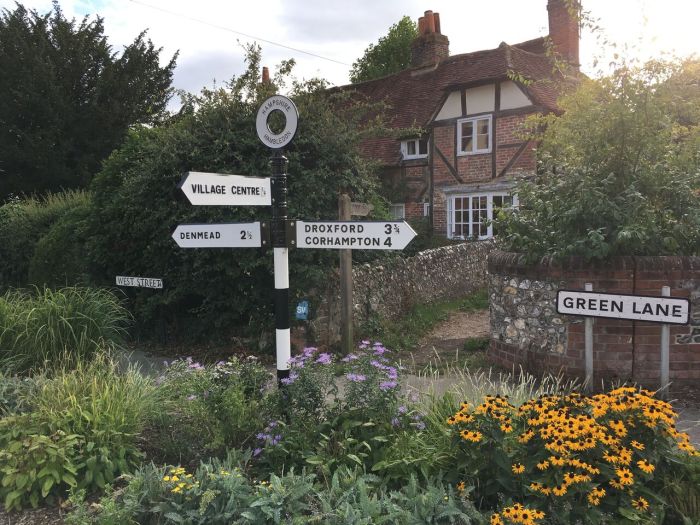
Photo: Murray Mahon, The Village of Hambledon, Hampshire, UK

Rooted Sideways

Rooted1:stephen-leonardi-369733-unsplash

“Strictly speaking it is incorrect to say that the single individual thinks. Rather it is more correct to insist that he participates in thinking further what other men have thought before him.” Karl Mannheim, Ideology and Utopia

One can look at this in both positive and negative lights. Negatively, we’ll never have an original thought. Everything we think and wrestle with is contingent and formed from time immemorial before us. We may rearrange the words, and thus arrive at some new shadings or nuances, but essentially everything has been thought of before. More ominously, these patterns that we inherit may be racist and sexist, prejudiced to the core, modes of thinking and acting that appear normal unless they are countered by different patterns.

Positively, we are connected with our past and with everything that has been expressed before. And that means, in like manner, we may continue to have an influence on those who come after us, who read what we write and think about what we have said. This is an argument for choosing our formative societies wisely or, more realistically, for experiencing, with eyes wide open, a variety of societies.

Karl Mannheim (1893-1947) was a Hungarian-born sociologist, who was one of the co-founders of the sociology of knowledge. His best-known book, Ideology and Utopia, argued that our ideas and ideologies are products of our times and of the social status of those who hold them. Knowing that this could lead to a harmful relativism, Mannheim proposed instead “relationism,” in which we understand that our ideas are limited and that we must trace them back to their roots in our history to see how they have influenced how we relate to society. He broadened the concept of ideology beyond its political roots to include how we arrive at ideas and how those ideas mirror our life and times.

This idea can be fruitful for religious groups who take the time to recognize that their conceptions about God, religion, social and religious behavior, and culture are rooted in history. In my view, as an Adventist Christian, it calls me to recognize that my beliefs are born in history and can be traced back to their sources. It both gives me a link to the past and helps me to recognize that my group and I don’t hold the key to all the secrets of life. It builds in epistemological humility without sacrificing awareness of what we owe to our forebears.

Mannheim says we think in patterns that are established by our societies. Which patterns become the dominant patterns? How do they change? He says that groups of people, scattered along the social strata, will not change unless there is tremendous upheaval to their way of life. Only when there is a conflict of ideas can change be possible—and even then, the ideas must somehow impinge on us or push us into radically new ways of thinking and seeing.

Mannheim again: “As long as the same meanings of words, the same ways of deducing ideas, are inculcated from childhood on into every member of the group, divergent thought-processes cannot exist in that society.”

I think it’s questionable if we each are imprinted with the template to this extent or if every person in our group falls as easily into these patterns. Most of us can remember some who stood out—often the quiet ones—in our school or college years because they would not follow the stream. I found them interesting, even admirable, and later came to think of them as remarkable for their independence of spirit against the pressures to conform.

Nevertheless, Mannheim is right, I believe, that for the most part we fall into a comfortable sharing of rituals, symbols, references, and habits that mark us as belonging to the same tribe. The question is, how do we think and act in new ways? Perhaps more to the point: what would prompt us to question that which we are?

Recently, I went to a reunion at the college I had attended in England back in the 70s. Aside from the delight of seeing people I had known almost 50 years ago, there was also the more sobering effect of hearing the stories of their journeys of faith in all that time. Illnesses, deaths of loved ones, divorce, reversal of fortunes — we had not escaped these molders and shapers of experience. Tentatively, at first, and then more confidently, we began to open up to each other about our faith and our doubts. Many of us had worked for our church denomination’s educational, medical and religious organizations for decades, and now we were verging on retirement or had already ventured into it.

The stories emerged, blinking in the sunlight, over the weekend. Consistently, as I listened I found myself thinking of the (somewhat) innocent youths that we were all those years ago, compared to the (somewhat) more experienced persons we are today. The people that we were and are presently serve as bookends to the volumes of years in between; over the weekend we found we could distinguish between the bookends and the books.

Some of these friends had worked in many different cultures and countries around the world, moving in and out of places as disparate as Rwanda, London, Iceland, and Michigan. All of this while raising children, finding homes to live in, establishing gardens, and getting the car fixed. Others had remained teaching or pastoring—or both—in one country, while seeing their societies evolving, changing, growing ever more diverse and sometimes more polarized.

Over the weekend you could see clusters of people together, laughing, leaning in to listen, pausing to remember something and then going on with a chuckle, knowing that what they were trying to retrieve would return to memory after the conversation was over. In any given group of four or five people there could be a combined total of over 200 years of work and service. And now these people were sensing gaps between what they had done and experienced and what they had hoped their church might become. They had diverged from the theological and social boundary markers they had been raised to guard because those positions were stationary, and life moves on. It was not that those beliefs were now invalid, but more that from day to day, in living and working with people, the larger concerns of compassion, patience, and humility had edged those beliefs to the periphery. Now they were wondering if they were alone in this or if there were others who also felt these gaps. They were like people who set down their burdens to travel lightly with the essential provisions.

“I believe in absolute truth and absolute contingency, at the same time,” says Christian Wiman in My Bright Abyss. On this side of the bookends, and at this stage in our life journeys, we are down to the essentials. They are essentials because they have been proven through experience to be useful for making one’s way through life faithfully and with care for others. “And I believe that Christ is the seam soldering together these wholes,” continues Wiman, “that our half vision—and our entire clock-bound, logic-locked way of life—shapes as polarities.”

At times we change our minds and our lives, decisively and consciously, at the same time we are being changed passively and incrementally over time. When we pause to look back, it is then that we realize how different our outlook presently is from the other end of the bookshelf where we began.

Mannheim says we only break out of the conventional ways we were raised to think in through horizontal or vertical mobility. Horizontal mobility is where we change locations or even countries without changing our social status and, in this way, we come to realize how differently people think and live. Vertical mobility is where our social status ascends or descends rapidly, and this, says Mannheim, “is the decisive factor in making persons uncertain and skeptical of their traditional view of the world.”

In conversation about this with a friend she remarked that those of us who find ourselves in these gaps have not radically stepped away from our Adventist roots and from our social context as she has. Viewed from the outside, our unease is trifling and our “gap-mindedness” comes from being too close to the trees to see the forest. Yet, there are many in this position who have paid dearly for their honest doubts and who are viewed with deep suspicion and distrust by those who hold power inside the Adventist religious organization. Depending on one’s vantage point, we have moved an inch or a thousand miles. In practical terms, this means that some in power in our church may already regard us as “outside the camp” with no possibility of being accepted back in. By contrast, some of those I spoke with at the reunion thought of themselves as at the boundary—but still within the circle. Most striking was the feeling that no one in authority should define us out of the church by drawing the circle tighter and thus excluding us. Being woke means being responsible for one’s actions.

Mannheim asks, “how it is possible that identical human thought-processes concerned with the same world produce divergent conceptions of that world. . . May it not be found, when one has examined all the possibilities of human thought, that there are numerous alternative paths which can be followed?”

One of the central metaphors of the New Testament is the idea of a spiritual communion with enough room for many different kinds and ways of serving and living. It is an expansive view rather than a constricted and exclusive position.

“There are varieties of gifts,” says Paul, “but the same Spirit. There are varieties of service, but the same Lord. There are many forms of work, but all of them, in all [people], are the work of the same God. In each of us the Spirit is manifested in one particular way, for some useful purpose (1 Corinthians 12: 4-7).”

There were some I spoke with who had found spiritual succor in other faith communities. They talked of being accepted, of simple caring and friendship, of the delight in finding shared spiritual communion. While they were not about to abandon their Adventist roots, it was invigorating to realize that spiritual sustenance could be found outside the camp.

Gary Gunderson writes in his Deeply Woven Roots, “Although we’ve been told for all our lives that we should put our roots down deep, actually, the healthy trees send them sideways . . . At the microbial level, the roots live together so intimately they literally function as one organism so that the light from one, the food from another is shared—even among different species. At least in healthy forests, a healthy community it is. Where are your roots tangled with others? How are you reaching sideways?”

Photo: Stephen Leonardi, Unsplash.com

Faith as Poetry

StoneChurch:stefan-kunze-16862-unsplash

Have patience with everything that is unsolved in your heart and try to cherish the questions themselves . . . Do not search now for the answers which cannot be given you because you could not live them. It is a matter of living everything. Live the questions now. Perhaps you will then gradually, without noticing it, one distant day live right into the answer. — Rainier Maria Rilke, Letters to a Young Poet

What if creating our personal faith was like writing a poem? Not doggerel or a sentimental one-size-fits-all Hallmark card, but a creation of content, form, style—all of that welling up through hard-won experience.

What is “faith”? Is it a journey, a process, a procedure with a product at the end, a string of moments that our memories turn into a continuous experience? Should we tend our faith like we would a garden, yanking out the weeds and watering regularly? Is it like playing a piece that we’ve performed hundreds of times, each performance slightly different from the last because we have incrementally changed since last we performed it? Perhaps, as we are often told, it is a gift not received until we open it. Or is it the speaking into sound of our suffering, the dis-ease we feel being apart from God, the telos of our completion?

If it were simple we would not be having this communion. I don’t know all the ways in which faith is veiled to our comprehension, but I can give voice to what I am beginning to grasp about it in the light of poetry.

Like poetry, faith can form from a slight movement within our vision or from a word that drops into our life at an opportune moment. As in poetry, we form an idea and express it in a way that allows for both consistency and fluidity. The writing of it—and the living of it—takes attention, creativity, commitment, sacrifice, and an ability to lift thought to sound. There is something on the page and in the life that can be read and understood; there is something else that arises and moves beyond the meaning of the words, something that could not be entirely predicted from the arrangement of those words. It is a seeing-into, an awareness of the numinous sleeping inside the modestly mundane.

Mary Oliver says in A Poetry Handbook that writing poetry demands “a perfect seriousness. For the would-be writer of poems, this is the first and most essential thing to understand.” Rainer Rilke, in his incomparable Letters to a Young Poet, implores his young friend who is doubtful about his calling, “This before all: ask yourself in the quietest hour of your night: must I write? . . . And if this should be in the affirmative, if you may meet this solemn question with a strong and simple ’I must,’ then build your life according to this necessity.” Could we ask for a deeper motivation for the building of our faith?

Rilke’s correspondent, a young officer in the army who longs to be a published poet, has asked for Rilke’s critique of his poems. Rilke responds gently: “You are looking outwards, and of all things that is what you must now not do. Nobody can advise and help you, nobody. There is only one single means. Go inside yourself.”

And we must work out our salvation with fear and trembling, a motion of utter seriousness, and yet not without its playfulness. Where do we begin?

Mary Oliver commends to beginning poets that “to write well it is entirely necessary to read widely and deeply. Good poems are the best teachers.” In flowing that out to faith we have no end of examples. For me, the two that I return to over and over are Abraham contesting with God for the souls in Sodom and Gomorrah, and Jacob desperately wrestling through the night by the river Jabbok. They are heroic figures, all the more appealing in their finitude, striving with all their might with a benignly awesome force that could flick them out of the way in a heartbeat. To read these stories is to wake up; it is to realize with a shiver that while God will not be mocked, He yearns for engagement at close quarters. Our faith is most alive when it is thrown on its back foot; whether reverently challenging God’s judgments as did Abraham or striving to realize our new identity in God as Jacob did, we learn first by seeing and then by doing.

Oliver continues her master class with an invitation to imitate. “Before we can be poets, we must practice; imitation is a very good way of investigating the real thing.” As she says, there is very little downside to this. In imitation we try on the unfamiliar, testing whether the expression we’re holding feels like it could be ours. “Imitation fades as a poet’s own style—that is, the poet’s own determined goals . . . Begins to be embraced.”

Are we the impassioned, but clear thinking Augustine of The Confessions, or the restrained tensile strength of Dorothy Day and Simone Weil? The gentle and comforting hand of Henri Nouwen or the stern ebullience of Martin Luther? The brilliant erudition of John Donne and Karl Rahner or the urgent intensity of Jurgen Moltmann and Dietrich Bonhoeffer?

We must begin in faith to find our “style” of faith. We are beginners and we do not know ourselves enough to know what is truly ours. Rilke, advising the young Herr Kappus, says, ”To love is also good: for love is difficult . . . Therefore young people, who are beginners in everything, cannot know love yet: they have to learn it.”

And we have to learn faith—it’s not self-evident or obvious nor is it a matter of simply trusting the smirking and coiffed televangelist. Whatever else we may learn about faith, we can know by example, by story—eventually by experience—that it is supple and flexible rather than hard and brittle. It not only adapts to changes, it is change; if it were not so there would be no possibility of surviving our pasts.

“What might it mean to be drawn into meanings that, in some profound and necessary sense, shatter us?,” asks Christian Wiman in My Bright Abyss. “This is what it means to love. This is what it should mean to write one more poem. The inner and outer urgency of it, the mysterious and confused agency of it. All love abhors habit, and poetry is a species of love.” The spark that jumps where love and faith touch is enough to renew us in responding to the God who “makes all things new.”

Our experience is all we’ve got, but it’s enough. Our bodies, ourselves, our needs and wants, may coalesce into some kind of coherent narrative over time, but that usually appears in the rear-view mirror. Going forward, and in the present moment, it’s much more difficult to know where we are. Christian Wiman, commenting on the American poet, Hart Crane, muses that “he did to some extent confuse meaningful experience with mere turbulence, as if one weren’t truly in one’s life unless one were being overwhelmed by it.” We needn’t feel ashamed if our experience is quiet, even reticent, rather than crackling with drama. We get the conversions we need, not the ones we envy.

There is a way of relating to faith that is indolently passive. We go about our business, occasionally mildly surprised that nothing has bloomed in the no-mans land between us and God—a change of situation, an uplifting feeling, a new viewpoint on our life’s journey—something that should happen to us. But when we attempt to make something happen it inevitably falls flat. Maybe we read our Bible for fifteen minutes a day, pray for fifteen, start going to church more or even for the first time, disconsolately trudging down the path mapped out by spiritual self-help consultants. These actions can seem like we’re priming the pump or cutting down on the odds that lightning will strike and we’ll have a spiritual experience. This is not the dark night of the soul, it’s more like twilight for spiritual zombies. If that sounds harsh it’s because there is no formula for writing great poetry any more than there is a formula for walking, open and unafraid, in faith.

Great poetry, I am convinced, is the result of being rooted in this world while seeing beyond it. It takes our full attention, both as writers and as readers. It is often difficult, because speaking life through our words is hard, just as folding our words into our waking lives is hard. All this can be said of faith, no doubt.

For poets, and for the rest of us, what really matters in life and in poetry begins with questions. For the poet, as for the traveler in faith, there is an active waiting, not straining, that is as much about hope as it is about faith. As the epigram from Rilke says, “Live the questions now,” and we may “one distant day live right into the answer.”

Photo: Stefan Kunze, Unsplash.com

The Faith of a Heretic

BlownAway:thomas-young-658905-unsplash

In the matter of religion, as indeed in other areas of human life and thought . . . the modern individual is faced not just with the opportunity but with the necessity to make choices as to his beliefs. This fact constitutes the heretical imperative in the contemporary situation. —Peter Berger, The Heretical Imperative

The English word ‘heresy’ comes from a Greek verb, hairein, which meant ‘to choose.’ Hairesis, then, simply meant ‘to make a choice.’

To be a heretic is to be a person who makes choices.

Within the Christian tradition, however, it holds a much more negative meaning. The apostle Paul warns in Galatians 5:20 against those who engage in a ‘party spirit’ (hairesis)—akin to partisan politics, but not to be confused with a keg-draining frat party. Those with a party spirit divide and fracture the community. In the theological and legal history of the early Christian church heretics were identified as those who promoted deviant views over against the authority and teachings of the Church. To be tagged with the term meant to carry a target on one’s back, to suffer denunciation, a quick trial, and sometimes a grisly death. In his The Heretical Imperative , sociologist of religion Peter Berger writes of heresy with straight-faced understatement: “Its etymology remains sharply illuminating.”

One of the major themes that Berger explored throughout his long career as a sociologist of religion who was also a practicing Christian, was the impact that modernity has had on religion and people of faith—not just in Christianity, but in all major religions.

In a premodern society religion had the quality of objective certainty for most people. The society supported this certainty and enforced it, to a degree, by making it difficult to question the social structures that undergirded its reality. Modern society, in contrast, undermines that certainty by collapsing the assumptions that allow us to take our social reality for granted. It relativizes knowledge and subjectivizes religion.

“If the typical condition of premodern man is one of religious certainty,” says Berger, “it follows that that of modern man is one of religious doubt.” If the background of premodern people was this religious consensus, then that authoritative consensus for modern society has vanished. Heresy—choosing a different religious path—was a rarity in societies in which the questions were settled, the religious and political authority was secure, and the penalties for deviance were dire. Yet, it’s very difficult to follow a consensus that is no longer available. “In other words,” says Berger, “individuals now must pick and choose. Having done so, it is very difficult to forget the fact.”

Berger makes the point that the orthodox person defines him or herself as living within a tradition. Traditions, by their very nature, are taken for granted, but this state of taken-for-grantedness is no longer possible in today’s society. “Every tradition consists of frozen memories,” says Berger, “And every questioning of tradition is likely to lead to an effort at unfreezing the memories.” The unfreezing of memories means that every generation questions why the tradition exists and where it came from. On the principle, however vaguely sensed in one’s life, that we cannot inherit our grandparent’s religion, we question in order to understand. It’s a natural and essential process. Through the asking of questions and the testing of traditions we may come full circle back to our starting point, but now we know what we believe and who we put our trust in.

Where the social and religious consensus breaks down, pluralism rises. Modernity opens up choices and narrows down what was considered destiny. In any given city across America, the religious traveler has a choice to attend the services of not only most of the major world religions but also scores of Christian denominations and sects. American religion is a buffet of choices.

But beyond the choices to be made between religions, there are choices to be made within a religion. It’s interesting how ‘heresy’ transmogrified from ‘choice’ to anathema—as if the true disciple would never ask questions, never see differences, never compare, and never step over the lines drawn by authority. In fact, faith requires choice, otherwise, it would not be faith but a cramped and reluctant obedience to authority. When the integrity of religious authority collapses, the inward turning to reflection on one’s religious experience is both inevitable and necessary for one’s faith. That is, after all, where the exhortation to develop a “personal relationship with Christ” will lead.

Christ asks for our free choice in faith. The rich young ruler is dismayed because he must choose between identifying with his wealth or following Jesus. The man born blind chooses Jesus over his rigid tradition—and risks the sullen plotting of the religious authorities in retaliation.

What we call heresy may be viewed as making a choice out of what was previously thought to be closed, over and done with. Faith, then, is the continual act of choosing the way we should go. There is less certainty here. But while modernity alienates and isolates us from each other, we are saying that community can be found with others who also choose. Because we are social beings and because we make our ethical and moral decisions to a great extent according to what is affirmed by our communities, we need each other. Because our worship is both solitary and communal our fellowship of faith is a fellowship of heretics, people who continue to make their choices every day about Jesus as they live within the world. To be faithful is to exercise choice and thus to be a heretic.

Berger gives us three ways that people live within their religions. The first is what he calls the deductive approach, familiar to orthodoxy, in which we go on believing as if nothing had changed in the world. The behaviors are prescribed according to law, the rewards are contractually-based, and knowledge of traditions and rules is paramount. Certainty is high because our unquestioning trust is in religious authorities.

At the other extreme is the reductionist approach, typical of liberal theology, in which accommodation to the secularizing force of society is almost total. Religion is reduced to a political agenda and there is little sense of a personal religious experience. Jesus is seen as the great ethicist and the New Testament a compendium of motifs of justice and responses to the oppression of others. What makes religion palatable to a secular person, then, is its emphasis on psychological, political, and ethical analyses of our current unjust society.

Berger’s choice is the third option, the inductive approach, in which we turn from external authorities, both religious and political, and from tradition, to our own experience of God. This is the heretical imperative in which our faith is constantly making choices and our trust in Christ is the experience that lifts us daily. It is not an easy path and uncertainty is high because we are not following well-worn paths of tradition nor are we simply swept along with the crowd. We reason, we “test the spirits,” we recall that we are “surrounded by a great cloud of witnesses,” we revel in Scripture and in the many avenues to the Spirit that we find. We pray and we decide; we seek in order to realize our foundness.

There is much that is good in tradition and the assurance it bears. Tradition gives us stability and it reminds us of the mountains and valleys in the experiences of our forebears; it can be a bright line of consistency when everything else is murky and chaotic. But it may too easily slide from authority into authoritarianism and from guidance into coercion. It substitutes response to God with reaction to religious power.

We must be clear that other people’s experience of God, crystallized into tradition and dogma, will never be enough for those of us on the road to Emmaus. We need to see Christ’s hands for ourselves.

The heresy that is faithfulness relies on thinking for oneself, praying for guidance, looking to counsel from those we trust, and finally, choosing our path. It is a path of humility; there is no glory to be gained in side-stepping religious authority that is exercised just to keep one in line.

In the original sense of the word, we may all aspire to be heretics, people who choose daily, with eyes wide open, to follow Christ.

Photo: Thomas Young, Unsplash.com

My Bibles, My Life

WalkStars:rafael-barquero-677303-unsplash

“The Bible, more than most books, forms part of one’s life once it is absorbed into the system. It does not remain static, any more than you remain ever the same. Your perspective of it will change with the years.” — A. N. Wilson, The Book of the People

I cannot remember a time in my reading life when a Bible was not within my reach, both literally and figuratively. In the home I grew up in, the Scripture was the primary source of one’s instruction and inspiration. It was read aloud morning and evening, discussed at church, memorized as Bible verses, emblazoned on bulletin boards at school, and called upon in times of celebration and grief. Its phrases came naturally to the lips, its stories became the video of our imaginations long before there were pixels, the grand highway of its narrative from Genesis to Revelation (pitted with potholes in the Pentateuch) provided both a spiritual history of humankind and a kind of eschatological weather report (“Look for a cloud on the horizon the size of a man’s hand!”). Later, through the ministrations of our well-meaning elders, its revelations came to us like birthday gifts from distant uncles who still thought of us as five-year olds. It was unavoidable and indispensable.

But I find I can trace out the course of my life by looking at the Bibles on my bookshelves, each one having played a role in my life that was both episodic and cumulative.

***

In high school my Bibles of choice were the Living Bible and Good News for Modern Man: The New Testament in Today’s English. The Living Bible was a paperback brick, lovingly slipped into a doeskin cover that my grandfather had gotten for me in Canada, with a painting of an Indian brave on the front. Inside the end pages I wrote notes of favorite verses, quotes from religious authors, and lines of poetry. The LB was fresh, a bit cheeky, conversational without falling into cultural jargon. The Good News New Testament was plain, small enough to carry in one hand, and modest in its literary aspirations. Its line drawings were simple, evocative, and good-humored. I was also reading a lot of C. S. Lewis at the time, along with Lord of the Rings, The Hobbit, Byron, Shelley, Yeats, and Matthew Arnold. It was a heady mix.

My first year in college, working on a double major in religion and journalism, I used a standard issue King James in my religion classes. I’d had it since my baptism at 12 and I knew my way around its paths by sight. These were the phrases and verses I had heard all my life. They seeped into my consciousness and became the language of my operating system, an eloquent counterpoint to the informality of the modern versions.

***

In the summer of 1971 I left California for England to work with friends in Coventry in starting and running a Christian folk club and then to spend the school year at Newbold College. Away from home for the first time, I spent the year in a constant state of wonder and discovery. That summer I bought my first New English Bible, a paperback Penguin version of the New Testament whose language and verses seemed like poetry to me. I found a tanner’s shop in Leamington Spa and made a book cover for it from suede leather, stitching a peace symbol with a cross in the center on the front. The cover art on the Penguin version was a reproduction of Georges Rouault’s Head of Christ, thus beginning a lifelong admiration for his art. In the fall, as a student at Newbold, I hitchhiked down to Reading and bought J. B. Phillip’s The New Testament in Modern English. I also started a year-long course in Koine Greek. I was terrible at it, but I scraped by with enough margin to be given a copy of the British and Foreign Bible Society’s Greek New Testament with critical apparatus. Burrowing into the permutations of Greek verbs and nouns reinforced my life-long fascination with word origins and their meanings.

That year I always carried in my backpack at least one Bible, usually two. As I hitchhiked to Scotland or down to Wales or up to London, these Bibles became my traveling companions, provoking comment and conversation from the generous people who gave me rides. Comparing these translations and paraphrases jolted my imagination and gave me different lines of sight to their meaning. And always I carried a small Authorized Version whose cover could be zipped closed. I left it behind in a train station in Milan one December; two years later it showed up in my mailbox at Pacific Union College, having made the journey through the kindness of strangers on the strength of my college address at Newbold.

***

All through graduate studies at Andrews University and Claremont Graduate University, my familiars were the New English Bible I had bought in Wales in 1974 when I worked in evangelism there, and The Jerusalem Bible, another chunk of a Bible whose lyrical Psalms were refreshing and whose Job was high tragedy. Later, teaching Jesus and the Gospels, Hebrew Prophets, and Paul and His Letters at Columbia Union College, I entered into a professional relationship with The New International Version. Those who knew their Biblical languages assured me it was the latest and most accurate rendering, but its starched and anemic language gave me no joy. Time and again I went back to my NEB, by now so annotated and stuffed with typed-out quotes and photos of friends, that when the spine finally collapsed my wife made me a book cover for it from the jeans I wore out hitchhiking through the UK.

***

In these later years I have come back to the New Revised Standard Version, not to be confused with the Revised English Bible, a second take on the NEB. As I write there is one just behind my shoulder on the bookshelf, another one next to my comfy chair across the loft, and a third one, barely marked, in another bookshelf. Recently, having finished my courses for the semester at Trinity Washington University, I stopped into the Saint John Paul II National Shrine, right across the street from Catholic University, and indulged myself in a beautifully leather-bound Catholic edition of the Revised Standard Version with the Apocrypha. I intend to study the Apocrypha this summer.

***

I’ve entered the Bible as into a vast and varied library — ta biblia, the books. Not a single, coherent narrative, but stories of wonder, beginning in a garden of light and ending in a city with a river running through it. To try to understand the people within the stories is to read with a dual vision: that in certain irreducible ways they and we come from the same stock and harbor the same emotions and motivations. And in other ways, bound by time, culture, language, and technology, we arrive at our final home having traveled such disparate paths. I am grateful to the archeologists, linguists, anthropologists, and theologians who have peeled back the layers of the Bible for us and interpreted its structures.

The Bible has meant different things to me through many different stages of life. It has both revealed and hidden God, and it has held a mirror up to myself. The Jesus I have found there is no less enigmatically divine than when I first began with the Gospels, but now even more touchingly human. The Bible, I’ve found, is large enough that it can play many roles in a person’s life. Like the Earth itself it presents a different but constant face to the observer hovering in orbit above it. It is guide, wisdom, puzzle, danger, mystery, and light. It is still the literary foundation of many of us.

The Bible creates an alternate world that runs parallel to our own. It is like holding two magnets in tension so that you feel the pull of one to the other. Let one go and the tension is gone, the case closed, the story resolved, the horizon suddenly walled up. Unless we see both the fragments of light it illumines around us and the Light itself — and the distinction makes all the difference — the Bible remains just another revered and unread bestseller.

Photo: Rafael Barquero, Unsplash

In Blindness Then We See

BlindYoungMan:joao-santos-219449.jpg

“Once when the king of Aram was at war with Israel, he took counsel with his officers. He said, ‘At such and such a place shall be my camp.’ But the man of God sent word to the king of Israel, ‘Take care not to pass this place, because the Arameans are going down there.’ The king of Israel sent word to the place of which the man of God spoke. More than once or twice he warned such a place so that it was on the alert.

The mind of the king of Aram was greatly perturbed because of this; he called his officers and said to them, ‘Now tell me who among us sides with the king of Israel?’ Then one of his officers said, ‘No one, my lord king. It is Elisha, the prophet in Israel, who tells the king of Israel the words that you speak in your bedchamber.’ He said, ‘Go and find where he is; I will send and seize him.’ He was told, ‘He is in Dothan.’ So he sent horses and chariots there and a great army; they came by night and surrounded the city.

When a servant of the man of God rose early in the morning and went out, an army with horses and chariots was all around the city. His servant said, ‘Alas, master! What shall we do?’ He replied, ‘Do not be afraid, for there are more with us than there are with them.’ Then Elisha prayed: ‘O Lord, please open his eyes that he may see.’ So the Lord opened the eyes of the servant, and he saw; the mountain was full of horses and chariots of fire all around Elisha.” (2 Kings 6: 8-17)

And what stops us in our tracks is not the cloak-and-dagger tension of military secrets revealed, and not the perfectly understandable reaction of the servant to besiegement, but the laconic way the man of God answers his servant’s terrified cry. He may not have even looked up when the fellow burst in through the door as the first streaks of morning light shot across the threshold.

“They’ve come for you, you know!”

“Yes.”

“What are we going to do?”

It was a matter of what one sees and what one understands. Was it a trick of the light, maybe a distortion in the retina that early in the morning? The eye sees dark shapes, maybe boulders . . . but then they move, and suddenly a vast army is revealed and we cannot see it now as anything but rank upon rank of men and horses, standing silently, with a stamping of hooves occasionally, and a muttered command, and the awful dryness in the mouth as one’s eye begins to twitch.

William James says we pay attention to what matters to us and yet we grasp so little. “One of the most extraordinary facts of our life is that, although we are besieged at every moment by impressions from our whole sensory surface, we notice so very small a part of them.”

Let us imagine the young man as one of us, a person who relies on the facts, sees for himself what is real, and runs everything he encounters through his field-tested, rigorized, and fully guaranteed BS filter. We are surrounded by troops in white Toyota Land Cruisers with turret-mounted 50-caliber machine guns, grenade-launchers, and farther back, armored trucks.

“Don’t worry,” says the master behind us. “There’s more with us than are with them.” And he prays, short and simple: “Lord, open his eyes that he might see.”

We can see alright. We know what we see before us and what we see is a guarantee of a quick and excruciating death. If it were dark we could still see with night-scopes, night-vision googles, all manner of devices to cut through the darkness and the fear. We see what can be touched. Our hope for survival is built on nothing less.

Thomas Merton says, “So much depends on our idea of God! . . We must learn to realize that the love of God seeks us in every situation, and seeks our good. His inscrutable love seeks our awakening.”

So let us freeze this frame and ask ourselves what the old man sees, as a matter of course, that we are missing? What is out there that he is so sure exists that he doesn’t even come to the window, that he doesn’t even get up from the table nor close the book he is reading? What does he know that we don’t? How does he even do that?

Elaborated Spontaneity #7

(Photo: Joao Santos on Unsplash.com)

For To Give

DesertFloating:pawel-nolbert-315359.jpg

“Take heart, son; your sins are forgiven.” This is Jesus, bent over, talking to a young man lying on a stretcher, the stretcher carried by his friends, sweating and shifting their grips from hand to hand as they come up alongside the Son of Man. And they haven’t even said anything yet, but He sees their faith and says to this guy, “Your sins are forgiven.”

This is a one-sided conversation that they’ve entered, but it seems to them like it’s one that’s been going on for some time—maybe all time—and while they don’t want to interrupt there is, nevertheless, the fact that this man is standing right in front of them, the man who can heal at a glance, a once-in-a-lifetime chance for them and their friend, who, by the way, hasn’t said a word, just looks, his hand curled like a claw, his arms like brown sticks, his fingers splayed like roots, chin covered in stubble, breath coming hard—no words—his eyes burning deep like topaz in the last light of the day.

And we, looking on, shift a bit and smile at nothing in particular. Sins! Not a word we’ve heard or used in quite awhile, and truth be told, not something we can actually relate to, come to think of it.

*****

“Have you ever sought God’s forgiveness?” asks the reporter. The candidate stops, puzzled. “I’m not sure I have ever asked God’s forgiveness,” he says. “I don’t bring God into that picture . . . When I go to church and I have my little wine and my little cracker. I guess that is a form of forgiveness.” He pauses, shrugs his shoulders. “Why do I have to repent or ask for forgiveness, if I am not making mistakes? I work hard, I’m an honorable person.”

*****

Actually, we’d be more comfortable if the conversation revolved around rights and obligations. We have respect for privacy; we believe everyone has the right to their own opinion and who are we to say who has committed a sin or not. That’s their business and not something which can really — or should really — be talked about, seeing as nobody has the right to tell me or anybody else, what I should or should not be doing. I pay my taxes, I work hard, I try to help others out where I can, but in the end it’s really my life and no one else’s and I really don’t — I mean, you know — you don’t have a right to tell me what to do, you know?

This moment: this paralyzed man, his friends, breathless, waiting, the crowd at our backs, the sun slanting into our eyes, a dry, coppery taste in our mouths. Jesus smiles and straightens. “I know what you’re thinking,” he says. “Why do you think such evil? What’s easier, to say, ‘Your sins are forgiven’, or to say, ‘Stand up and walk?’

*****

We don’t know what to say, they’re just words, anyone could say them but that doesn’t prove a thing. I mean, I could say that—not that I would—but if I wanted to I could say that, but what good would that do anyway? Nobody talks like that! Who talks like that, anyway?

Jesus turns. “Stand up,” he says to the guy on the stretcher. “Go home.”

And I do. I swing my legs down, set my feet on the ground and stand up, a little shaky at first, but I’m up.

“Thank you,” I croak. I look down. My fingers ball up and I rub my arm. My friends stand paralyzed.

“Thank you,” I say, and the people near me fall back.

“Thank you,” — the words are stronger now — and I walk.

Elaborated Spontaneity #6 (Photo: Pawel Nolbert at Unsplash.com)