When The World is Too Much With Us

“And I, when I am lifted up from the earth, will draw all people to me.” John 12:32 (NRSV)

Being a carbon-based bipedal organism with a comparatively short life span has its drawbacks. At birth we are helpless, red-faced, squawking bundles of potential—if we can live long enough to gain a foothold on this third rock from the sun.

Most other mammal babies get up and walk within minutes of hitting the ground—we take years. We can’t see as keenly as eagles, trot as fast as horses, climb as good as monkeys, or swim like dolphins. Almost everything we’ve done to overcome these physical deficiencies is through extensions—mechanical devices that give us reach, sharpen our hearing, project our voices, and peel back surfaces to see underneath and beyond. There has to be some payoff for all this vulnerability and there is—we have imaginations.

The imagination lifts us up and out of our reality into another place, even another time. A vibrant imagination is necessary for a child to try out scenarios, play with images and ideas, and stretch the mind in the process. Somewhere I’ve read that day-dreaming is part of mental exercise, as important as toughening the muscles and building endurance.

Our imaginations specialize. Architects can visualize their buildings in three dimensions while most of us can’t “see” the structure until it’s built, a disadvantage that is not trifling. Others spin stories, bring clay to life under their fingers, or uncover the symmetry of equations. I marvel at those who can leap from intuition to concept to theory to image like a ninja at parkour. At times I write like a man trying to thread a needle behind his back: it can be done, but it takes a great deal of time and there will be blood.

Blessedly, one form of expression triggers another. When I was a journalism student struggling for a lead to a story I’d often take a break, get myself down to the college library, and spend some time with Communication Arts, a magazine that features some of the best art and design in the world. Something about absorbing all that visual creativity and the possibility of wonder just over the page usually set me free to write my version of the truth.

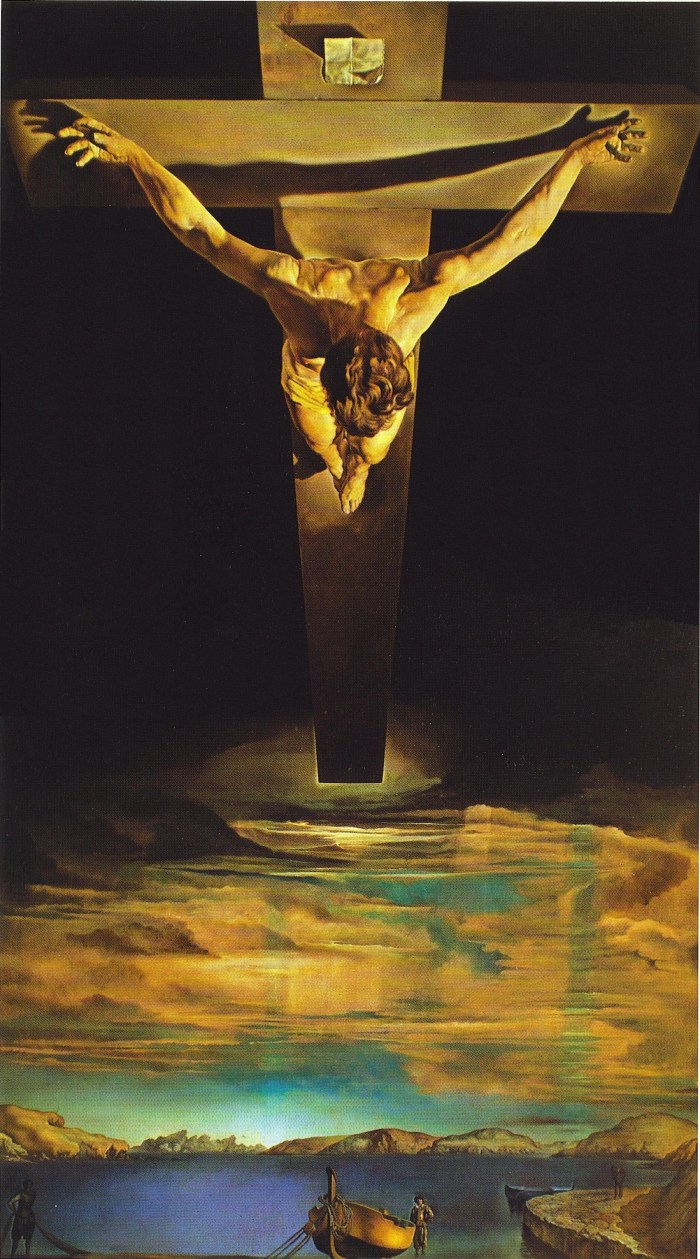
So too in my spiritual landscape: I’ve found that seeing through another’s creative vision often gives me new eyes to see what was there all along. Through the years I’ve found artists who give me a place to stand and thus change my understanding. Chagall is one, Roualt is another, Picasso, Rothko, Cezanne, Paul Klee—and Dali. One painting of his in particular has been a kind of talisman for me, the function of which is to bring me to a humbling perception of humanity.

Dali’s Christ of St. John of the Cross (1951) was based on a drawing by a 16th century monk named St. John of the Cross. Christ hangs suspended on the cross above the world, unbloodied, without nails or wounds. The observer looks down at the top of Christ’s bowed head and simultaneously at a landscape of fisherman and boats. The effect is disconcerting at first as we plunge down vertically past the Christ and immediately level off to a horizontal plane. Dali traced inspiration for the extreme angle back to a dream he had, the vision of which appeared to him in color as the cosmic Christ.
christofsaintjohnofthecrossdali

We see Christ from God’s point of view; His Son, His beloved Son, eternally hanging there above the world, floating in silent and profound dignity, magnificent in death. Down below, the fishermen, oblivious to the Light of the World above them, draw their boat up on the shore. One is standing at the stern in water up to his knees while his companion on the shore drags out the nets to dry. They seem indecisive or perhaps just tired. If they caught any fish we’re not seeing the evidence. They may be heading home, weary from work, wondering how long they can survive without a catch.

The painting was purchased in the early 50s by the Glasgow Corporation for 8,200 pounds sterling, considered quite extravagant at the time. In 1961 a visitor heaved a brick through the canvas, apparently incensed by the angle that looked down upon Christ instead of up. The painting was restored and now hangs in the Kelingrove Art Gallery and Museum in Glasgow, the curators having stoutly resisted an offer of $127 million by the Spanish government.

When the world is too much with us, when we find ourselves loathing humanity, when we feel, with shame, our complicity in the wickedness and suffering of this age, we can be lifted up, free and clear, to look down through Christ and see our tired world from a new perspective—one that through imagination wounds and heals.


Personal Satan

NightThoughts

I can believe in a personal satan

When I see my words jetting forth
As scalding steam,
To sear and scorch another.

No more proof is needed
Than the rush of violence boiling up
Behind the eyes,
Behind the smiles that cut both ways.

Yes, there is a personal satan for each one of us.

How else to explain the halting speech of gratitude,
The lame stumblings of thank-you’s and please?
The blind, the deaf, the weirdly twisted conversations
In elegant side-rooms and vestibules?

We have our satans, our adversaries, the ones
Who throw down the bolas of our making
Around the ankles of our friends, our lovers, our children.
Even our blessed enemies.

We scrape for words of repentance,
Humility, simple wonder. There is dryness here.

Yet, words of scorn flow with vigor, with bounty,
With health brimming,

Wave to wave,
From our personal Satan.

The Blessings of Doubt

FogCliff-2How it tilts while you are thinking,

and then you know. How it makes no difference
for a long time—then it does. — William Stafford, “Figuring Out How It Is”

The world is made up of two kinds of people: those who think they know and those who know they don’t. I am definitely in the second camp. . . I think. How can we even make definitive statements like the one above when we are “of two minds”? How can we know anything with certainty?

I am fascinated and slightly repelled by people who speak with absolute certainty. I wonder how they can be so sure, why they think they have an inside track on knowledge, and most of all, do they ever admit to being wrong? Confucius said, “Do you know what true knowledge is? To know when you know a thing, and to know when you do not know a thing. That is true knowledge.” Epictetus, that tough old Stoic, used to say, “You can’t teach a man something he thinks he already knows.” And therein lies the beginning of wisdom, without a doubt . . .

It’s not easy being this way. For one thing, living in a state of doubt means constantly seeking evidence, testing, sifting, weighing what appears, until something emerges from this process that offers a glimmer of hope. There are facts, of course, and necessary truths, such as 2 + 2 = 4, and all those a priori truths that Kant lured out of the shadows. For the doubter, even these pose at least a momentary pause (Whaddya mean these are axiomatic? Prove it!) until the mind overrules the emotions in the interest of saving time.

Down at the level of leather-on-the-pavement this kind of epistemological suspicion can become quite inconvenient. For awhile, after the United States Postal Service misdirected a couple of bills and my electricity was cut off, I could not bring myself to drop any letters through a post box slot. Instead, I delivered the check in person, not trusting a service that daily delivers, with uncanny precision, tons of junk mail to each and every citizen with an address. I got over it. Eventually.

For years I have wished that I could hold a viewpoint with confidence, if not with complete assurance, for it would make life so much easier. Inevitably, I admit that an opposing perspective has its points, that in all honesty some of its points are better than mine, and after all, who am I to say that I stand upon the solid rock, while all around is shifting sand? Seeing multiple points of view often leads to double vision—and to vertigo—that existential disease that leaves one panting, hanging over the abyss while mice gnaw at the sleeve caught on a branch that soon will snap. Dubious workarounds present themselves in such desperate circumstances. One begins a sentence without knowing how it will end, but the mind churns on, dredging up in nanoseconds all manner of rusty facts and anecdotes, the tires of memory lying at the bottom of our subconscious, the flotsam and jetsam of headlines and conversation. Occasionally, the will to power asserts itself, all niceties are sheared away, and the mind fastens, terrier-like, upon a position, any position that looks like it could withstand an absent-minded glance, if not a steely scrutiny. In those moments, one feels a giddiness that can be mistaken for certainty until someone breaks the silence that follows with a sigh and a shake of the head.

Time and time again I’ve had the experience of suddenly seeing something familiar shift ever so slightly and take on a new form. In those moments I wonder at the filters I’ve apparently installed that prevent me from seeing the full spectrum of visible light. Once having seen the new thing it cannot be ignored, of course, and one is left to ponder how much else has been overlooked or ignored because it simply did not register on our consciousness.

But selective perception is not the only constraint upon us. In discussions I used to be the one who waited so long with a question or a comment that the general train of thought had hurtled over the horizon by the time I offered something up. I wanted to make sure that my question did not betray any lack of knowledge or foresight. Once I realized that recognizing our ignorance is the first movement toward learning, much of the ego simply melted away.

So I bow to the idea that we are social animals and that we learn together. I’m rarely capable of doing a Descartes—shutting myself up in a little room and doubting my way down through the detritus to the solid foundation of indubitable existence. I learn faster when I’m with a group of people who have maximum curiosity and the willingness to share it. Most of what we know is handed to us, warm to the touch, from people like ourselves or sometimes from people we think we’d like to be. In those cases, having our doubts can be a good thing because they give us a moment to step back and look at the wide shot first.

Humility and grace—the two virtues that free us up to learn. Of that I am certain.

Help, Help, I’m Being Depressed

Those people should not be listened to who keep saying the voice of the people is the voice of God, since the riotousness of the crowd is always very close to madness. — Alcuin, c. 804

On an otherwise lovely day in the tentative transition zone between a Maryland winter and spring I fell into a melancholia that lasted into the night. Some might say this was a perfectly natural reaction to an American Zeitgeist that had inexorably, over the months, twisted its grip like the coils of a python around the necks of the innocents. Others, less given to reflection on civilization and its discontents, were insistent that America would be great again, and proved it by punching out reporters and protesters who dared object to the emperor, who not only had no clothes but was gleefully parading, butt naked, across the arena stages of these Untied States of America.

As the Republican party trudged along on its trail of tears, the E pluribus unum (out of the many, one) of elimination trials powered along at a burn rate of millions per day, each approved Superpac message arcing through its trajectory like incendiary flares. In that white-hot glare every pore, every bead of sweat, every curl of the lip and glint of the eye transfixed the doubtful and transported the faithful.

Whatever is new is news — history need not apply  — and the news, like an unholy simulacrum of God’s creation, was brought forth every evening and morning in the fullness of time. The chairman of CBS chortled that whatever else was clear in the wake of yet another episode of the reality show called the Republican debates, the news for the stockholders was very, very good as 14.5 million viewers tuned in on February 13 for the Saturday night fights.

Throughout it all the doctor from Detroit, Ben Carson, ambled through his campaign with a benign smile as he pronounced the president a psychopath, Obamacare worse than slavery, and the pyramids — who knew? — to be ancient granaries. In the debates he was both literally and figuratively sidelined, giving way to the bombast of his opponents, while occasionally bleating that he got no air time.

Carson’s campaign was fueled from the beginning by his inspirational story of rising from poverty to become one of the world’s leading neurosurgeons. He was the recipient of countless awards, honorary doctorates, and royalties stemming from his autobiographical books. A movie starring Cuba Gooding, Jr. was made of his life. It was a good life.

Friends of mine who knew him from the Spencerville SDA Church spoke of him with respect for his accomplishments while quietly sidestepping a commitment to his campaign. But many Adventists believed he was sent “for such a time as this,” and enthusiastically followed his every pronouncement on the campaign trail.

When Adventists hit the news it’s rarely a good thing. Despite our relevance as an indigenous American product of the Second Great Awakening, our global hospital and educational systems, and our healthy lifestyles, we usually get pegged in the media as vegetarian blood brothers of David Koresh. Add to that the full coverage of our refusal to ordain women during last summer’s world-wide gathering of delegates at San Antonio, and we can be forgiven for wanting a different profile.

Thus, when Ben Carson, Seventh-day Adventist physician and inspirational speaker, dissed the President at a National Prayer Breakfast, it seemed like once again we’d be known for all the wrong reasons. And then he announced his candidacy. Compelled, he said, by thousands who implored him to run, and given the green light by a revelation from God, Carson jumped into a crowded and boisterous Republican field.

Well, we thought, okay, maybe his personal integrity would make up for his lack of experience. Maybe all that street cred he’d built up all those years, and his notable charisma, would carry the day. He might bring some civility and professionalism to a fractious national arena. His political positions didn’t seem all that different, in many ways, from those of Cruz and Trump, but at least he didn’t raise his voice when he insulted  immigrants, his Democratic opponents, and the president.

We want to believe that political candidates don’t toy with our trust. We hope that we’re seeing the real person  when he speaks and that he believes what he says. We hope that these candidates are not just pandering to their audiences to get the vote. Most of all, we hope that their personal integrity runs like a silver thread from past to present, that whatever their positions on issues they respect themselves enough not to bow the knee to whatever Mammon looms up demanding their worship.

But no. Carson took himself out of the race in the same oblique fashion that he entered it. He did not join in his last debate, but it was unclear if that meant he’d be heading home to Florida to chill. Finally, he made the decision, picked up his bags and headed for the exit. At that point one could suppose that he’d retire gracefully, beaten but not bowed, his dignity intact to fight for his causes another day, another way.

Thus, when he endorsed Donald Trump, the very antithesis of his own campaign style and of his personal Christian values, it was a stunner. He was consistent, though, in that his flair for the bizarre came through when he declared Trump to be “cerebral” and that they’d buried the hatchet. There may be depths to Trump that only Ben Carson and Trump’s wife have seen. Humans are complex, act for a variety of reasons, and do things surprising even to themselves.

But the notion that a kinder, gentler Trump might appear on January 20, 2017 is about as plausible as Ben Carson signing on with all his heart and soul to the whole Trumpian package. Because that’s what he did when he endorsed Donald Trump on March 11, 2016. Carson said yes to The Wall, to reducing freedom of speech and of the press, to violently throwing peaceful demonstrators out of public spaces, to labeling an entire country as rapists and murderers, and to regarding waterboarding as but the beginning of horrors for captured enemies.

So that is why I fell into a melancholy. While I would never have voted for Carson for president I respected his self-discipline, his abilities, and his faith. Chris Christie endorsing Trump seemed sheer opportunism for two combatants who certainly gave the impression that their blows were intended. But Carson?

Has all this rancor, this bile, this winter of our discontent, just been a show? Off the stage, behind the scenes, out of range of a hot mike, are these candidates really just good buds who have figured out who the alpha dog is and where each of them might line up in the pack? Were Carson’s good manners, apparent Christian faith, and personal integrity just chips he was willing to trade for a bigger score?

I had hoped he was better than that.

Are Adventist Leaders Our High Priests?

bearcee's avatarWashington Adventist Community

How are Adventist church leaders like Jesus? According to Weymouth Spence, president of Washington Adventist University (WAU), they have been given authority over all people so that they might give eternal life to those whom God has given into their care. This is the interpretation President Spence gives to the “High Priestly” prayer of Jesus in John 17:1-26.

In the August 2015 edition of The Gateway, WAU’s section of Columbia Union Conference’s monthly magazine, The Visitor, Spence takes care to congratulate Ted N. C. Wilson on his re-election as the General Conference president, and to offer up the wish that “the Lord will grant our leaders the knowledge, wisdom and understanding to lead our church in the 21st century.” It’s an ambivalent gesture, especially in the turbulent wake of Wilson’s re-election, the controversial revision of several of the Fundamental Beliefs, and the rejection of women’s ordination.

But it’s the unequivocal identification of…

View original post 372 more words

Still Here: Five Ways to Live after GC2015

Dancer:etienne-boulanger-305086

Like so many others I am deeply disappointed at the results of the vote against women’s ordination at the GC session today. Many are saying that this must be God’s will. Since those who engineered this No vote and those who voted against it also think the result is God’s will, I will say that I don’t know God’s will in this matter—at least not definitively. But what I can say with some confidence is this.

First, God has always honored the freedom given by God to humans. It’s not that God doesn’t care about how we treat each other on this earth, it’s rather that God is hoping against hope that we will care how we treat each other. Sometimes we get it right; usually we don’t. But God doesn’t throw in the towel just because it takes us decades—millennia usually—to commit ourselves to the right path. But above all else God will not rescind our freedom. So I don’t think God tipped the vote. This was a human endeavor and like most things in life it was a test. Not a test posed by God to catch us out, but a test of what it means to be authentically human and authentically followers of Jesus. And in my view we failed.

But this is not our final exam; every day is another opportunity to follow Jesus and to do the right thing. God has time, infinite time. God can and will wait for us to listen, to have the courage to stand up to injustice, and the grace to carry on doing what we believe to be right no matter who stands in the path and proclaims a political decision as God’s will.

Second, Paul says all things work together for good for those who love the Lord. “Good,” in my experience, doesn’t always mean I get what I want. Nor does it mean that what I get I can even understand right now as beneficial to me. What I take it to mean is that we have to learn to adapt on the run. God meets us where we are, not where we were. Be here now, God says. Be somewhere else some other time. So here we are: now what?

A friend pointed out that when the vote for women’s ordination first came up in 1990 it was 24% in favor; in 1995 the “Yes” vote was 31.2%; today it was 41.3% in favor (courtesy of David Trim, Director of GC Archives). That’s agonizingly slow but it’s headed in the right direction. This is going to take time. Many of us may not see its completion in our lifetime. But if this is right and if it’s needed this will prevail.

I grew up on Adventist college campuses. My grandparents were teachers, and since I lived with them from the age of three until I graduated from college, I saw the light and the dark of Adventism up close. I can remember my grandmother weeping quietly in her room, hoping, I suppose, that I couldn’t hear and wouldn’t ask what was wrong. But I asked my grandfather anyway. My grandfather was British, almost courtly in his courteousness, and incapable of gossip or accusations against “the brethren.” But it was clear he had been deeply hurt too, and though he would not tell me what—or who—was troubling him I could see the tears in his eyes. “This is God’s church,” he told me, “but we don’t always do what God wants.”

I don’t think Adventism has an exclusive claim on being God’s church. Churches are a broken but valiant effort on the part of humans to get together and try to hold each other up. More often than not—way more often than not—we let each other down. We did that today and we’ll probably do it again tomorrow. But our better nature says we don’t have to do it that way and our faith can say, “Right. Try again, and again, and again.”

God has given us everything we need to do justice, to love mercy, and to walk humbly. I’m not saying that this is easy; on the contrary, it’s the hardest thing any Christian can do, given our inclination to take up the sword in God’s name to slay our own.

So here’s what I’m going to do. More than at any point in my life I’m going to follow Jesus. I think I’ve barely understood what that means, but as I say, God is patient. Infinite possibilities are offered every day. Adventure awaits! More specifically, this is what I want to do

  • Learn in humility
  • Live in grace
  • Worship in gratitude
  • Look for the good
  • Fear no evil

That’s the general outline. Details to follow as I have the faith, hope, and love to carry on.

(Photo by Etienne Boulanger on Unsplash.com)

We Are Our Communication

“Every part of a system is so related to its fellow parts that a change in one part will cause a change in all of them and in the total system. That is, a system behaves not as a simple composite of independent elements, but coherently and as an inseparable whole.”

These dispassionate words may not come to mind when we see the shelling in Gaza or watch in horror the videos of what the Islamic State is doing to Christians in Mosul. But they give us a way to deal with these extremes and to understand them.

The quote is from Pragmatics of Human Communication (1967) by Paul Watzlawick, Janet Beavin, and Don Jackson, who were three of the principal researchers at the Mental Research Institute of Palo Alto in the late 60s and early 70s. The pioneering work that they did, trying to understand the connections between communication and human behavior, was an interdisciplinary venture that spanned psychopathology, mathematics, literature, systems theory, and communication studies. They wanted to know how communication as an interactional process affected our behavior.

Starting from the axiom that “all behavior is communication and one cannot not communicate,” they arrived at the conclusion that everything we do when we communicate with each other affects all our communication processes and cannot be separated out. Put simply, to say that the actions of person A causes the behavior of person B ignores the relation of B to A and the effect B may have on A’s subsequent reactions.

Like it or not, they seem to be saying, we’re all in this together. Every time Hamas fires a rocket at an Israeli settlement it is communicating; with the inevitable reciprocation on Gazan villages there is a deadly communication process in place that becomes a feedback loop. Every action results in a reaction which provokes a new action ad infinitum.

Furthermore, if we isolate an action in order to find its cause—and thus to blame—we miss the wider context in which that action takes place. We discover that actions happen in a context and that that context occurs within a relationship between people and groups. Focusing on the particular actions and not on the relationship between the parts of this system results in us missing the meaning of the actions that take place.

An example given by the authors is the difference between my foot kicking a stone and me kicking a dog. When my foot hits the stone it will move and eventually come to rest again. But if I kick the dog it may jump up and bite me. The kick has become not simply energy but information; my behavior has communicated something which the dog, rightfully so, interprets as an attack and responds accordingly. A kick is not just a kick within a relationship: it sends a message that grew out of the relationship prior to the kick and will affect responses to the kick.

As I read news reports of the actions of ISIS/Islamic State, watched videos, and read the comments of readers and viewers I could feel a tension building in me. I could imagine the desperation of the thousands trapped on Sinjar Mountain, the children dying from thirst and exhaustion. And I wanted to obliterate the militants surrounding them on the plains below. It wasn’t enough that American pilots drop supplies to the victims: I wanted to see the bodies of those fighters after the bombs tore through them. I wanted video of them calling out for help as they bled to death.

And then a curious but inevitable thing happened. As the tension in me built the world divided up neatly into right and wrong, black and white, us and them. Crush them all! Barbarians! Stomp their lives out! So they’re killing Christians and ethnic minorities? Damn Muslims!

In a flash I had gone from righteous indignation to murderous wrath, from a generalized tolerance for other religions to a Crusade mentality against all Muslims. From the particular to the general. Kill ’em all and let God sort it out later.

It got even worse when I stumbled across a website that is apparently run by Christians who believe Islam is Satanic. Their comments were raw hatred, all the visceral fear and fury of those who are absolutely certain that their enemy is the Devil and they are on the side of the angels. And these were self-confessed Christians. In the words of George Orwell’s Animal Farm, I looked from pigs to men and from men to pigs, and already I could not tell the difference. And that’s when I remembered Paul Watzlawick and his pragmatics of human communication.

I realized I was confronted with a moral dilemma that I couldn’t face—the slaughter of the innocents. I was helpless to do anything except inwardly rail against the perpetrators. The situation was too complex for me to handle, so I simplified it. I had divided my perceptual world in two: Christians and Muslims. But of course it’s much more nuanced than that. It’s Sunni against Shiite, Kurdish against Iraqis, caliphate against sovereign states, America against rebel forces, economic interests against religious and political ideologies, men against women and children, hate-filled Christian extremists against fanatical Islamic jihadists.

But even that was still too simple, a binary response to something multi-faceted and entangled. I recalled something I’d read years ago by William Irwin Thompson, a cultural historian and philosopher: “We become the thing we hate,” he said. And I remembered, too, how easily we are manipulated by media images, and how adept political and military groups have become at the propaganda arts. Our instant and ubiquitous media draws us all across the lines in the sand. By watching we become changed—and not for the better. All those Christian groups glued to their YouTube videos, who thought Hamas and Islamic State would be in our streets next week unless we nuked them, would be more likely to turn on their neighborhood mosque or to beat up someone wearing a hijab on the Metro.

I am not at all settled on this. I could visualize myself, with the best intentions, running out into no mans land with my hands out, imploring both sides to cease fire, and getting shot before I could make my eloquent statement. Where am I on the non-violence idea? Generally for it, from the safety of my Maryland suburb. Children in Mosul were being beheaded, said a Chaldean-American activist on CNN. Is that true? I shudder to think so, and yet my children have their heads on their shoulders in the sweet summer evening air. Am I to feel guilt because we are safe, our home has not been bombed, my wife and daughter have not been raped? Guilt of that sort doesn’t seem productive and yet my heart can feel the terror and the blind rage and the sheer relief of having survived an attack, all in my imagination.

Hobbes thought the world was a place of constant terror, a life that was, as he famously put it, ‘nasty, brutish, and short.’ Kant was steadfast against lying and murder, for any reason, and Aristotle counseled moderation in all things. Courage and prudence were cardinal virtues that didn’t need to be moderated; how could you be too courageous or too prudent? Dietrich Bonhoeffer, that Christian exemplar of integrity and ethics, said, ‘When a horse is running wild in the street, you stop the horse.’ There is a time for words and a time for action, he seemed to be saying. Pacifist that I am would I hesitate to shoot someone about to murder women and children? The Tao cautions that violence should be the absolute last resort, and be discharged with sorrow and not with triumph.

What is becoming clearer to me is that we are, all of us in this tortured, dark, yet beautiful world, bound to one another. The death of one—any one—impoverishes all of us. This, I am convinced, is not New Age ignorance disguised as bliss. It is, rather, part of the virtues of humility and courage that Jesus and others exemplified. We cannot not communicate. All that we are, says the Dhammapada, is a result of what we have thought. Our revolution begins from the inside—and affects the world.

Every Breath We Take

“In the beginning was the Word, and the Word was with God, and the Word was God.” John 1:1 (NRSV)

According to the Gospel of John the world begins with the Word. Communication requires two, not just one. The Tao Te Ching, the book of wisdom in Taoism, notes that:

The Tao gives birth to One
One gives birth to Two
Two gives birth to Three
Three gives birth to all things

In the astonishing clarity of the prologue to the gospel the writer gives us three phrases that build in intensity, each one leaping farther into the unknown.

“In the beginning was the Word.”

Not simply a word, but the Word. It’s a Word that is mysterious, yet so encompassing that the singular article exists to create the One that is all and communes with all.

But lest we think that this Word is alone, there is from the beginning a simple preposition, “with,” that evokes the image of relationship.

“And the Word was with God.”

This is not just proximity, an accident of spatial congruence that creates a false sense of belonging. To be with someone implies a confluence, a commingling, a relationship that continues even when the two are separated. “Are you with someone?” we ask the stranger at a party or a gathering. ‘Yes,’ comes the reply, ‘I’m just waiting for my friend.’ “And the Word was with God.”

Then comes the third phrase that jolts us with its audacity.

“And the Word was God.”

Not only is the Word with God, the Word is God. And it implies that the eternal One creates out of desire: it takes two to tango, it takes two to communicate. Bruce Springsteen and the Book of Proverbs say, ‘Two hearts are better than one.’

Everything begins with communication, with the Word. Communication gives rise to communion with the other, the one to whom we turn, without whom we are but silence beating the air, the sound of one hand clapping, a tree falling forever in a forest born before sound and light.

Everything and everyone begins with the Word; not just a word but the Word, and the Word is life and light and love. It brings us into being for each other, for without each other we are simply syllables looking for completion. Our lives against the vastness of the light of the stars are so fragile that we are drawn to each other in order to reflect God’s glory to each other.

The Word was and is God and thus is there from the beginning. The beginning is not just the beginning of us or of our glorious, fragile world, but a beginning of which we cannot conceive because we have no way of grasping how time can expand in all directions at once. We think in linear fashion: front to back, up and down, left to right, start to finish, but this beginning takes us back and back until, gasping, we are drawn in through the first word to some place infinitely beyond the beginning point.

“In the beginning was the Word, and the Word was with God, and the Word was God.” That is a description of communication in action, of communion in process. That Word creates community within itself, and every time we open our mouths to speak we take on the risk to become one with that community, a community that exists within us and without which we are not complete. But as Thomas Merton reminds us, “The deepest level of communication is not communication, but communion. It is wordless. It is beyond words, beyond speech, beyond concept.” The Word draws us into communion.

Communion is that possibility that exists between people—the eternal possibility—that we may actually come to understand one another, the first step toward loving another. In all our faltering attempts at communication, with every word that rises up from within us, that possibility is there. It is not yet embodied, not yet made flesh until breathed out in our words, but it is there. So in every breath we take—no matter what the word is—in that breath not yet become a word lies the hope for true understanding between you and I. Between Sunni and Shiite, Protestant and Catholic, homophobic and gay, progressive and conservative, man and woman, Israeli and Palestinian, Tutsi and Hutu, sex worker and client, border guard and immigrant.

Once upon a time God came to this earth; the Word became flesh and lived here with us. Now the Word continues in our communion with one another. The infinite possibility for peace is literally within us at every moment if we will imagine our words to be the Word that came into the world to bring us light.

“What has come into being in him was life, and the life was the light of all people. The light shines in the darkness, and the darkness did not overcome it.”

Cutting the Branches at WAU

A short post on the dubious reading of Scripture to justify faculty cuts and layoffs . . .

bearcee's avatarWashington Adventist Community

Weymouth Spence writes a half-page column each month in the Visitor, the primary publication of the Columbia Union Conference. His column for July 2014, entitled “Partnering for Fruitfulness,” drew our attention here at WAC (Washington Adventist Community) for several reasons. We’ll look at what it suggests about his management style in this post and leave the rest for another time.

He points out that external stakeholders have grown increasingly interested in the academic performance of colleges and universities, calling for more accountability and more assurance that graduates can perform at the levels these institutions claim they can. The tools employed to gather this evidence are numerous: enrollment patterns, retention, completion, and graduation percentages, job placement rates, graduate school admissions, and more. In the business of higher education these approaches go by the names of evidence-based or competence-based outcomes. Gathering this data and crunching the numbers reveals, in President Spence’s words, “whether the institution’s…

View original post 688 more words

Begin Again, in Myth

“. . . [T]he purpose of a myth was to make people more fully conscious of the spiritual dimension that surrounded them on all sides and was a natural part of life.” — Karen Armstrong, A Short History of Myth

Myth is a word that has suffered greatly in our times, but it wasn’t always this way. As used by Plato in his dialogues it had an honorable place next to logic: it carried the truth of a concept through a story. Those whom we like to call ‘the ancients’ seemed to live in a myth-ful world in which stories were told, repeated, passed on, modified, lived out and lived within — in short, a myth was a portal to a dimension of transcendence which only had to be invoked to be experienced. We are so far from that now.

“In every culture,” notes Karen Armstrong, “we find the myth of a lost paradise, in which humans lived in close and daily contact with the divine (A Short History of Myth 14).” Through many cultures and times the heavens were opened up, sometimes with a tree, a pole, a mountain, an escalator at the center of the world by which people could climb up to the god lands. These were the Golden Ages, common to most cultures around the world, a time when people and animals could commune together, and the gods walked among humans, sometimes in disguise, sometimes revealed through a flash of insight or a glance understood. These were the good old days.

Then somehow a catastrophe snapped the connection between heaven and earth. The mountain crumbled, the tree was cut, the ladder broke. As a species we’ve never been the same since. Joni Mitchell pointed out our longing in Woodstock—“and we’re trying to get ourselves back to the garden.” None of this was meant to be history, a deliberate and verifiable account of events. It was myth, stories that taught us how to live in the face of the inexplicable and to survive in the shadowlands. 

We divide our world into the religious and the secular, a concept that would have been blasphemous to our ancestors. To them the world was imbued with the sacred; they walked in light that was cast by divine beings. Nothing was untouched by the gods, anything could be imbued with the sacred. The idea that we worship in a building on a designated day would have been laughable had it not been so seriously bent. For them, the divine could be seen—and heard—in a burning bush, just off the path. While the sacred was all around them it was not so obvious that they could afford to be inattentive. Moses, on the lam from a murder charge in Egypt, making a life for himself in the desert, sees a bush burning and turns aside. He is awestruck, naturally, and curious, but to our eyes the remarkable thing is what happens next. He hears a voice from within the bush telling him to take off his shoes for he is on holy ground—and he does it! 

Our first instinct would have been incredulity, tinged with panic. We might have thought ourselves to be slipping, hearing things, suffering hallucinations, most likely from dehydration. A couple of long pulls on the ever-present bottled water and we’d be set right again. Back slowly away, slip around the rock and forget the whole thing ever happened. But Moses turned off the path, allowed the distraction, and met his destiny. By so doing he expanded his universe infinitely in all directions. We would contract it, reduce it, constrict and desiccate it. 

I am envious of this inclination to the transcendent. It’s all through sacred writings from all cultures; it is depicted sometimes laconically, sometimes in bewildering detail. The great divide between those people and us is at the molecular level of the One versus the Many. They saw the world as one being, everything in it spinning up in the drama between heaven and earth. Somewhere along the line it was understood that “on earth, as it is in heaven,” was real. This world was a mirror image, on its best days, of what transpired in the heavens. There were people with an acute sensitivity, who saw the signs and could read the wind. You went to them because they could see from a great height what the earth looked like and where you were placed.  

There were rituals, sacraments to be carried out, each one another opportunity to come closer to transcendence. It was not a matter of belief, but of practice. Beliefs came and went or wore out and had to be replaced. Or they were found to be impractical. What mattered was the doing, the deed, the action that made the ritual real. When the ancient stories were told you could see yourself in the moment: the hearing made the acting vivid. The acting recreated the story with you, this time, in the starring role. “This is the way,” you heard, “walk in it.” The world is One and you are part of it.

But you don’t get science that way. In order to understand the whole it must be seen through the parts. Not for nothing do we talk about “breaking it down” in analysis. Our metaphors build categories; without categorization there is no possibility of analytical thinking. Usually this works well for us: we see the world as it is; we break it down into parts and then build it back up into a new form and hope there are no little pieces left out in the rebuilding. Thus we can separate action from belief, understand the process, see where the system gets clogged or breaks, and make our repairs. By reducing the world to the lowest common denominator we see what energizes it from the inside. This is what gives us immunizations, molecular biology, synthetic drugs, and nanobots. 

But I long for Jacob’s ladder, with the angels going about their business, magnificent beings who barely gave him a glance. He was dumbstruck, touching himself to see if he was dreaming all this and hoping it was real. It was as real as it needed to be because he felt the weight of the numinous, the holy, and he shouted, “Surely the Lord is in this place!” And he placed some stones together to mark the spot, for in the absence of angelic footprints he needed to find it again when he passed by that way. And he called it Beth-el, the house of the god El. And for everyone who came by that place the stones spoke of an experience that was had by someone that was worthy to be remembered. In the remembering one might enter that experience too and feel oneself transformed.

But there’s an inevitability here that can become tragic. A man has a transcendent experience at a nameless desert scree and piles the stones to mark the spot. The story gets out, the people come in hopes of their own experience. The crowds pour in, the tents go up, the hustlers work the crowd, t-shirts are sold, and miracles performed. In time, a city springs up, the temple at its center. There are opportunities for business and investment, legends grow, and soon the religious tourism is booming. And if you should be able to slip out at night, where the buildings give way to sand and desert rocks, and you lie on your back and look up, you must shield your eyes from the glare, but faintly against the sky you might see a moving star, a satellite. No angels, no ladder, no brush of the wind against your cheek, just the clear and certain knowledge that your texts and calls are being carried by that point of moving light. 

And yet . . . and yet . . . we may still find the power in the myth if we’re willing to see with our imaginations and suspend our need for irreducible certainty. The world is One and Many, God is in this place, be it Syria, Iraq, Capitol Hill, or Orange County. We will find what we need if we act on our beliefs. ‘I believe, help my unbelief!’