Is THIS My Father’s World?

ColdDesert

It’s on the problem of evil that reason truly stumbles, and skepticism truly triumphs. For here reason is not merely in trouble but in pain.

— Susan Neiman, Evil in Modern Thought

In one way or another, for most of my adult life, I’ve been struggling with the problem of evil. In philosophy of religion this is known as theodicy, the act of justifying God’s character in the face of the constant presence of evil in the world.

The problem is stated by British philosopher David Hume (1711-1776) in this way: “Is he willing to prevent evil, but not able? Then is he impotent. Is he able, but not willing? Then is he malevolent. Is he both able and willing? Whence then is evil?”

Something like theodicies, or at least stories that raised the question, have been around for as long as people could tell stories—even before they could write them down. But in fact, blaming or justifying God is the effect. The more pressing question is the cause: why is there evil at all?

There are a multitude of viewpoints. Some are trivial: This is evil, that is good. Excise the evil, keep the good. Repeat as needed. Some are nuanced: Alexander Solzhenitsyn, reflecting on his years in the Soviet Gulag, says, “But the line dividing good and evil cuts through the heart of every human being. And who is willing to destroy a part of his own heart?”

Philosophers refer to evil as a problem, as do most people when they talk about it in a rather abstract way. We think of problems as things which can be solved. We might not solve them, but we’re confidant that something will make them better one day. Technology, probably.

In the most reasonable of ways, Hume sets out in his Dialogues Concerning Natural Religion, to show that reason utterly fails when attempting to solve this “problem.” Susan Neiman, whose history of philosophy, Evil in Modern Thought, includes a masterful and ironic reading of Hume, gives us a well-crafted sketch of his evidence.

Theodicies generally make a distinction between natural evil (the hurricanes that devastated Houston and Puerto Rico) and moral evil (Harvey Weinstein’s predations on women). Hume uses the assumptions of natural religion, the idea that our natural abilities—reason and the senses—can be used to discern the nature of God and our religious and moral duties—he uses those to undermine the interests of reason.

Traditional and natural religion relied on a school-yard challenge to opponents of God’s design in nature. What kind of world would you create? Not a fantasy world where everything magically worked out, but a real world with constraints like gravity, decay, and extremes. Hume looks at the world with a skeptical eye and asserts that the evils of the world can be expressed in four circumstances. Any and all of them could have been avoided with a bit more planning on the part of the Creator.

The first circumstance is that pain is used as a goad to action. But couldn’t a world be designed in which pleasure is the prime motivator? Would it have been so hard, asks Hume, to drive us to action through degrees of pleasure? When we’re hungry our pleasure is decreased, leading us to seek nourishment. When we’re cold we seek a return to warmth. Is the amount of pain we experience in the world really necessary in a modestly successful world-design?

The second circumstance is the necessity for natural laws. A world based on laws is predictable and stable. But while there are natural laws, they don’t necessarily work to our particular advantage. What seems much more obvious, says Hume, are the accidents. In fact, instead of constancy and predictability what we most often experience is the irregular and the contingent. If anything can go wrong it will. Couldn’t we have a world in which tankers didn’t burst into flame, in which people in the prime of life weren’t cut down by cancer, and in which those in power didn’t grind the faces of the poor just because they could? Is that asking too much of a Designer?

A third circumstance is the stinginess of nature. The Author of creation didn’t distribute gifts equally to His creatures. The swift are frail—think of the thin legs of deer. The slow and ponderous are helpless if stopped in their tracks—think of a turtle flipped onto its back. And reasoning creatures—we humans—have no natural defenses and we take a disproportionate time to mature. We need constant attention to physically survive to the point where we can successfully rely on our brains to get us through life. It’s really shortsighted of God to skimp on the materials; couldn’t He have thought about these problems before starting? Do we chalk it up to a lack of goodwill or sheer incompetence?

And while he’s at it, Hume adds a fourth circumstance that produces evils in the world. When we look at the “great machine of nature” we can see that some of the parts fit together fairly well, but most of them lack precision. It’s a sloppy job. Winds might be required to make a world work, but why do they have to become hurricanes? Passions and emotions are necessary, but why do they have to spill over into hatred and violence?

If this is my Father’s world it’s not a very satisfying one. Hume, having contracted the Creator for the job, would fire Him for shoddy workmanship. If God is all-powerful, surely He could make a world that worked better. If He is benevolent and powerful, why wouldn’t He want to make the best possible world? Try to reason that out to a satisfactory conclusion: Hume says it’s not going to happen because human reason will let you down and lead you wrong.

Susan Neiman summarizes Hume’s argument: “If you follow human reason, you expect the world to be one way. If you open your eyes, you see that it’s another.” The world doesn’t bend to our syllogisms and arguments. We’re not going to solve the problem of evil through reason, says Hume cheerfully. If we want to maintain God’s existence and benevolence we are free to do so through faith, without anything that looks reasonable at all.

Reason or faith? Pick one, because you can’t have them both.

The Latin word “problema” finds its origin in ballein, Greek for “to throw;” thus a problem is something thrown in our path. Ballein also gives us “diabolical”, from diabolos the name of the devil, the literal meaning of which is ‘to throw across.’ Problems are thrown in our path by the original problem-thrower, the Diabolos, the Devil. We can go over them, under them, around them, or through them. Or we can remove the obstacles from our path.

But if we’ve learned anything through all these stories in these many millennia, it’s that evil cannot be removed like an obstacle in our path. One philosopher, Gabriel Marcel, makes a useful distinction between a problem—something that is objective and outside my being, which can be reduced to a set of details—and a mystery —“something in which I find myself caught up” and in which my very identity can be questioned. Problems can be solved, objectively, at a distance. Mysteries of this sort can only be understood from inside them, subjectively, and without ceasing.

What are we to do?

This is not the place for smugness and self-righteousness nor should we indulge in what Thomas Merton calls “the rotten luxury of self-pity.” Likewise, any trumpeting about the “Church triumphant” should be stilled. We are not saved through the Church nor will the Church save the world.

As long as humankind subverts its freedom we will be subject to evil in our world. Since that subversion is how we play this game this is the mystery that shapes us—person, tribe, and nation.

“For the Christian who really understands his faith,” writes Reinhold Niebuhr in Beyond Tragedy, “life is worth living and this world is not merely a ‘vale of tears.’ He is able to discern the goodness of creation beneath the corruptions of human sin. Nor will he be driven to despair by the latter; for the God in whom he believes is the redeemer as well as creator.”

I do not want cheap grace nor a faith that does not reckon the cost. I want faith that has the courage to be kind and strength that is unashamed about its need. Like Jacob, I must strive with God. There is innocence—to which we cannot return, and there is experience—within which we cannot remain. But our hope and redemption lies in an innocent experience, a transformed seeing of the world in all its cruelty, tragedy, comedy, and glory.

There is undeniable goodness and beauty in the world. At times it is difficult to see, but it is always, always, here. That’s encouraging, but these glimmers will not be enough to last us when optimism in human progress dries up.

Where do we look when we try to hope in spite of evil? When I carry a cup up to my loft I’ve found that if I don’t want to spill it everywhere I have to look at the cup, not my feet. In that way I can provide equilibrium for the cup while trusting my feet to find their way without tripping. That’s a metaphor for the tangled hopes we carry. We’ve got the cup of salvation in our hands, but we’re still afraid for our feet.

“For you have delivered my soul from death,

my eyes from tears,

my feet from stumbling.

I walk before the Lord

in the land of the living.

I kept my faith, even when I said,

‘I am greatly afflicted’;

I said in my consternation,

‘Everyone is a liar.’

“What shall I return to the Lord

for all his bounty to me?

I will lift up the cup of salvation

and call upon the name of the Lord,

I will pay my vows to the Lord

in the presence of all his people.” (Ps. 116: 8-14)

Photo: Unsplash.com

First Church of Common Mysteries Now Open (v. 2)

GirlHatField:priscilla-du-preez-361818

Every human society is an enterprise of world-building. Religion occupies a distinctive place in this enterprise . . . All socially constructed worlds are inherently precarious. Supported by human activity, they are constantly threatened by the human facts of self-interest and stupidity. — Peter Berger, The Sacred Canopy

Religion gets its knocks these days as the perpetrator of all things evil, the invention of adults who never outgrew their childish fears, the condemner of all that is spontaneous and upgrowing. Some of that is true, and when we who can still remember our childhood conscription into religion somehow find ourselves passing as adults and still floundering gracelessly around in the warm waters of the faith we were baptized into we may be forgiven for our slack-jawed lack of defense. Some practices of religion, like manners and clothes, are a matter of habit. Habits smooth our way and free us up to think about important things, so we may be reluctant to drop those which, so far, have not resulted in serious injury or loss of footing.

But, perhaps, like a man whose waist has outgrown his trousers, our boundaries to religion are too small, too much the skinny jeans rather than the comfort waist regular cut with a smoosh more room in the seat. “Were we to limit our view to it,” says William James in The Varieties of Religious Experience, “we should have to define religion as an external art, the art of winning the favor of the gods.”

Few Christians would admit to that, although their practices might. The institution of religion—its churches, ecclesiastical hierarchies, vestments, holy books, and, of course, the systematic theologies, commentaries, councils, and connections—all of that is the external manifestation of world-building and world-maintenance, as Peter Berger notes in The Sacred Canopy. It’s a way of not only maintaining order in the world, but also, says Berger, “the audacious attempt to conceive of the entire universe as being humanly significant.”

We can’t fault people for organizing a religion: that’s what symbol and ritual lead to, after all. The first person to consciously repeat an action that had projected him into a holy and awesome experience was trying to recapture the moment. And it must have worked on some level or he wouldn’t have passed it on to others. It’s certainly not wrong to long for a repeat of something that moved us deeply, but no experience, however vivid, can fully be duplicated. In fact, the more vivid and detailed the experience the less likely it can be reconstituted.

It’s the generic expressions that translate best over time and culture: the movement of the body in dance and worship, the eating together in fellowship, the common prayer shared amongst a grieving circle, the reading of holy scripture in search of understanding.

All of this is religion, religare, from the Latin for ‘to bind.’ It’s religion that binds us together through these rituals, these attempts to relive an experience of the past. There is nothing wrong with this. But we must realize we are trying to elevate a secondary reflection of someone’s primary experience to a primary experience for ourselves.

What we retain is a reverence for the gesture, the word, the ritual—the ‘finger pointing to the moon’, instead of the cool radiance of the moon itself. We feel a solidarity with the countless congregations through the centuries, gathered in glades deep in the forest, in huts and homes, in cathedrals and chapels, in temples, mosques, and tents.

We are reenacting a drama, reading from a script that by now is tattered and smudged from a thousand fingers tracing out the lines. The script itself becomes a holy object, passed reverently from hand to hand, as the players rehearse for a show that never ends.

Religion binds us together then, sometimes closer than we want, and sometimes in ways that seem to trap and fetter us. But there is another derivation of the word, this one from Cicero, who suggests that religion is connected to relegare, Latin for ‘to go through’ or ‘over again as in reading, speech or thought.’ Still another rendering is that ‘religion’ is related to the English reck, ‘to heed,’ or ‘to have a care for.’

Religion as an activity that humans engage in is that which they care about, what they perform with care over and again from many different motives and with mixed results, to be sure, but at the very least with the hope that through this they will come into the presence of the divine.

Thus, the external symbols and rituals seek to penetrate to one’s heart.

But the internal response, the deep inwardness that comes when we fall into a reverie waiting for the light to change—that is not to be trifled with nor ignored. “The relation goes direct from heart to heart,” says James, “from soul to soul, between man and his maker.”

This is what we call ‘spirituality,’ the diffuse but real sense of the divine surrounding us. I suspect that part of its appeal to many is the fact that it is non-binding. The binding to the institution of religion, its religare function, may be more than some people can bear. Political evangelicals have already alienated many by their enthusiastic endorsement of Trump and his administration’s actions in recent months. Their explicit support for these policies is a break point for many Christians.

But the power of spirituality lies in its first-order, primary experience with God. That’s what people want, even those who are entrenched in rituals, week after week, that make no sense to them. They want to hunger after God, they want the numinous, the mysterium tremendum et fascinansthat lifted Moses and Abraham and Jacob, Jesus, Paul, Martin Luther King, and millions more. They desire meaning and purpose to their lives.

We have these holy moments of beauty; they drift up like dandelion seeds before us and we might not even see them, focused as we are on the flotsam of our days.

There is no inherent reason why spirituality and religion can’t coexist. But it’s clear that religion without spirituality is a valley full of dry bones. And it’s also clear that, as Karen Armstrong says, some people just don’t have the knack for religion.

The capacity for spirituality is encoded in every person. It is not magic nor is it superstition. It is not unreasonable nor does it depend on some secret instruction, a laGnosticism. It is a capacity for wonder that we begin to lose early in life. It is a way of perceiving the beauty around us, despite what we have done to the natural world. It is a willingness to be released from the bonds that fetter us and narrow our vision. It is a prayer of grace and courage to live in this moment in the presence of Jesus.

We should ask ourselves a simple question: Do we want to see God’s beauty in the world? Then attention must be paid, and spirituality as a practice provides the means.

“Beauty is nothing but the beginning of terror,” says Rilke. “Every angel is terrifying.” A star is waiting to be noticed, a wave rolls toward us from the past, a violin yields to our hearing as we pass under an open window—all these are intimations of God if we are awake. Will we practice noticing?

“All this was mission,” declares Rilke. “But could you accomplish it?” This is what grace gives us: the courage to notice the common mysteries of our lives.

“Truly, we live with mysteries

too marvelous to be understood . . .

Let me keep my distance, always, from those

who think they have the answers.

Let me keep company, always, with those

who say, “Look!” and laugh in astonishment,

and bow their heads.” — Mary Oliver

Photo: Priscilla Du Perez, Unsplash.com

Oprah Maybe, Arpaio No

One is unable to notice something—because it is always before one’s eyes. . . And this means: we fail to be struck by what, once seen, is most striking and powerful. — Ludwig Wittgenstein, Philosophical Investigations, #129

Sometimes, the conjunction of two very different people or events or ideas can provoke a perception that would not have been possible otherwise. The ascendancy of Oprah in the wake of her Golden Globes speech, and the announcement in The New York Times that Joe Arpaio, the former Arizona sheriff, is running for the senate, provides such a moment.

One of the foundational myths of American culture is that anyone can become president. It is a story, usually bolstered by reference to Lincoln, that is meant to widen our horizons and reassure us that opportunities seized can result in the fulfillment of private ambition rendered for the public good. No matter how humble one’s origin, the story goes, America’s egalitarianism theoretically makes it possible for the guy down at the 7-Eleven, or your neighbor—hell, even for you!—to strive and to rise to presidential heights.

Never mind that the 2016 presidential campaigns alone racked up a price tag of $2.4 billion out of a total of $6.5 billion after the congressional elections were tallied. That means that our last presidential election cost just under the United Kingdom’s gross domestic product (GDP) for 2017 ($2.5 billion), as estimated by the IMF.

Never mind that our last political contest, by contrast to other democracies, ran to 596 days, while Britain’s 2015 election was 139 days, Canada’s longest election cycle was just 78 days, and Japan’s elections, which are limited by law, are never more than 12 days.

Somehow we live with the cognitive dissonance that the office is open to anyone over 35, while still knowing that a presidential candidate must be prepared to raise and spend about a billion dollars for the privilege.

But in a curious and vulgar way, Donald Trump proved that the myth is true: anyone—no matter how unqualified, incompetent, and dangerous—really can become president, provided the money is there.

We have now entered the era of the celebrity president, one who has no discernible ability to lead and negotiate among the factions of American society nor any desire to support allies across the world. The confounding spectacle of a billionaire whose racist sympathies and misogynistic attitudes were enough to win him the White House but not the popular vote seems to have set the stage for other improbable candidates. If success is name recognition, vast wealth, and the unlimited ability to indulge oneself, then we can expect other celebrities to be courted for a presidential run.

And that brings us to Oprah, whose Golden Globes speech won her the applause of the audience, and the fervent endorsement of Meryl Streep and other Democrats desperate for charisma in 2020. She’s a self-made billionaire, a philanthropist, a uniter instead of a divider, and beloved by millions. What’s not to like? But the fact that people are seriously considering Oprah as a candidate shows how low the bar has dropped for American democracy.

Her achievements are extraordinary, made all the more so by what she has personally overcome through life. But none of that has prepared her for the decisions that must be made when there are no good outcomes and the lives of millions are at risk. If she is serious about public service then she should run for mayor of Chicago. If she could do that job with grit and grace then perhaps she could try for a governorship or a Senate seat. From there, with experience and testing, she could become a powerful candidate for the presidency, taking into account her character, her charm, and her many other likable qualities.

On the other hand, there is Joe Arpaio, the controversial Arizona sheriff who was facing jail time for abusing his power and defying a court order until Trump pardoned him, and who has announced he is running for the Republican senate seat soon to be vacated by Jeffrey Flake.

Arpaio was entrusted with the protection of his citizens and with upholding justice under the law. In his tenure as sheriff of Maricopa County in Arizona he styled himself as “America’s Toughest Sheriff.” He consistently mistreated prisoners, discounted and ignored crimes against women, misused public funds, defiantly bucked a court order to stop illegal immigration roundups, and relished the power he wielded to terrify people of color. If he wins the seat for Arizona Trump will find a senator who is devoted to him, who is willing to flout the law, and whose stance on immigration and civil rights is illegal under current laws.

For elected office a candidate must possess character, vision, and prudence. Character would include, at the very least, courage, integrity, honesty, and compassion. Vision would be a capacity to imagine and to articulate plans for the future that understood historical patterns and present problems. Prudence would be the ability to exercise good judgement about the use of one’s power.

With time and experience it’s possible that Oprah could be that person.

As for Arpaio, his record should stand as disqualifying him for public office of any sort. He represents the worst of what people fear in a politician: blinding ambition, cruelty honed to a knife-edge, a willingness to bend the law until it breaks, and a profound contempt for those he considers his inferiors.

In a country of 343 million people, surely we can do better.

In the End, Hope

HopeTree:das-sasha-24277

Dear fellow-creature, praise our God of Love

That we are so admonished, that no day

Of conscious trial be a wasted day.


Or else we make a scarecrow of the day,

Loose ends and jumble of our common world,

And stuff and nonsense our own free will;

Or else our changing flesh may never know

There must be sorrow if there can be love.

— W. H. Auden, Canzone

Now that it is safely out of earshot we can admit that for many of us 2017 was an annus horribilis, a horrible year. We need think only of the erosion of trust in the truth and the attacks on the values that we thought formed our social community. They are the foreground to the constant thrumming background of deaths to terrorism and domestic violence, to the roiling tempest of wars and natural disasters, and the tossing about of millions of refugees.

For many of us, 2017 brought the eviscerating awareness that politics was war by another name. If the thin veneer of humanity that overlays our social realm seemed to blacken and curl around the edges in the blast furnace of the vox populi of Twitter, then we also realized that by beholding we become deranged. Many of us recoiled from social media in these months while we absorbed the news of the day strained through a much more critical filter.

Millions of us stumbled through November 9, 2016, nauseated and apprehensive. In the endless purgatory that was the election cycle, Donald Trump morphed from a bully and a buffoon into an improbable winner whose jaw-dropping ability to defy the political odds was matched only by his bottomless narcissism. A businessman who consistently failed upwards, he supplied the demand for the open expression of hatreds that were usually masked.

But in the midst of the deluge there were those who managed to rise to the surface. The courageous action of two prominent women and the persistent reporting of The New York Times resulted in the #MeToo phenomenon about sexual assault on women. Within weeks men in high places were resigning or being fired for numerous assaults and indiscretions. It is a beginning. Much that has been taken for granted about the power of men over women will no longer be tolerated. Going forward, communication between men and women—and on this topic—will need honesty, resilience, and empathy more than ever.

For some the ties that bound them to their religions and their faiths frayed, parted, and dropped away. The corrosive effect of policies without principles exposed the pillars of faith to rust. Actions taken by Ted Wilson and the General Conference executive committee at the 2016 Annual Council, and then again at the 2017 Annual Council, seemed to double down on the divisive vote of the 2015 General Conference Session against the unions allowing women to be ordained to the pastoral ministry. In the views of many authority seemed to give way to authoritarianism and uniformity seemed dressed in unity’s clothing.

And yet, hundreds of women who pastored and taught went about their mission with cheerfulness and quiet determination. The attitudes and actions of the few could not distract the many from working in tandem with the Spirit.

This was a year of quiet revelations for me. Crises provoke self-examination or self-destruction: if we’re attentive we can ingest the former and avoid the latter.

I learned that my personal aspirations ran deeper than I had understood and that my enthusiasm for teaching—part of my self-identity for decades—was cooling. Was my perception accurate that my teacherly powers were diminishing? Or was it simply an erosion of my self-confidence? As the gap between my expectations for my students and my awareness of their personal situations widened I realized how tenuous is this process we call education. No amount of “multivalent incentive matrices” can make up for the fact that learning is a solitary and disciplined curiosity made authentic in a community of individuals.

In matters of faith and reason I remain both a believer and a doubter, inherently driven by doubt while longing to trust more fully. I attempt to thread my way between the Scylla of the materialism of the age and the Charybdis of religious fundamentalism. My spiritual mentors this past year were Thomas Merton, Sigve Tonstad, Anne Lamott, and Barbara Brown Taylor, whose sermons and essays enliven the imagination and bring me to my knees in gratitude.

This year it dawned on me that faith is best defined as the courage to follow Jesus. I lack courage of any sort and I wish only to come to the end of the day and not be ashamed of who I was in the world with others. In a myriad of ways, we were asked this year to be courageous in resisting and transforming the casual brutality of the Trump administration. Many of us also recoiled from the methods and goals of self-designated evangelical Christians. We will need to redefine for ourselves what it means to follow Jesus.

Mircea Eliade, one of the great 20th-century historians of religion, noted in his classic, The Myth of the Eternal Return, that ancient civilizations, including the Hebrews, saw the end of the year as the ultimate cosmic degeneration, the wearing down of the world under the weight of sins. The world and its people must be remade through a cleansing ritual that restores them to the newness of Creation. For the Hebrews, Yom Kippur—the Day of Atonement—preceded Rosh Hoshana—the New Year. Sacrifice and the cleansing of one’s sins prepared one for the renewal of the world and oneself. Despite the inevitable running down of both time and vitality, there was always the possibility of a fresh start.

For us it would be as if December 31 was the end of the world, a death that was inevitable, but then an astonishing rising to life on January 1 in the pure stillness of New Year’s Day.

Without forgetting what brought us to this point in our history, perhaps we can take to heart Isaiah’s words:

Cease to dwell on days gone by

and to brood over past history.

Here and now I will do a new thing;

this moment it will break from the bud.

Can you not perceive it?

I imagine that at the end of the year the virtues and the gifts of the Spirit we have been trying to cultivate gather round for inventory. Courage, Moderation, Prudence and Wisdom, all have their say, as do Faith and Love. Last to speak is Hope: “I didn’t see much of you this year,” it says quietly. “Do we have a future together? Should I go or should I stay?”

And I imagine myself, startled and stuttering to say, “Stay, please stay! It’s you who makes the others even possible.”

(Photo by Das Sasha on Unsplash.com)

Back to Beowulf and Beyond

juan-davila-221687

“Whoever lives long on earth, endures the unrest of these times, will be involved in much good and much evil.” — Beowulf

What can I tell you about my obsession with Beowulf, except that it’s caught me like a healthy virus, drawing me through a fiery portal into Denmark in the 9th century? In one of those serendipitous grazings through my library that I’ve come to see as a deja vu in the making, I pulled down The Anglo-Saxon World: An Anthology, Including the complete Beowulf—the full title—and began to read the main feature. It had been years since I had first ventured into the story, probably through an assignment, and as these things go it had gone poorly. I read as much as was required, did the assignment, and placed it on a mental shelf of books that I resolved to get back to in due time. Apparently the time had come because I read through it in two days and came back for more.

By now Beowulf has been translated many times, edited, commented upon, anthologized, stretched upon the rack of many a Ph.D. dissertation, and even filmed, but its power to enthrall has not diminished. Seamus Heaney, one of the finest poets in the English-speaking world, comments in his translation of Beowulf, that “It is impossible to attain a full understanding and estimate of Beowulf without recourse to this immense body of commentary and elucidation,” but first-time readers, he notes, will be as delighted as they are discomfited by the strangeness of that world.

The strangeness derives from the names (Hrothgar, Hnaef, Hilderburh, Ecglaf, and Ecgtheow), the places (‘the land of the Scyldings’), and the style, but most of all from what counts the most—the virtues they honored and strove to live by.

The story was written by someone in England who wrote about the Swedes, the Danes, and the Geats, the forebears of many who called themselves English in the centuries after the Romans left. Christianity shaped their world but the old gods lingered in stories and songs. The poet lives and breathes a robust Christianity and ascribes belief to Beowulf and his companions. He pities those whose gods are idols and who cannot count on them for deliverance.

Midway through the poem, jacked up on various translator’s notes, it dawned on me that the author and I have something in common: we both look back in wonder on those times. For him they are the exploits of his distant ancestors; for me they walk in the realm between myth and history. For both of us the poem reveals the epic conflicts of life and death, good and evil, chaos and harmony, light and darkness. In other words, like all great literature Beowulf  illumines human experience.

The hero faces three consuming tests of strength and character: he battles Grendel and defeats him, he battles Grendel’s demon mother and defeats her, and late in life he battles the dragon that threatens his people. He battles the first two monsters alone because he is determined to win renown and glory, to be known throughout the world for his strength and prowess. Fifty years later, facing the dragon that is terrorizing his people, he stands alone again. But this time, when he needs them most, his warrior band melts back into the forest, sorrowful in their cowardice. Only one stands with him—Wiglaf—a young man whose loyalty to his king overrides his terror. When Beowulf finally falls it is Wiglaf who buys time, driving his sword into the belly of the beast. The king, his life ebbing away, draws his sword and kills the dragon. “That,” says the author, “was the last of all the king’s achievements, his last exploit in the world.”

As the poem draws to a close, Beowulf’s body is burned on the pyre, a massive barrow is raised in his memory, and his deeds are recounted in song. His people, now defenseless, await with dread the attack of their enemies.

The values of honor, loyalty, and courage also come to mind in The Hobbit. Tolkien, whose epic story of the battle for Middle-Earth drew on his deep knowledge of Beowulf, had given the twentieth-century its own ‘Ring Cycle’ in The Hobbit and The Lord of the Rings. It was Tolkien’s seminal essay, ‘Beowulf: The Monsters and the Critics’, published in 1936, that changed perspectives on the poem because he assumed, and proceeded to show, the artistic integrity of the piece. It was Tolkien’s view that the author had melded the traditional stories of a heroic past together with the mythic qualities, and through his own oracular artistry had created a masterpiece for the ages.

It does us well to ask why our children are so drawn to heroes such as Superman, Spiderman, Batman, and the myriad creatures that sweep across their gaming devices. Could it be that this hunger for the heroic is a necessary element in their own character formation? The heroic age of the earth is over, but our fascination with them continues.

Coursing through Beowulf, The Hobbit, Lord of the Rings and many other epics is loyalty to family and clan, loyalties are put to the test time and time again. As Michael Alexander, translator of one of the most well-known versions of Beowulf puts it: “Northern heroic tales involve a conflict between the obligation to lord or kinsman and obligations to an ally, a spouse, a host or a guest.” Later, in his introduction to the book, Alexander remarks that, “an ethos of retribution for slighted honor or slain kindred governs most of the stories behind the central action.”

It is striking that we do not condone this way any longer. The Enlightenment emphasis on individuality, autonomy, and an ethic of personal responsibility helped to erode the ties to clan and family. In Western societies the individual’s rights are claimed above all else, often times to the detriment of the community or the family. When we do hear of such things it’s usually in the context of ‘warlords’ in Afghanistan or Pakistan, and it’s anything but heroic.

I’m drawn to the courage and the honor exemplified in Beowulf ; the idea of following a leader worth following stirs something deep inside me. Yet blood feuds sicken me as does any war that purports to defend God’s name. Can we aspire to such virtues without bloody conflict? Can we hold to a view of life that rules out any war on evil? Gandalf, the formidable wizard of The Hobbit and Lord of the Rings, didn’t think so. Evil is always looking to break, corrupt, and destroy, he said.

Is our natural state of existence one of constant conflict, like Hobbes believed? Are we doomed to be cannon fodder for the powers that be? The evil that arises in Beowulf and in Lord of the Rings comes from greed and aggression that is unrelenting and remorseless, serving no end but destruction and chaos. The tragedy for the valiant and the brave is that their nobility is seen only through war and destruction.

Why does it seem that the choices back then, though hard, were at least clear? Either you fought for the right or you capitulated to evil.

It was never that easy then and it still isn’t easy today. One enduring lesson of Beowulf is that evil is never just Out There in the howling darkness. It runs right through all of us. In the moment of our greatest triumph we can succumb to the lure of power, fame, and wealth.

Our true heroism lies in understanding that we are all ‘poor, blind, and naked’—and fighting bravely anyway.

(Photo by Juan Davila, Unsplash.com)

Imagined Truth

nativity_scene_by_geeyah

Reader and writer, we wish each other well. Don’t we want and don’t we understand the same thing? A story of beauty and passion, some fresh approximation of human truth?

— Eudora Welty, On Writing

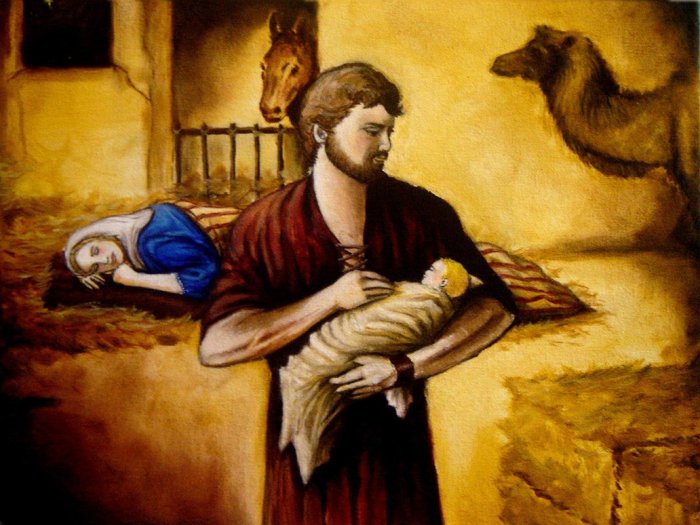
We return to the Gospel stories of the birth of Jesus every year. We line them out in song, in chorus, sermon, poetry, and plays. Our children, every last one of them, have their parts in the Christmas play. We watch, amused, tense, conscious of each lisp and stutter, against the backdrop of church platform or gym stage. Later, in the parking lot, under the cold brilliance of stars, some of which may no longer burn, we start up sluggish car engines and praise our children while the heater thrashes to warmth. The baby Jesus survives all this with a tender smile on his lips.

Scholars tell us that most certainly the baby Jesus was not born in the winter, not on December 25, maybe not in Bethlehem, and that the stable and manger would not look anything like those painted so lovingly by Botticelli or Raphael or Rembrandt. Perhaps it doesn’t matter. The telling of it carries us through the year.

There is a young woman vastly pregnant, her man protective but terrified, no pre-natal care, unblinking poverty, insurgents stroking their weapons, police with a license to kill, and all of this under a ruler who is vain, paranoid, ignorant, and volatile. It’s a story that is playing somewhere in the world every hour.

But this story, once heard and thereafter wholly imagined, transcends the details. It becomes a universal story, a comedy within a tragedy. It is as if, to choose a ready example, a Rohingya mother gave birth in a refugee camp to an infant who, thirty years later, emerged as a healer and a teacher. That is the grit and dust and blood of it. But more, this child as a man, against all odds, against all socioeconomic factors, in spite of racism, poverty, oppression, disease, and everything else that conspires to twist a child into a despairing and lethal weapon—in spite of all that—this child becomes a man who is compassion incarnated.

And the story survives too, year after year, resisting the corrosion of the hucksters and the false prophets, because it is a story so incredible that its truth, when imagined, can simply be lived.

Old Prayers

OldPrayers2:clement-gerbaud-478777

Bring out those old prayers, the ones smoothed

and shiny in the worn places, the ones

we bring out when our hearts are full

or breaking

or fogged with the breath of our escaping hope.


Bring out the ones that proclaim “Gloria Patri in the highest!”

or simply, “You still there?”


Bring them out; we can trade them back and forth.


Here’s one that was given to me by an old sailor. He said

it came to him in a tempest, but it’s not magic,

it’s what you would say when taking your leave

from an old friend:

‘Thank you! I have loved this world you gave us.’

Photo: Clement Gerbaud, Unsplash.com

Slow Train Coming

SlowTrain2:guilherme-stecanella-368391

Man lives, not directly or nakedly in nature like the animals, but within a mythological universe, a body of assumptions and beliefs developed from his existential concerns. Most of this is held unconsciously, which means that our imaginations may recognize elements of it, when presented in art or literature, without consciously understanding what it is that we recognize. — Northrop Frye, The Great Code

In Augustine’s Confessions—the original of the species of literary prayers—he devotes a whole chapter to memory. It is as fine a psychological and spiritual study of that faculty as you could find anywhere. Like a stone in the palm he turns it over and over, tracing out the striata, smoothing its roughness, feeling its weight and shape. He ponders the strangeness that he can remember remembering just as he can remember forgetting, and that somehow forgetting must also be in his memory. “Who can fathom such a thing,” he marvels, “or make any sense of it?”

The book was written a decade after his baptism into the Catholic Church on April 25, 387 CE. The chapter is like a traffic roundabout that directs the story of the events that drew him—both feverish for God and anguished at surrendering up his old ways—around toward the climatic moment in the garden of a friend’s house when his defenses gave way before a tidal surge of longing for belonging. All of that before he spun off in another direction to discuss the Trinity.

Like a viral agent Augustine gets in through the weak places in our skin of defenses. As much as I rise with him to that summit of emotion at conversion, it’s the passages on memory that I’m most vulnerable to these days since my memory itself seems increasingly vulnerable. Of all the potholes in the road to life’s end the ones that I swerve to avoid the most have to do with losing my memory. Even more than going blind, that seems the worst of the fates, because as Augustine says, “my memory is me.”  So I build habits and routines that can bridge my absentmindedness and defuse my anxiety.

Augustine’s analogies reveal him seeking out the deep crevices where memory hides in the mind or striding down the aisles in a capacious warehouse, or pausing at one of many doors in a long corridor to the past. He searches confusedly until “the dim thing sought arrives at last, fresh from depths.” In an envy-producing flourish he boasts that some things are brought up easily, properly sequenced and recalled at will, “which happens whenever I recite a literary passage by heart.” We should all be so lucky.

Alas, my current experience has me hacking my way through a landscape tangled with kudzu into a formless forest with few distinguishing marks. More positively, I see myself swimming from island to island in the sea of memory, regarding them as the tips of sea mounts that go down into the darkest depths, but give us stability in the meantime.

I’ve also realized that for some years now I’ve been re-experiencing some of the pivotal artists and musicians who have helped to construct my inner world. Without design, but surely with some intent, I’ve collected concert videos of Paul Simon, Crosby, Stills & Nash, Paul McCartney’s “Good Evening New York!” and Billy Joel’s “Live at Shea” concert, along with most of U2’s concert videos, as well as reading biographies of Joni Mitchell, Carole King, Carly Simon, CSN, John Lennon, Paul McCartney, Paul Simon, and Mick Jagger. These are of a piece with going back to books I’ve picked up over the years about Edward Hopper, Paul Klee, Georges Rouault, Marc Chagall, and Wassily Kandinsky—artists whose works are the windows of my soul. Their music and their art evoke the memories that continue to form my experience.

As I write, it is 37 years ago that John Lennon was shot outside the Dakota in New York City. As hard as it is to imagine, he would have been 77 this year. He died at 40 in 1980 and will be, as Dylan sang, ‘forever young.’ Like many of us, ‘midway through this life he awoke in a dark wood.’ I wanted to see him grow older, and to understand how he found his way out, and what his wit and wonder might have created had he lived.

Which brings me back to memories and the loss thereof, and the regaining of them through our tricks to stay afloat, as well as the silent entrance of memories half-formed, but more strongly sensed only when our striving ceases and our fences drop.

All those years ago, John said it well:

There are places I remember 

All my life, though some have changed 

Some forever not for better 

Some have gone and some remain 

All these places have their moments 

With lovers and friends I still can recall 

Some are dead and some are living 

In my life I’ve loved them all

— In My Life 

We are both the shapers and the shaped when it comes to our identities. We are drawn to those in the arts who sing our stuttering words, who sculpt our unformed desires and paint our fears in light. As Northrop Frye says in the epigram, our imaginations recognize what we may not consciously see. When we need it, it will appear. Like the Zen saying goes, “When the pupil is ready, the teacher will arrive.”

Sometimes memory is a slow train.

Photo: Guilherme Stecanella on Unsplash.com

Real Facts

RealFacts2:simon-wijers-37854

The distinctive thing about real facts, however, is their individuality. Not to put too fine a point on it, one could say that the real picture consists of nothing but exceptions to the rule, and that, in consequence, absolute reality has predominantly the character of irregularity.— Carl Jung, The Undiscovered Self

Of all the strange things that happened to us that year, my walking on the water got the most laughs. Even today it’s a cliche for magical thinking, the punchline about someone who thinks he’s divine or just insufferably self-righteous.

I’ve always had impulse-control issues. I load, I fire, I aim. I leap—and I look—all the way down.

I am Peter, aka The Rock, not because I am the foundation for the church, but because I am hard-headed. He knew that, of course; it was an inside joke between us. You put the least-qualified in charge and see how it rolls. By beholding we become changed and all that. There is something to that, by the way, for I softened over the years. Not that I was weak, but rather I became deliberate. That was years away from the unfortunate water landing, and well after Jesus leaned into me one afternoon and said, “Someday they will bind you and take you where you do not want to go.” Just that, and he held my gaze for a moment, stopping my quick retort.

For once, I had nothing to say. I dropped my eyes then, for I was seeing myself on a stony path by torchlight, my hands bound in front of me, soldiers at my back and front.

I am the disciple, remember, who almost got it right about Jesus and then got it all wrong—all within an hour. He had asked one of his questions again; this time he wanted to know what people were saying about him. An odd question, until you realized that almost no one knew what he was. It wasn’t enough that he was a man from Nazareth or even that he was the one who made a few loaves and fishes into a meal for thousands. The crowds only had a few superheroes they could imagine: Abraham, Moses, Elijah . . . oh, and John, recently beheaded by Herod. So they thought he was another version of one of those.

He asked, “Who do people say I am?,” and we all muttered one thing and another about Elijah and John. “Who do you say I am?” he said, and we all looked at our shoes. He really seemed unsure. It was as if he needed confirmation of something he desperately hoped was true—or was afraid was true.

You have to get these things right for him, and frankly, we weren’t all that sure ourselves. But, as usual, I jumped in there with the answer we all wanted to hear. “You’re the Messiah!” I blurted. There wasn’t anyone else who it could be, even though he didn’t seem to care much about the position. But this time he didn’t deny it. Of course, he didn’t admit to it either. He just told us to keep it to ourselves.

“Well, good,” I thought, “things are looking up.” But then he started in about going up to Jerusalem, and how the elders, and the chief priests, and the scribes would reject him. That wasn’t a surprise: he’d been on the outs with them for a long time. The words were coming in a rush now, about how he would be killed and would live again three days later. He was very plain about it. That’s when I pulled him away from the others. I lowered my voice, “What are you saying? We here know you are the Messiah. Take it! The Messiah doesn’t die. Am I missing something here?”

At that he spun back to the others. “Get away from me, Satan!” he shouted. “You’re counting on human plans, not divine ones!” He was speaking to them, but he meant me. I saw the shock on their faces at his words and then they glanced at me, horror-stricken. Before I could reply, he was rounding on the crowd that was gathering.

“If you want to follow me, then take up your cross! If you want to save your life, you will lose it, and if you lose your life because of me and the gospel, you will save it.” Clearly, this was crazy talk, but he wasn’t through.

“What does it matter if you gain the whole world, but you lose your own soul?” He glanced around at them. “What could you give to get your soul back, eh?”

I am remembering all this because I have been trying to sort out how we who followed him understood him. When you’re in the midst of it you just try to keep up. The understanding comes later, I found. And if we take up our cross to follow him, then at some point the cross becomes more than a symbol: it is a killing machine upon which we really do die. After all, the point of “taking up one’s cross” is to realize that we carry our death with us daily. What I couldn’t understand at the time is how that could ever be anything but suicide or treason.

At the time I could not bear the thought that he would die in this way. I envisioned a deathless life for him. I saw him as the one who would change the architecture of our world so that the long shadow of this constant cruelty would vanish. I wanted him to open up the sky so we could stand in the sunlight as creatures of God, not as prisoners of Rome. If that meant pulling down the palaces and temples that blocked the sun, then let’s get on with it.

But that’s not what he was on about. He saw the world so differently than we did. I wanted to ask him, “When you look at the world what is it that you see?”* There were times when we were with him that something he said or did clicked into focus and we saw an expression that was so clear and so true that it changed the atmosphere when he walked into the room.

But I found that the clarity dissolved when he wasn’t around. When we tried together to remember and explain it to each other later in that upper room, it refracted like a kaleidoscope. My unprayed thought back then before his death was that I tried to be like him, I tried to feel the way he did, but without him it was no use.

I couldn’t see what he saw when I looked at the world.

****

All these years later I am writing from this prison cell. As he said so long ago, my hands were bound and I was led away.

His death changed everything, of course. That was all, but it was everything. I carried my cross every day after that.

I betrayed him and he forgave me.

This is how we see the world like he does — through the lens of betrayal and forgiveness.

These are the real facts.

*U2 (2000), “When I Look at the World,” All That You Can’t Leave Behind.
(Photo: Simon Wijers, Unsplash.com)

We Are What We Think

WhatThink:rendiansyah-nugroho-454059

Oh East is East and West is West, and never the twain shall meet. . . — Rudyard Kipling

We are what we think. All that we are arises with our thoughts. With our thoughts we make the world. — The Dhammapada

The world is orderly and simple.

The world changes constantly and is immensely complex.

These two ways of thinking have shaped human behavior and culture for millenia—and lately they have been tested in the laboratories of cultural psychology.

Richard Nisbett’s book, The Geography of Thought, builds the case that Westerners and Easterners differ in their fundamental beliefs about the world. As one of his graduate students from China said to him, “You know, the difference between you and me is that I think the world is a circle, and you think it’s a line.” Nisbett, a distinguished professor of psychology at the University of Michigan, was skeptical but intrigued. He’d always thought of himself as a universalist, someone who believed humans perceive and reason in the same way. While their cultural practices may vary widely, he thought, their ways of perceiving the world are generally similar.

He summarizes this tradition in four general principles. First, everyone has the same basic thinking processes when it comes to memory, categorization, inference, and causal analysis. Second, when people from different cultures have different beliefs it’s because they have been exposed to different aspects of the world, not because they actually think differently. Third, reasoning rests upon logic: a proposition can’t be both true and false. And fourth, our reasoning is separate from what we are reasoning about. You can think about a thing many different ways—and you can use your reasoning to come up with wildly different results. Such was the tradition that could be traced back through the Enlightenment to the Greeks. Surely everybody thought in the same way.

But that turns out not to be the case at all.

In test after test, Western subjects focused on the objects in the foreground of a video while Eastern subjects took in the whole background. That’s consistent with another finding that Westerners regard objects as most important and Easterners emphasize relationships. Following Greek thought, Westerners think of themselves above all as free agents, individuals who act upon the environment around them, changing their circumstances to match their ambitions. Easterners, following Confucian thought, see themselves as part of a harmonious whole, experiencing the links between people and their environment as continuous. One does not so much wrest control away from Nature as align oneself with it.

Independence, practically a virtue in Western societies, begins at an early age as we teach our children to “stand on their own two feet,” “think for themselves,” and “grow up.” Interdependence, the way of many in Eastern cultures, helps children to understand the reactions of others. One of Nisbett’s research partners, a 6 ft. 2 inch football-playing graduate student from Japan, was dismayed to discover, at his first American football game, that University of Michigan football fans thought nothing of blocking his view of the game by standing up in front of him. “We would never do anything to impair the enjoyment of others at a public function like that,” he said to Nisbett. It seems that compared to the Japanese wide-angle view Americans have tunnel vision.

Sensitivity to others’ emotions provides Easterners with a different set of assumptions about communication also. Whereas Westerners take responsibility for speaking directly and clearly, a “transmitter” orientation, Easterners adopt a “receiver” orientation in which it’s the hearer’s responsibility to make sure the message is understood. Nisbett notes that Americans sometimes find Asians hard to read because Asians make their points indirectly; Asians, on the other hand, may find Americans direct to the point of rudeness.

The differences extend to how we think about causality and how we deal with historical events. Japanese teachers, says historian Masako Watanabe, begin a history lecture by setting the context. They then proceed chronologically through the events, linking each one to the proceeding event. Students are encouraged to put themselves in the mental and emotional states of the historical figures being studied and to draw analogies to their own lives. Students are regarded as thinking historically when they are able to see the events from the point of view of the other, even Japan’s enemies. Questions of “how” are asked about twice as much as in American classrooms.

By contrast, American teachers usually begin with the outcomes and ask why this result was produced. The pedagogical process often has the effect of destroying historical continuity and reversing the flow to effect-cause. This reflects the Greek heritage of the West in which we have the liberty to find our goals and define the means to attain them.

“Easterners,” says Nisbett, “are almost surely closer to the truth than Westerners in their belief that the world is a highly complicated place and Westerners are undoubtedly often far too simple-minded in their explicit models of the world. . . . But Aristotle has testable propositions about the world while the Chinese did not. . . . The Chinese may have understood the principle of action at a distance, but they had no means of proving it.”

No one is making value judgements about these varying perspectives. They are different ways of being in the world and viewing the world. But if this research is true or even close, we should pay attention to it for it could change how we communicate with millions and millions of people.

Occasionally in life we stumble across something that opens a window into our own interior castles. That is the experience I had reading The Geography of Thought. Time and again, as I followed the tests scattered throughout the book, I was taken aback at my unconscious affinity for Eastern thought. More often than not, when I was absolutely honest with myself, I realized how often they are my default positions.

That might explain why I found it so difficult to be the ‘answer man’ when working in faculty development at a research university. While some thought I should provide techniques that would work in every classroom—universals, in effect—my tendency was to see each teacher and each classroom as distinct. Instead of developing objectives for all to reach my thought was to develop each teacher’s own style to fit their context. Context and background instead of rules and foreground. At the time I lacked the analogies to talk about it, although pushing against that instinctual feeling made me feel off balance much of the time.

Thus we live and learn and discover coves and bays along our spiritual shoreline we did not know were there until we put out to sea.

Photo: Rendiahsyah Nugroho on Unsplash.com