One Love

”By his grace and help therefore let us in spirit stand and gaze, eternally marveling at the supreme, surpassing, singleminded, incalculable love that God, who is goodness, has for us.” — Julian of Norwich
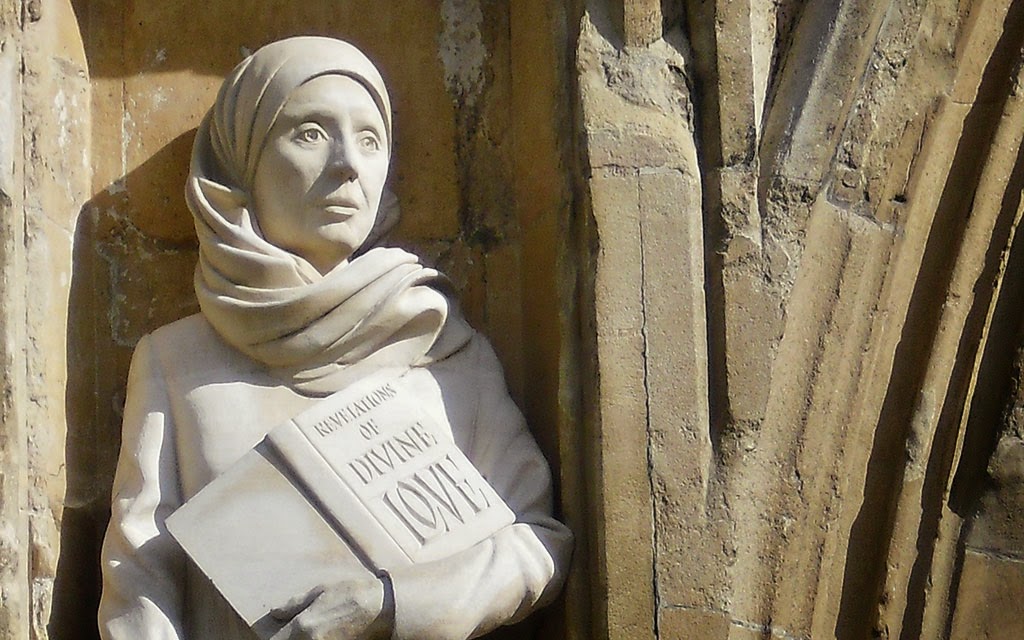
On the eighth of May, in the year of our Lord 1373—the third Sunday after Easter—a thirty year-old woman, known to us as Julian of Norwich, received sixteen “shewings” or revelations, which she later acknowledged were visions from God. Near the beginning of that month she had fallen to an illness, the nature of which was not known. After a week in which her condition worsened and she was thought to be dying, a parish priest was called to administer the last rites. At the conclusion, as he was leaving, he placed a crucifix before her and bid her look upon the face of her Savior for comfort. In the next hours, as she prepared herself for death, the showings were revealed to her in rapid succession.

The first fifteen came to her the morning after the visit of the priest, starting at four a.m. and finishing at nine. The last one, the sixteenth, occurred later that night, concluding and affirming the previous ones. Much to her surprise, and that of her family and friends, she recovered. The meaning of the visions occupied her for the remainder of her long life.

There resulted two written versions of the revelations, the first and shorter version inscribed soon after she recovered, and the longer version some twenty years later, the result of much meditation in the intervening years. Although the later, longer version may naturally contain some embellishment on the original visions, both are considered authentic by the Church. She called herself “an unlettered person,” a deprecatory statement that testifies to her humility, but is refuted by “the sheer integrity of Julian’s reasoning, the precision of her theology, the depth of her insight, and the simplicity with which she expounds profound truths.”1

So little is known of her life that what we learn of her character and background must be gleaned from the writings themselves. Based on allusions and hints in the text, biographers have tried to put together a plausible story that takes into account the context of her times.

In 1332, ten years before her birth, the bubonic plague—the Black Death—originated in India, making its way westward by 1347 to devastate Europe. Geoffrey Chaucer was born in 1340, two years before Julian, the same year that Queen’s College was founded at Oxford. In 1349 the Black Death arrived to kill off a third of the population of England. By 1350 Salisbury Cathedral was completed, and in 1352 Corpus Christi College, Oxford, was founded.

In 1361 the Black Death reappeared in England for the second time, devastating Julian’s home city of Norwich, this time striking down infants and small children. Julian would have been nineteen at the time. Her memories of the first plague during her childhood may have been diffuse but unforgettable. In the second wave she was nineteen, married and probably the mother of at least one child, a child who quite possibly was also one of the victims.

Although she does not mention specific personal losses in her writings, she does reflect on the travail and sadness she experienced. There was a time, she writes, “when I had a great longing and desire of God’s gift to be delivered of this world and of this life. For oft times I beheld the woe that is here and the wellness and blessed being that is there . . . This made me to mourn and earnestly to long—and also my own wretchedness and sloth and weariness—that I did not want to live and to travail as it fell to me to do.”2

Plagues and wars were regarded as God’s punishment in Julian’s time, although human sin was the weakness that brought on the devastation. A single sinner could bring down the wrath of heaven on a community. It is the state of our sufferings here that weighs upon her in her solitude. Like anyone else, the presence of evil and suffering seems to her disproportionate to our culpability.

Her biographers and translators (she wrote an early form of English that can be difficult to read) are quick to affirm that in matters theological she followed the Church’s teachings without question—with two important exceptions. She did not accept that God could be wrathful and she did not believe that humans were wholly evil. Augustine’s doctrine of original sin neither convinced her nor intimidated her. As for the wrath of God, she saw only love in all that God did.

Just as the whole of life is rooted and grounded in love, and just as we cannot even exist were it not for God’s love poured out on us, so Julian infers that it is impossible that God should be angry. “I could see no sort of anger in God, however long I looked,” she recounts. “Indeed, if God were to be angry but for a moment we could not live, endure, or be (Julian 138)!” The dread we feel when we sin is not from fear of God, but from our deep need for God’s forgiveness and grace to overcome our sense of separation. It is the fear of the runaway child who suddenly sees herself alone and longs for home and for her parents.

Various theories and conjectures have been put forward to explain her divergence on these matters. Insubordination does not factor here: she voluntarily submitted to the Church’s authority and teachings. Lack of knowledge? Hardly, since the doctrine of hellfire, purgatory, and eternal torment would have been part of every child’s upbringing in her time. One commentator suggests that despite the trauma of surviving two waves of the Black Death before she was twenty, she was the product of a loving, stable, and happy home. While Norwich was a consequential city, the fourth largest city in England at the time, she had been shielded from its ranker aspects and probably never traveled beyond its immediate countryside. Simply put, she had little continued exposure to the cruelties and vileness of human depravity. In her innocence she saw the beauty and worth of every person.

“There is a godly will in our higher part, which by its basic goodness never wills what is evil, but only what is good. This is the reason why he loves us, and why we can always do what pleases him,” she wrote (Julian 118).

In her work as an anchoress, a person who voluntarily withdraws from the larger world to pray for the world and to counsel others, she no doubt heard their woes, their pains, their grievances against others, and their spitefulness. But she steadfastly held the belief that there was a seed in every person—without exception—that was pure and undefiled and was the germination point for the Holy Spirit in that person’s life.

Yet, the very presence of evil and suffering troubled her. She returned to the subject time and again throughout the revelations. “Good Lord,” she writes, “how can everything be all right when such great hurt has come to your creatures through sin?” In an aside to her readers she confides, “I desired, as far as I dared, to have more information for my own peace of mind (Julian 106).”

The answer came to her in two parts. Of the first, concerning our salvation, there is no mystery. Everything we need to know, everything we are hungering to hear from God about forgiveness, grace, and love, is there for the taking. “In this our Lord intends us to be occupied: delighting in himself, as he delights in us (Julian 106).”

The other part may not satisfy us today, accustomed as we are to perceive mysteries as information we have not yet analyzed, collated, and distributed. “The other part is completely hidden from us,” she writes. “It is our Lord’s own private matter, and it is the royal prerogative of God to be undisturbed in that which is his own business (Julian 107).” If we really wanted to please God, she says, we would want only what is God’s will, and in this case it is God’s will that we should not know this just yet. In later passages she hints that the last great secret that God will reveal to his children will be how he has determined the final judgment.

Sin, Julian says, “has no substance or real existence. It can only be known by the pain it causes (Julian 104).” The pain passes quickly and works on us to purge us and make us self-aware; in that pain we turn to God for mercy. “Because of his tender love for all those who are to be saved our good Lord comforts us at once and sweetly, as if to say, ‘It is true that sin is the cause of all this pain; but it is all going to be all right; it is all going to be all right; everything is going to be all right (Julian 104).’ ”

The refrain that sings throughout the Revelations, from beginning to end, is that all will be well. We might think this to be a passing surge of emotion, but it remains at the core of her being after a lifetime of reflection on her extraordinary personal vision. She lived, as near as can be determined, well into her seventies, loved and admired by those drawn through need and circumstance into her circle, as acquainted with the sorrows and agonies of life as with the abiding assurance of God’s love.

***

Every once in awhile, perhaps when it is most needed, some person is lifted and held in the arms of God long enough that they return with God’s heartbeat pulsing through their veins. This has happened in diverse eras to reassure us that God has not left us orphaned. What catches our breath and quickens our spirits is that some of them return with gifts from that far country (as miraculously close as the light behind their eyes)—gifts of words and images that draw us up to God.

“With regard to the physical sight,” Julian states, “I have related what I have seen as truthfully as I can. For the words I have repeated them exactly as our Lord showed them me. About the spiritual sight I have already said a fair amount, but I can never describe it fully (Julian 191–2).”

What we can say runs behind what we can imagine. What we can imagine we can’t always say. Does our imagination outrun our language? Does our language constrict the limits of our imagination? Julian’s vision of God and of Jesus—she called him ‘Mother Jesus’—and of the Holy Spirit, transcended both her time and her Church.

The being of God is, in our present state, unknowable, but in the Word made flesh—in Jesus—we see all we need to know of God that we can bear. We sometimes turn away from this because we do not trust our experience. Julian herself at first could not believe her spiritual eyes: “On the very day that it happened, when the vision had passed, I—wretch that I am!—denied it, and said quite openly that I had raved (Julian 187).” But the Lord showed it all over again to her, in greater detail this time, and quietly said, “You know that was no raving that you saw today.” Take it, he said to her. Believe it, comfort yourself with it, live in it. “For his will is that we should continue to believe it to the end of our life, and remain in the fullness of this joy thereafter (Julian 188).”

All will be well.

  1. Julian of Norwich. Revelations of Divine Love. Translated into Modern English by Clifton Wolters. New York: Penguin Books, 1966, 29–30.
  2. Frykholm, Amy. Julian of Norwich: A Contemplative Biography. Brewster, MA: Paraclete Press, 2010, 24.

Our House

Photo: Pierre le Vaillant, Unsplash

”The kingdom of truth is consequently not the kingdom of some other world. It is the picture of what this world ought to be . . . It is not some realm of eternal perfection which has nothing to do with historical existence. It constantly impinges upon man’s every decision and is involved in every action.”1

For a good stretch of my younger reading life I was immersed in science fiction. It offered worlds that could only be imagined, thankfully, since most of them were ramped-up versions of this one, but several orders of magnitude more hideous. They were warning messages and the message was, if you think this is bad you ain’t seen nothin’ yet.

They featured intergalactic battles, plagues scourging entire civilizations, aliens traveling thousands of light years to obliterate our planet out of sheer, arbitrary cussedness (“Of all the planets in all the solar systems in all the universe, TZoth, you had to pick this one”), and the occasional beneficent link between worlds.

The best of the hard science fiction built plausibility on a platform of physics; it was exhilarating to see where science could go when imagination pushed the status quo. For a layperson in science, these revelations came as a surprise and a preview of what might come to fruition.

There was heroism too, when the future of civilization and of the world itself belonged to the one whose grip forced the hand holding the death-ray down, down, and then, snap. Order restored; don’t screw it up again. Please.

I liked the stories best that played with questions about ultimate meaning, like whether humans really had anything to offer the universe or what it was that distinguished us from androids. After all, androids were faster, smarter, more efficient, impervious to physical maladies, and couldn’t lie. Humans, well, we are a mixed bag, to put it generously.

Often, the bright line of value between humans and androids was in the freedom we possessed that allowed us to color outside the lines. From that freedom arises beauty, creativity, and truth. But where there is freedom there is the potential for giddy mischief, sullen imperfection, and tragedy. The alternative, however, a sterile perfection of monochrome conformity, kills everything in its path. The grim truth that almost every utopian community has had to face is that coercion in the name of preserving freedom turns a eutopia (a ‘good place’) into a dystopia (a ‘place too awful to work’).

But what we lose in the process, we gain in the effects. Remember how Data on Star Trek achieved technical perfection on the violin, but lacked the feelings to wash the notes with pathos and hope? He knew what he was missing, but that wasn’t enough to grant him the emotional muscles that would move his fingers to draw out the beauty in a Hayden violin concerto.

The humans in some of these tales were clearly louts on the lam, who found their mettle in the midst of battle and survived to rise above their “fleshly nature,” as Paul might have put it. While most of them were wedded to a form of individualism more reflective of Gordon Gekko than Ralph Waldo Emerson, occasionally there would be a spiritual breakthrough, and one of them would admit to feeling in the presence of a vast and lonely Force, while gazing moodily out a porthole en route to another military assignment. Their virtues were often exercised in the face of a tragic decision to die fighting for the lives of the innocent victims of the corrupt corporations that had hired them to preserve their power.

In one of the book series, intrepid human explorers journeyed light years away to an uninhabited world to establish an outpost, a way-station for further exploration. They had hijacked a small fleet of interstellar transport vehicles and had escaped Earth because of mounting anarchy around the globe, climate change run amok, and an America ruled by right-wing authoritarians. The chance to start from scratch, to build a world that had learned from history and would not repeat its mistakes, was the lure that drew this diverse band of artists, engineers, mathematicians, policy wonks, historians, and community organizers.

This was Sim-World on a grand scale, with all the complexity and diversity that one could imagine, now put to good use with attention and intention. This is Creation, Day One, with a chance to reverse-engineer all our present social conundrums back to their original lines of code and rewrite them. It is tempting to think that we could do better this time around because we’re starting out with knowledge of past mistakes and the technology and will to invent the future.

In such a society, historians would be venerated for their interpretive abilities, while scientists would be honored for their adherence to the facts. The poets and artists would portray the acts of the imagination that would cast light on the darkness of unknown futures. Prophets and priests need not apply, since we were intimately acquainted with the neural transmitters that boosted our endorphins or inhibited our guilt.

Yet, one theme that was often present, even at a faint decibel level, was the love for this Earth, this ‘dear, old, warm Earth, as comforting as a grandmother.’ I remember one novel, the title and author of which is lost to me now, that was the story of the literal breakup of the Earth as the result of electro-magnetic forces deep within the core that had gone haywire.

The central figure was a young scientist who had first stumbled upon the clues to this disaster and worked together with an international team to alert the world. The last third of the book follows those who are preparing for the end. Our young man drives from San Francisco to Yosemite and climbs Half Dome to witness the dawn of the last day on Earth. He knows the hour the cataclysm will arrive; he wants to be in a place where he can face the wave that is coming with stoic courage. But as he waits in the semi-darkness, feeling the first tremors around him, he hears the wafting of wings overhead as a flock of birds rushes up from the valley. He takes in the fragrance of the pines, feels the coolness of the stone beneath him, and he begins to weep, not from fear—he’s beyond that—but for the love of the body of the Earth which will be no more.

***

Ask anyone to describe Heaven and they might facetiously give you the clouds, the harps, and the pearly gates. But if they reflect for a moment—and set aside their skepticism—they’ll probably imagine something infinitely better than the most beautiful place they already know. Our heavens are linear extensions of this Earth. Once you trim off the silliness of caricature you realize that there are as many versions of Heaven as there are people to imagine them. And that alone should preclude any obstinate certainty about its dimensions.

We do get a glimpse at the most famous scenario of them all in the Book of Revelation. There John describes a city with streets of gold, gates of pearl, and walls of jasper and other precious stones—a vision, if taken literally, that would nicely fit the garish tastes of a Las Vegas casino magnate. My own desires run to a kind of Hobbiton, each of us with our own cosy burrow built into the side of a hill, overlooking a verdant valley, with a backdrop of mountains from the Canadian Rockies.

No matter. What John gave us was what he saw through the lens of his experience, married to his greatest hopes. For him, it was the most beautiful city he could imagine, clean, sparkling, bathed in light, with no dark, dank corners and no terrors. There would be no night there for God is there and the darkness will never overcome the light that has come into the world.

The story, which we are free to believe, is that God will come to live among the people. However it appears to those whose eyes are opened, what everyone will see is “Immanuel,” God with us. Where Jesus is, there is God, and where God is there is love. And the measure of that love is that God moves into our house with us, this sweet old Earth made new. And how fitting, somehow, that ecology, the study of the relationships between all organisms, is derived from the Greek word oikos, which simply means “house.”

  1. Niebuhr, Beyond Tragedy, 277.

Glory Days

Paul is perhaps the greatest poet of personal religion . . . The first romantic poet in history.”1

Photo: Marius Christiansen, Unsplash

Those who set out to write The Great American Novel after Huckleberry Finn are doomed to failure, although the attempt has produced works worthy of admiration, and inevitably, emulation. Did Twain know he was writing literature that would not only have a shelf-life beyond his own mortality, but would stand as a story that continues to delight and enrage people to the present day? Did the artist known as Homer grasp that his Iliad and Odyssey would become the templates for war novels, road trip movies, and epics of war heroes returning home in disguise? Probably not, although in Dante’s case he was pretty matter of fact that his Divine Commedia was destined for greatness, and within his lifetime it was proven so.

We make our judgments about what is good-better-best when we have more than one thing to compare. We rely on our experience and, probably more than we should, on what experts tell us. We know what we like to read, what moves us and fills our heads with strange and huge ideas.

But when it comes to the Bible, particularly the New Testament, we rarely think of the beauty of the writing. We’re concerned for the authenticity of the voice and the orthodoxy of the theology. The irony is that none of the writers of the New Testament thought of themselves as theologians. They wrote what they saw and imagined and recalled within their communities as they were moved by the Spirit of God. That any of their narratives came together in the first place, particularly the Gospels, seems like something of a miracle in itself.

When we realize that post-resurrection believers of the Way, who lived and worked and worshipped together weekly, exchanging stories of ‘the Christ,” did so without any of the written texts that we know as the Gospels—did so for some forty years, an entire generation—it should give us pause as we dust off that paperback version of the New Testament which can be had for the price of a latte.

Editions of the Bible, niche-marketed more heavily than any other book in the world, may strike us as opportunistic (a “Souldiers Bible,” a Protestant version, was carried by Oliver Cromwell’s troops), the goal of Bible publishers being to spread the Word by any means necessary. Annual sales of the Bible top $425 million, with over 80,000 versions loose in the world today (Brandon Gaille.com). Zondervan alone has over 350 versions of the Bible in print, and in any given year over 20 million Bibles are sold in the United States. The average Christian owns at least nine versions of the Bible, nevertheless twelve percent of American Christians think that Noah was married to Joan of Arc.2

Thus, we idealize the Biblical authors in such ways that we don’t see them having a life apart from their writings. Amos is “among the shepherds of Tekoa” when he is gripped by God to prophesy. We don’t know how he felt about this disruption to his life. Given that the message he carried was of woe and darkness, it couldn’t have given him much comfort or ease among those with ears to hear. Was he a shepherd himself? We assume so, but we don’t know. Did he go back to sheepherding after his prophecies thundered out?

Maybe they came in spurts as he meditated on the hills with his flocks. Maybe he carried them in his head until such time as he could write them down—and how remarkable that he was literate. Did he exult at the excoriations of Israel’s neighbors and tremble at the judgements on Judah and Israel for their triple transgressions? When he was bashing the rich and indolent women of Bashan for their vanity and cruelty, did he imagine that thousands of years later we would read of them dragged out through their breached city walls by fishhooks through their noses and cheeks?

Isaiah—and then Second Isaiah and probably a Third Isaiah—are years apart as authors, their writings spliced by anonymous editors into some of the most beautiful, heartbreaking, jaw-dropping poems of grief, exultation, and glory in the Western canon. As Robert Alter notes in his magnum opus, the translation of The Hebrew Bible, “It is above all the vehicle of poetry in all these prophets that demands close attention . . . and it is perfectly fitting that God should address Israel not in prose, which is closer to the language of everyday human intercourse, but in the elevated and impressive diction of poetry.”3 Were they writing for the ages or for their own time?

We want to know their motivation for writing, the methods they used, whether the writing itself was a burden or a joy or something they saw as a holy duty. In contrast to the best-selling authors of our time, they functioned as conduits instead of celebrities in their own right. We infer their temperament and purpose from the broad strokes of their writings.

The author of Mark writes a hasty, breathless, and down-home form of Greek. It is a compressed narrative that Matthew and Luke expand, revise, and extend. Matthew’s constant citing of Hebrew prophecies and laws reveals Jesus as the fulfillment of centuries-old hopes. Luke begins his gospel with a personal salutation, but then drops into the background and stays there, even through his sequel in Acts, appearing obliquely as the companion of Paul. John offers some tantalizing hints about himself as “the disciple Jesus loved” and “this is the disciple who is testifying,” and then finally, in the last verse, emerges onto the stage himself to say, “I suppose that the world itself could not contain the books that would be written” about his best friend.

But it is in Paul’s letters—all of them written in a fairly short span between the middle fifties and sixties before his execution, probably in CE 64—that we get a sense of a Biblical author in some detail. He can be, and probably was, an infuriating person. He certainly provoked enough animosity to be beaten, threatened by mobs, chased out of towns, and forced to flee for his life more than once.

That he was an extraordinary person is beyond question. Fluent in several languages, he was fueled from a passionate core that took him from being one zealous for God to the point of having a license to hunt down the people of the Way, to one equally zealous in the service of the risen Christ. The man who could roundly curse his opponents in Galatia by calling them “dogs” could also write a panegyric on love in First Corinthians 13 that has never been equalled.

There is no disputing that what we know as Christianity owes its existence in large measure to this indefatigable little man, small enough to be lowered in a basket over a city wall, who traveled thousands of miles, usually on foot, for some thirty years, establishing small communities of believers in cities throughout Asia Minor.

He remained a faithful Jew all his life, but one who had his spiritual and intellectual axis violently recalibrated by a vision of the risen Christ. For him, this crucified Jesus had breached the defenses of the principalities and powers of this dark world, and had brought heaven and earth together. God, through Jesus, had bridged the abyss between divine and human, reconciling the world to himself, and it was Paul’s honor to carry that message and to suffer with Christ.

There are few people like Paul. He was relentless in his purpose, unwearying in his efforts to build communities of people who would cease to live for themselves and instead be the hands of God in the world. Confident to a fault, he could yet call himself “chief among sinners,” and in his lowest moments wonder if he had wasted his life for no purpose.

In his second letter to the Corinthians he confides that “we were so utterly, unbearably crushed that we despaired of life itself (2 Cor. 1:8).” While God had rescued him from that peril, in the letter to the Philippians written from prison in Ephesus, he writes a poem about Jesus that could only have come from a man who had had time to explore doubt, fear, and the sure prospect of a violent death. “Let the same mind be in you that was in Christ Jesus,” he pleads, tracing the self-emptying of Christ who “became obedient to the point of death—even death on a cross (Philippians 2:5,8).”

Paul encourages his friends—and we may count ourselves in that select group—to “work out your salvation with fear and trembling, for it is God who is at work in you, enabling you both to will and to work for his good pleasure (Philippians 2:12,13).”

He never loses hope, not that he will escape suffering and eventual death, but that he will soon see Christ Jesus face to face and he will “know as he is known.”

This complex, irascible, brilliant man, who can thread the needle of the closest arguments, and yet pour out his heart unreservedly to whoever is drawn into his orbit, probably had personal contact with fewer than a thousand people in his lifetime who would, in time, be referred to as “Christians.” In the letters he wrote, letters that both dealt with the common frictions of diverse people living together and yet revealed the most glorious secrets of the living God, we find the preparation for the Gospels themselves, and the most compelling example of other people’s mail changing the world.

  1. A. N. Wilson, Paul: The Mind of the Apostle, 220, 221.
  2. Brandongaille.com
  3. Alter, Robert. The Hebrew Bible: Prophets, 618.

The Patience of Hope

“Hope and patience belong together. Only a church that is learning patience can proclaim hope effectively.” — Rowan Williams, Being Disciples, 1

Photo: Valou C, Unsplash.com

When the King James Version writes of Jesus as saying to the disciples and those gathered around, “Suffer the little children to come unto me,” he means they should have patience with them, they should bring them into the circle and make allowances for them.

Patience, from the Latin verb pati, means “to allow, to suffer,” in the sense of endurance. To be patient with someone is to allow for their slowness, their fumbling, perhaps also their irritating arrogance.

I came across this pairing of hope and patience in a beautiful little book called Being Disciples, by Rowan Williams, the former Archbishop of Canterbury. Williams describes faith as confidence in a “dependable relationship” with God, and that, in turn, frees us from anxiety about who we are. As Christians, “Who I am is in the hands of God,” and “It tells me that I am more than I realize, in the eyes of God, for good or ill.”2 We may hope in the unseen God because God knows us intimately, even the depths of the human heart. Hope, then, is not simply confidence about the future, but it also ties together past, present, and future in the memory that just as God has had our backs in the past, so God can be depended on to hold us in the future.

The Church should model this too, as Williams says, “This suggests that the Church needs to be marked by profound patience: patience with actual human beings in their confusions and uncertainties.”3 There are some hard truths for anyone who chooses to belong to a spiritual community:

It takes time to grow up into Christ.

We grow at different rates.

Sometimes we reverse our growth.

“And if it takes time for us,” Williams says, “then it takes time for the Body, the community, to grow overall. Hope and patience belong together. Only a Church that is learning patience can proclaim hope effectively.”4

I witnessed this first hand in a little church in Canada, the last place my stereotypes of such a church would have allowed me to imagine it. Soon after we were married, my wife and I joined another couple in volunteering for a year to teach in a K-12 school and help out at the local church in a town in the Okanagan Valley of British Columbia.

Not long after we arrived in the fall, a young couple was baptized into the church. Nothing unusual about that except that the two candidates were unmarried—and the young woman was vastly pregnant. The pastor, a kindly and humorous man in his fifties of Ukrainian descent—one of many Ukrainian families in that area of Canada—had a mannerism of fixing his eye on a spot up in the corner of the church while he preached and speaking with a broad smile on his face.

I can’t recall much of his sermon after the baptism, except his comment that this young couple had decided they wanted to join with the body of Christ and they wanted to bring their child up in the church from the start. It was now our privilege and responsibility to see that they had the love and support they needed from all of us. And he said, with a smile on his face and in his voice, that we could expect to see them up front again soon and we were all invited to witness their marriage.

My stereotypes—conservative church, conservative pastor—hadn’t prepared me for this. The community I had grown up in made such people invisible. While they would never have been publicly called out for censure, they also wouldn’t have been baptized. Conventional religious wisdom said these kids had gotten the prescribed order wrong: first you date, then you marry, then you have children, and, of course, you bring them up in the church because you’ve already been baptized, probably about the age of twelve. But here they were, a bit bashful but joyous, clothed in their robes and immersed not only in the waters of baptism, but also in the assurance of love and acceptance by their community.

This raises a fundamental question about the kind of community we think the church should be. Is it a place for perfected people who are safe to admit to the kingdom? Or is it a home for the spiritually halt, the blind, and the lame? People like you and me, in other words. Do we accept people into the fellowship in order to let them grow or grow them first and then bring them into the fellowship?

Critics of the Church (and Christians themselves) often point out that Christians talk a good line, but don’t live up to it. Shouldn’t it make a difference how you treat people, they say, if you’re going to claim that you’re better than the rest of us?

They’re right—it should make a difference, a difference that others can see and feel. It should make a difference in the places we work, the lives we touch, the decisions we make. When we’re honest with ourselves—the kind of honesty that opens up from assurance, not from fear—we know that we are broken, and we know that we are ill. There’s no self-pity in that; we simply own up that our situation is serious.

That shouldn’t be the end of it, of course, as if we woke up one morning paralyzed from the neck down and then idly wondered what we might make for breakfast. Awareness of our condition comes through humility, but it also requires a revelation, an insight from outside.

There are things about us that we know and others know; there are things that we know that others don’t know; there are things about us that others know, but that we can’t see. And there are things that others don’t know, and we don’t know either. The secret things of the heart, the Bible calls them, that which the Spirit searches out.

Some of these erupt when we least expect it and we find ourselves doing things that can’t be explained but horrify us, nonetheless. There’s hope in that; if we can still find our actions abhorrent, we know there remains a flicker of conscience, like a candle in the wind.

There’s also hope to be found in the strengths we didn’t know we possessed. These surprises of the heart that spring up from what Paul calls “the spiritual level” are the result of “Christ dwelling within you.”5 They may come out as the courage it takes to not go along with implicit racism or the self-control to bite back a quick retort or the willingness to risk something new that draws us into God’s sphere of compassion.

What we need is a watchfulness, an alertness to our surroundings and to the fluctuations in the atmosphere in which our expectations of change live and breathe. There are times when all we can do is rest in the space between the notes. It’s not for nothing that even in dire straits the Psalmist says, “I believe that I shall see the goodness of the Lord . . . Be strong, and let your heart take courage; wait for the Lord!”6

All of this takes time. And as faith in action complements the awakening of our conscience we begin to grasp that it’s not God who is slow to act on our behalf, but rather it’s our limited bandwidth in understanding.

God “suffers” us as he draws us to him through the Spirit. If Jesus was often impatient with the disciples for tripping over the basics, it was because he sensed his time on earth was almost up. After all, he was human too. But he also showed through his own faithfulness in reflecting God that “God’s way is not to coerce us by force or by some undeniable evidence of his power . . . But to allow us to do with him what we will . . . And to wait and to endure with the authority of an unchanging love.”7

God is patient with us as we tumble and stutter. And if the Church’s task in every age and every place is to witness to the divine story in history and “to make connections between his story and ours, between our little lives and the great life of God within us,”8 then our task as individuals in the Church is to bear with one another and to learn patience as we proclaim our hope for the world.

  1. Williams, Being Disciples, 31.
  2. Williams, Being Disciples, 30.
  3. Williams, Being Disciples, 30–31.
  4. Williams, Being Disciples, 31.
  5. Roms. 8:10
  6. Psalm 27:13,14.
  7. Michael Mayne, Pray, Love, Remember, 114.
  8. Mayne, Pray, Love, Remember, 76.